

Download our SSCE Study Guide Bundle
The characters in An Inspector Calls by J. B. Priestley are Arthur Birling, Sybil Birling, Sheila Birling, Eric Birling, Gerald Croft, Inspector Goole, and Edna. Aside from these characters, there are offstage characters in the text like Eva Smith whose death is the catalyst of the play, and others like Joe Meggarty, Sir George and Lady Croft, Chief Constable Colonel Roberts, and Charlie Brunswick who were all mentioned as passing references in the text. In this section, we shall examine these characters.
Arthur Birling
Arthur Birling is firmly established at the top of the Edwardian provincial social hierarchy as a “prosperous manufacturer” and a “hard-headed, practical man of business”. He is an ex-Lord Mayor and a current magistrate who wields significant civic power.
However, despite his wealth, he is “rather provincial in his speech” and is acutely aware that he is his wife’s social inferior, as well as socially beneath his future son-in-law’s family, the Crofts, who are “landed people”. Consequently, he is aggressively ambitious, viewing his daughter’s marriage primarily as a lucrative business merger that will allow his firm to work with Crofts Limited for “lower costs and higher prices,” and eagerly anticipating a knighthood to cement his social legitimacy.
As the patriarchal head of the household, he expects absolute obedience from his children and deference from his wife. He strictly enforces the gender expectations of his era by treating Sheila as a delicate child who should “run along” when serious matters arise.
Birling is arrogant, pompous, and deeply complacent. His language is heavily saturated with the terminology of commerce and capital; he cannot even toast his daughter’s engagement without turning it into a lecture on economics and self-interest. He employs sweeping, dismissive language—using words like “fiddlesticks!” and “rubbish!”—to belittle anyone who disagrees with him, particularly those warning of war or advocating for labour rights. He speaks in long, self-congratulatory monologues, demonstrating his belief that his financial success equates to infallible wisdom.
Birling is the ultimate mouthpiece for capitalist individualism. He utterly rejects the socialist concept of collective responsibility, famously dismissing the idea that “everybody has to look after everybody else” as “community and all that nonsense”. He justifies firing Eva Smith for simply asking for a raise from twenty-two and six to twenty-five shillings because it is his “duty to keep labour costs down”. He views the working class not as human beings, but as a commodity to be exploited.
He represents the stagnant, morally blind older generation. He constantly patronises Eric and Sheila, boasting that they have a lot to learn from his “good hard school of experience”. However, his parental authority is exposed as a sham. Eric actively resents him, revealing, “you’re not the kind of father a chap could go to when he’s in trouble”. By the play’s end, Birling contemptuously mocks Eric and Sheila as “the famous younger generation who know it all,” completely failing to understand their moral awakening.
Birling, as a character, experiences absolutely no moral growth. Throughout the interrogation, he refuses to accept any blame. His only real terror is the threat of a “downright public scandal” that might jeopardise his knighthood. The moment Gerald suggests the inspector was a hoax, Birling is jubilant. He declares the whole affair “just a lot of moonshine” and immediately pours drinks to celebrate. He proves that he has learned nothing. He sees the night’s revelations merely as a close call for his public reputation rather than a profound moral failure.
Arthur Birling is a symbolic construct representing the worst excesses of Edwardian capitalism: selfish, hypocritical, exploiting, and completely devoid of empathy. Priestley’s purpose in presenting him this way is to expose the moral bankruptcy of the class system and the devastating human cost of unbridled individualism.
Sybil Birling
Sybil Birling is firmly positioned at the top of the Edwardian social hierarchy in Brumley. She is introduced in the opening stage directions as “about fifty, a rather cold woman and her husband’s social superior.” Unlike Arthur Birling, who is a self-made man anxious for a knighthood, Mrs. Birling possesses inherited social status and is highly preoccupied with strict social etiquette, as evident in how she frequently corrects her husband and children. She wields her wealth and position as a weapon. She is a prominent member of the Brumley Women’s Charity Organisation, an institution she uses to exert power over the lower classes rather than to offer genuine aid.
Mrs. Birling is arrogant, unsympathetic, and fiercely prejudiced. She is completely devoid of empathy, particularly towards those she considers beneath her. When confronted with Eva Smith’s tragic death, her immediate reaction is defensive and callous: “I’m very sorry. But I think she had only herself to blame”. She is also remarkably hypocritical and self-righteous. Despite heading a charity designed to help women in distress, she openly admits to denying Eva help simply because she felt offended by the girl.
Her language is saturated with class prejudice and social snobbery. She frequently uses dismissive euphemisms to distance herself from the reality of working-class suffering. She refers to Eva and others as “girls of that class” and “a girl of that sort”. Her vocabulary is full of haughty, indignant words like “impertinence,” “disgusting,” and “absurd,” which she uses to maintain her social barricades. Her beliefs are brutally exposed when she claims that Eva’s story of refusing stolen money was ridiculous: “She was claiming elaborate fine feelings and scruples that were simply absurd in a girl in her position.” This reveals her deeply held belief that morality and basic human decency are exclusive privileges of the wealthy.
She exemplifies the moral blindness of the older generation. She constantly patronises Sheila, telling her she is “behaving like an hysterical child”. Furthermore, she is entirely ignorant of her own son’s struggles. She refuses to believe Eric is a heavy drinker by insisting, “He’s only a boy.”
Unlike her children, Mrs. Birling remains completely static and unrepentant. Even after Eric reveals that she turned away the girl carrying her own grandchild—prompting Eric to accuse her, “you killed them both—damn you”—her distress is entirely focused on the “public scandal” rather than the moral horror of her actions. The moment the family suspects the inspector is a hoax, she triumphantly reverts to her old self, boasting, “I was the only one of you who didn’t give in to him”. She learns absolutely nothing from the ordeal.
She treats the inspector with intense condescension. She attempts to use her husband’s status to intimidate him. She is also increasingly alienated from her children. She clashes bitterly with Sheila, who desperately tries to stop her mother from digging her own grave. Her most devastating conflict is with Eric, whose unborn child she effectively condemned to death, permanently shattering their relationship.
Sheila Birling
Sheila Birling begins the play firmly entrenched in the privileged, upper-middle-class Edwardian elite. She is introduced as a “pretty girl in her early twenties, very pleased with life and rather excited.” As the daughter of a “prosperous manufacturer,” she has no occupation and enjoys a life of leisure, evidenced by her casual shopping at luxury stores like Milwards.
Furthermore, she is deeply constrained by the gender expectations of 1912. She is treated as a delicate, naive child by the men around her; Mr. Birling tells her to “run along” when the investigation begins, and Gerald argues that “young women ought to be protected against unpleasant and disturbing things”. Her primary social function is to secure a lucrative marriage, which her father views as a business merger for “lower costs and higher prices.”
At the start, Sheila is materialistic and easily swept up in appearances. She is ecstatic about her engagement ring. She admits she had Eva Smith fired simply out of vanity and jealousy because the dress suited Eva while she herself “looked silly in the thing.”
However, unlike her parents, Sheila possesses a strong conscience. Upon hearing of Eva’s death, she is genuinely distressed. When her own guilt is exposed, she does not deflect blame; instead, she admits it.
Sheila is highly perceptive. She is the first character to understand the inspector’s omniscience and methods. While the others try to lie, she warns Gerald, “Why—you fool—he knows. Of course he knows.”
Priestley uses Sheila’s language to map her dramatic transformation. In Act 1, her language is childish, playful, and colloquial; she calls her parents “Mummy” and “Daddy” and uses slang like “squiffy” and “chump”. This reflects her sheltered, immature attitude. However, as the play progresses, her language becomes sharp, passionate, and heavily ironic. She begins to adopt the inspector’s moral vocabulary. By the end, she bitterly mocks her parents’ complacency, saying, “I suppose we’re all nice people now”, and haunts them with the inspector’s prophetic rhetoric: “I remember what he said, how he looked, and what he made me feel. Fire and blood and anguish.”
Sheila is a primary vehicle for Priestley’s socialist message. She is the first to reject the capitalist commodification of the working class. She famously argues, “But these girls aren’t cheap labour—they’re people”. She fully embraces the inspector’s doctrine of collective guilt.
She also embodies the ideological schism between the old and young. While her parents prioritise public reputation and attempt to cover up the scandal, she is appalled by their moral blindness.
Sheila undergoes the most profound moral transformation in the play. She shifts from a sheltered, somewhat spiteful girl into an independent, socially conscious young woman. This is best symbolised by her changing relationship with her engagement ring; she happily accepts it initially, returns it when Gerald’s affair is exposed, and ultimately refuses to simply take it back when the immediate threat of a police scandal passes. Her transformation suggests Priestley’s belief that society can be reformed, as the younger generation remains capable of profound moral awakening.
Eric Birling
Eric Birling is the privileged son of a wealthy, upper-middle-class manufacturer in the Edwardian industrial city of Brumley. Benefiting from a “public-school-and-Varsity life”, Eric is expected to seamlessly inherit his father’s capitalist ideology and eventually help run Birling and Company. However, beneath this affluent surface, Eric is unfulfilled and restless; he does not fit comfortably into the rigid, respectable mold his parents have cast for him.
Priestley immediately introduces Eric as an awkward, unsettled figure. The opening stage directions describe him as “in his early twenties, not quite at ease, half shy, half assertive.” He frequently interrupts conversations or behaves inappropriately, such as when he suddenly guffaws and explains, “I don’t know—really. Suddenly I felt I just had to laugh”.
Eric is irresponsible and dissipated. He secretly struggles with alcoholism, which his family is oblivious to or ignores. Sheila explicitly notes that “he’s been steadily drinking too much for the last two years.”
Despite his flaws, Eric exhibits an innate sense of fairness early in the play. When Arthur Birling justifies sacking Eva Smith for demanding a small raise, Eric bravely counters, “Why shouldn’t they try for higher wages? We try for the highest possible prices.”
Eric’s language evolves significantly throughout the play. Initially, his speech is littered with immature, colloquial slang which highlights his boyishness and lack of gravity. However, as the play progresses, his language becomes blunt, passionate, and fragmented by emotion. When he realises his mother turned away Eva Smith, who was carrying his child, his language breaks down into furious, accusatory outbursts: “Then—you killed her… and the child she’d have had too—my child—your own grandchild—you killed them both—damn you, damn you—”. This reveals a deep-seated belief in human accountability that starkly contrasts with his father’s focus on “facts” and “costs.”
Eric is central to the play’s exploration of the generational divide. He fiercely resents his father’s coldness. He reveals the emotional barrenness of the Birling household when he admits he stole from the firm because “you’re not the kind of father a chap could go to when he’s in trouble”.
Eric’s treatment of Eva Smith highlights the upper-class exploitation of the working class. He admits that when he forced his way into her lodgings, he “was in that state when a chap easily turns nasty.” He used her because she was “pretty and a good sport.” She treats her as an object of temporary amusement rather than an equal. Despite his grave mistakes, Eric fully embraces the theme of collective responsibility by the play’s end, refusing to cover up his guilt.
Eric undergoes a profound moral transformation. He begins the play as a pampered, secretive youth trying to evade his mistakes, but ends it as a man fully awakened to his social conscience. Even when Gerald returns with the theory that the inspector was a “fake” and Mr. Birling rejoices that they are safe from a public scandal, Eric absolutely refuses to remain the same. He furiously rejects his parents’ complacency. This proves that his moral awakening is permanent; he has internalised the inspector’s lesson regardless of the legal consequences.
Eric is entirely alienated from his parents. Mr. Birling bullies him. He calls him a “damned fool” and a “spoilt” boy. Eric, in turn, is disgusted by his parents’ hypocrisy. He finally tells them that he is ashamed of them.
In the same breath, Eric and Sheila begin as bickering siblings (“she’s got a nasty temper… but she’s not bad really”), but they become closely united as moral allies against their parents. Both accept their guilt and are deeply frightened by the older generation’s eagerness to return to their old ways.
Get the Full Analysis in PDF
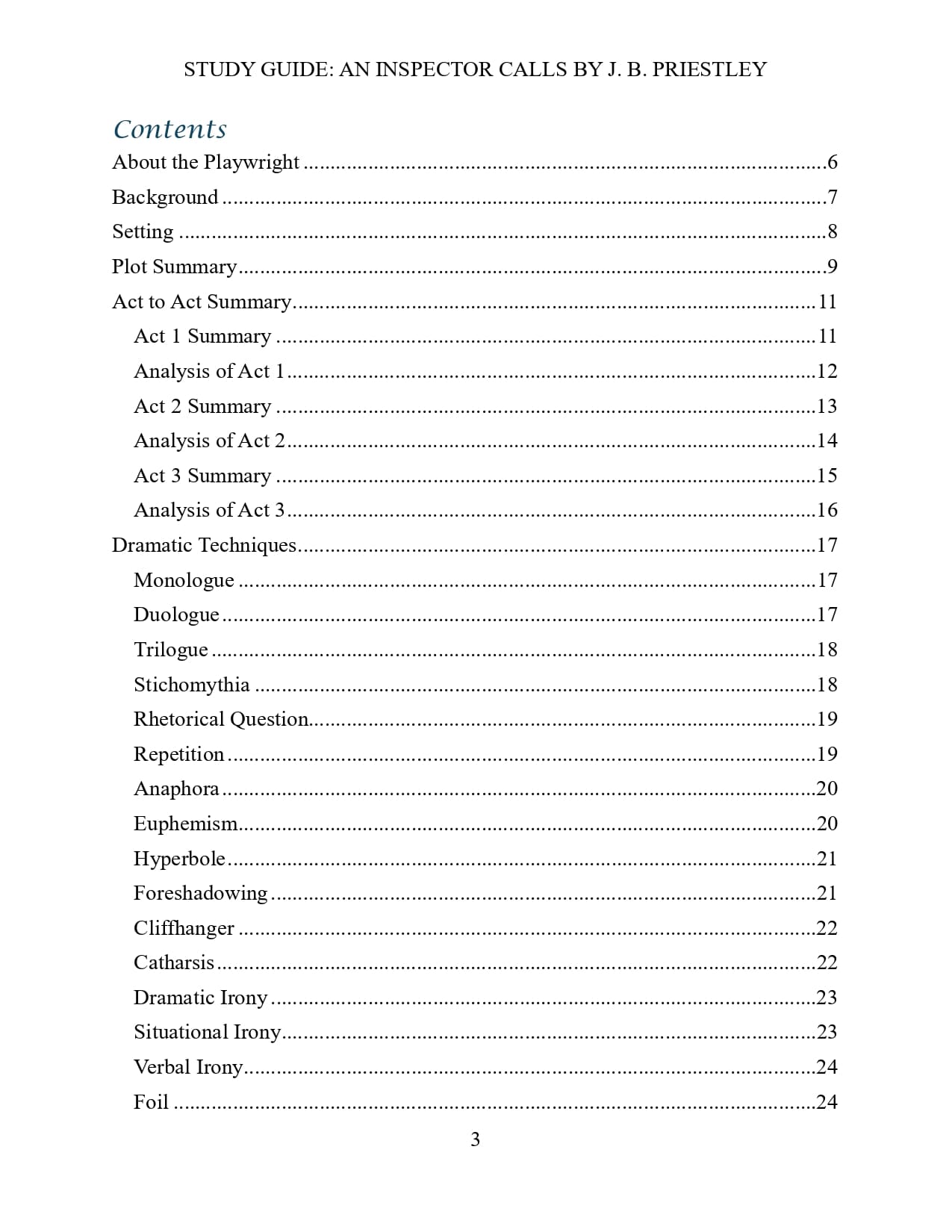
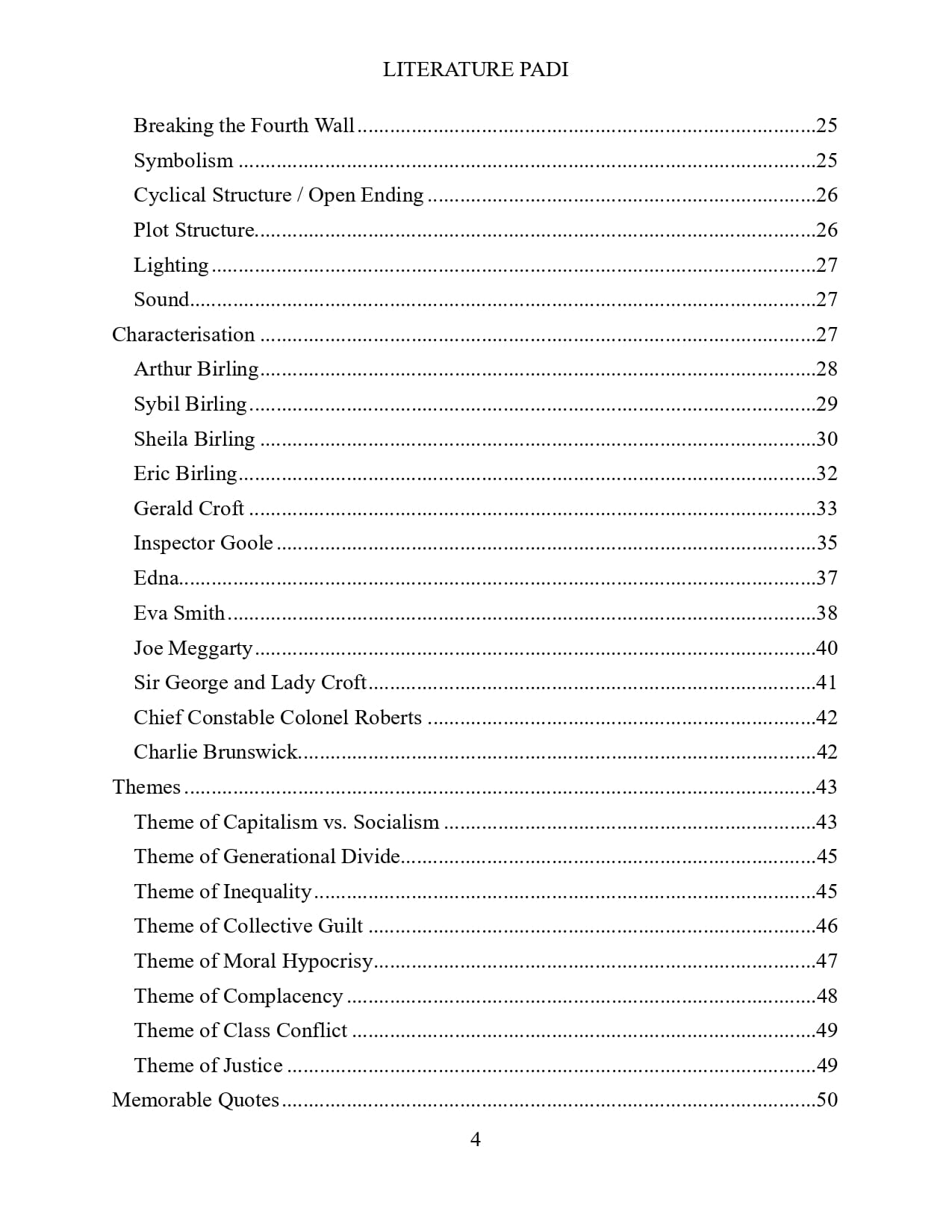
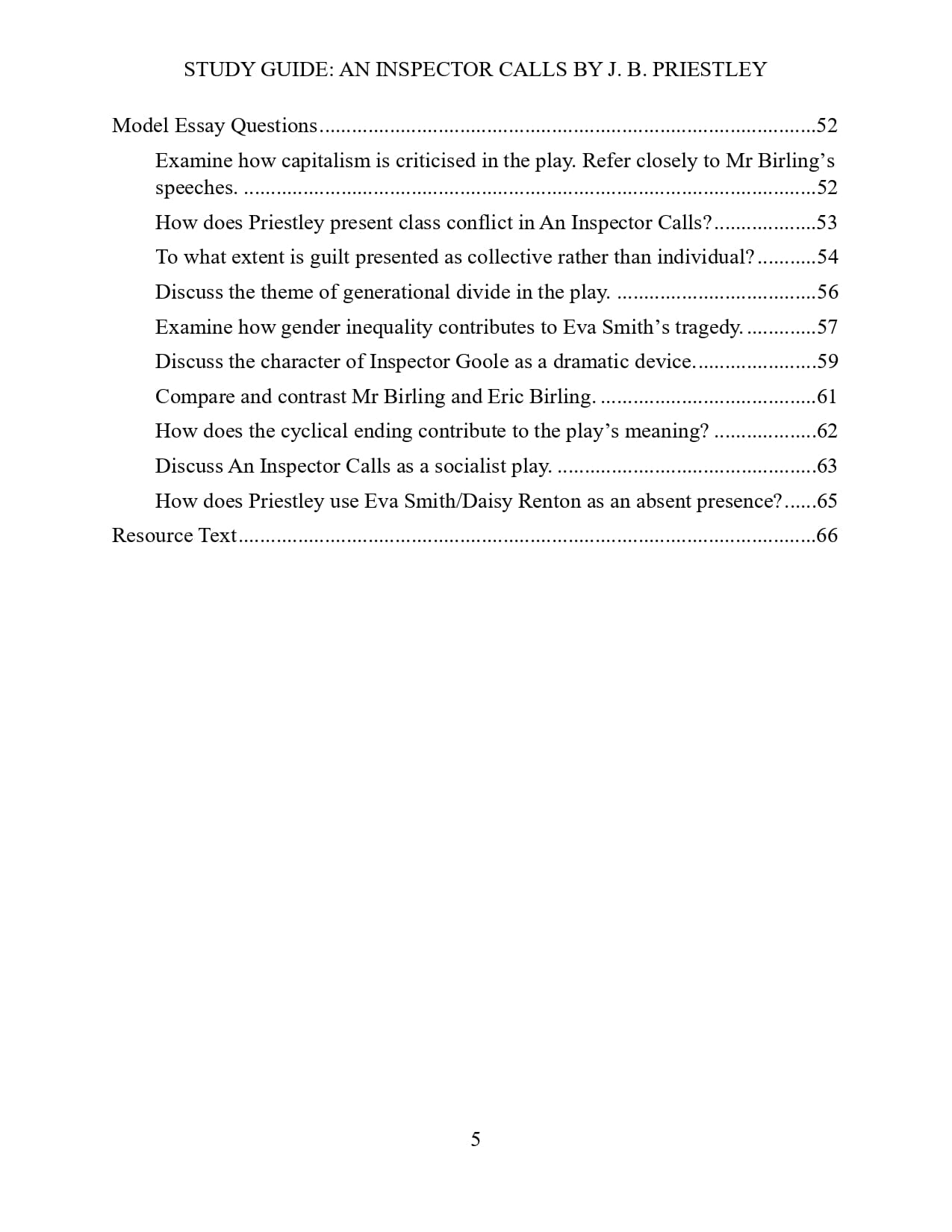
Enjoying this breakdown? What you’re reading is just part of the full experience. The premium PDF edition brings everything together in one seamless, distraction-free document that has the background, setting, plot summary, act-to-act summary and analysis, dramatic techniques, characterisation, themes, memorable quotes and model questions. If you’re studying seriously, this is the version you’ll want.
Gerald Croft
Gerald Croft occupies the highest social position among the characters present in the play. He is introduced as an “attractive chap about thirty… very much the easy well-bred young man-about-town.” As the son of Sir George and Lady Croft, who own “Crofts Limited,” he comes from an “old county family—landed people” with established wealth and aristocratic ties. Consequently, Mr. Birling treats him more as a social superior and a valuable business ally than a subordinate son-in-law, openly hoping their marriage will mean that their competing firms will begin “working together—for lower costs and higher prices”. Gerald operates comfortably within the patriarchal gender expectations of the era, agreeing with the notion that “young women ought to be protected against unpleasant and disturbing things,” while hypocritically keeping a mistress himself.
Gerald is confident, polite, and practical, but also deeply complacent and capable of self-deception. Initially, he demonstrates a strong sense of self-preservation. He attempts to hide his involvement with Eva Smith (under the name Daisy Renton) by urging Sheila to keep it from the inspector: “We can keep it from him.” However, he is not entirely without a conscience or a capacity for pity; he originally rescued Daisy from the “notorious womaniser” Alderman Meggarty and gave her money and lodgings out of genuine sympathy, insisting he “didn’t ask for anything in return”. Yet, he possesses a ruthless streak of selfishness He admits that while he enjoyed being her “wonderful Fairy Prince,” he did not love her as she loved him, and he broke off the affair simply because it suited his schedule when he had to go away on business.
Gerald’s language reveals a man who is socially assured, logical, and firmly entrenched in capitalist ideology. In the opening act, his speech consists of polite agreements with Mr. Birling’s capitalist worldview, politely echoing “I believe you’re right, sir” and “You couldn’t have done anything else” when Birling justifies firing Eva Smith for demanding a living wage. Later, his language becomes highly analytical and persuasive as he leads the family in dismantling the inspector’s credibility. He constructs logical arguments to comfort himself and the others: “We’ve no proof it was the same photograph and therefore no proof it was the same girl.” His vocabulary focuses on the technicalities of “evidence” and “proof,” revealing his belief that morality is dictated by public exposure and legalities rather than inner conscience.
Gerald represents a superficial approach to social responsibility. He helps Daisy Renton individually through charity, but he eventually treats her as disposable. He demonstrates the inadequacy of personal philanthropy when unaccompanied by a true shift in social equality. He is also acutely aware of class distinctions. He knows that a permanent relationship with a working-class girl like Daisy is impossible, and he safely discards her with a “parting gift of enough money.”
Beyond this, Gerald is a bridge between the older and younger generations. Although closer in age to Eric and Sheila, his ideology aligns completely with the rigid, self-interested older generation of Mr. and Mrs. Birling. His character arc is perhaps the most disappointing, as he demonstrates a capacity for genuine emotion but actively chooses to suppress it. When he first realises the girl he kept is dead, he is visibly shaken and asks to leave the house to be alone, showing a momentary emotional catharsis. However, once he discovers the inspector is not a real police officer and that there is no dead girl at the infirmary, his remorse vanishes entirely. He learns nothing from the moral exposure, cheerfully attempting to return the engagement ring to Sheila with the complacent assurance that “everything’s all right now.”
On the whole, Gerald represents the Edwardian aristocracy and the wealthy ruling class. Priestley’s purpose in presenting him as an “attractive,” relatively kind-hearted young man who nevertheless exploits and abandons a vulnerable girl is to show that the entire class system is inherently corrupt. Gerald proves that even the “best” of the upper class treat the working class as commodities to be used for pleasure and discarded when inconvenient.
Inspector Goole
Unlike the Birling family, Inspector Goole’s social position is deliberately ambiguous and detached from the Edwardian class system. He introduces himself as “Inspector Goole,” an officer of the police force, and arrives dressed in a “plain darkish suit of the period”. He possesses no apparent wealth or inherited status, and he actively rejects the social rituals of the upper-middle class, as evident in his polite but firm decline of Birling’s offer of a glass of port because he is “on duty.” Furthermore, he refuses to be impressed by Arthur Birling’s attempts to pull rank by mentioning his time as Lord Mayor or his friendship with the Chief Constable. His actual social status is revealed to be an illusion, as Gerald discovers “there wasn’t any Inspector Goole or anybody like him on the force here.” He is a classless entity.
Goole is depicted as commanding and authoritative. Despite his plain appearance, he immediately dominates the room. The stage directions note he need not be a big man, but “he creates at once an impression of massiveness, solidity and purposefulness.” He is also imperturbable and stern. He refuses to be intimidated or charmed. When Mrs. Birling attempts to put him in his place by stating he is being offensive, he calmly replies, “I never take offence.” When provoked by the family’s evasions, he becomes brutally stern: “Don’t stammer and yammer at me again, man. I’m losing all patience with you people.”
In addition, he is portrayed as omniscient. He possesses an unsettling, almost supernatural awareness of the family’s secrets. As Sheila quickly realises, “Why—you fool—he knows. Of course he knows”.
The inspector’s language is a powerful vehicle for his and Priestley’s socialist beliefs. While the Birlings use polite euphemisms to mask their cruelty, Goole uses blunt, highly emotive, and shocking language to force them to face reality. He brutally describes Eva Smith’s death, stating she “swallowed a lot of strong disinfectant” which “burnt her inside out, of course,” and later reminds Mrs. Birling that the girl she turned away now “lies with a burnt-out inside on a slab.”
His beliefs are rooted in empathy, equality, and collective responsibility. When Arthur Birling complains about workers demanding higher wages, the inspector sharply counters with a core socialist maxim: “But after all it’s better to ask for the earth than to take it”.
Inspector Goole is the play’s embodiment of social responsibility. He arrives to systematically dismantle Birling’s capitalist assertion that “a man has to mind his own business and look after himself.” His parting speech is the ideological climax of the play: “We don’t live alone. We are members of one body. We are responsible for each other.” He acts as an equaliser who demands that the wealthy treat the working class with basic human decency. He reminds the arrogant Arthur Birling that “public men, Mr. Birling, have responsibilities as well as privileges.”
He also recognises that the older generation is rigid and morally dead, while the younger generation represents hope for a better society. He notes to Mrs. Birling, “We often do on the young ones. They’re more impressionable”.
Inspector Goole is the only character in the play who remains entirely static. He undergoes no character arc, experiences no revelations, and does not alter his demeanour. This immutability is highly significant: it proves that he is not a realistic human character, but rather a dramatic catalyst, a moral touchstone, and an omniscient judge. His unbending nature highlights the fluctuating, crumbling psychological defences of the Birling family.
He is in direct ideological conflict with the older Birlings. He easily brushes aside Arthur’s blustering threats and mercilessly traps Sybil Birling in her own hypocrisy, leading her to unknowingly condemn her own son. He acts as a harsh confessor to the younger men, forcing them to confront the reality of their sexual and financial exploitation of a vulnerable working-class woman.
In summation, Inspector Goole represents the voice of J.B. Priestley, the socialist conscience, and perhaps even a supernatural entity or time-traveller. His very name, “Goole” (a homophone for ghoul or spirit), implies he is a phantom judge sent to test the family. As Priestley noted in his own writings, the play represents “1944 staring accusingly at 1912.” The inspector’s purpose is to act as a prophetic voice, warning the Edwardian characters that their selfish actions will lead to global tragedy.
Edna
Edna is the Birlings’ parlourmaid. She represents the exploited working class. Unlike the wealthy Birlings, who are dressed in “evening dress of the period” and enjoying a luxurious dinner with champagne and port, Edna is presented solely to serve them. Her occupation dictates her entire existence; she is expected to be an invisible, efficient machine catering to her employers’ whims. Her gender and class leave her entirely powerless, demonstrated by the fact that even late into the distressing night, Mrs. Birling casually mentions, “I asked her to wait up to make us some tea,” showing a complete disregard for Edna’s own need for rest.
Because of her strict societal conditioning, Edna’s personality is suppressed. She is obedient, deferential, and dutiful. Her language is entirely subservient and strictly functional, revealing her complete lack of agency or equality in this house. She only speaks when spoken to or when her duties require it. She responds to commands with a flat “Yes, ma’am.” When she has news, her language is brief and respectful: “Please, sir, an inspector’s called.” Her brief, polite announcements, such as “It’s Mr. Croft”, reflect the rigid boundaries she must not cross.
Edna is the only visible representative of the working class on stage. Priestley uses her as a physical juxtaposition to Eva Smith. While Eva Smith was the working-class girl who rebelled and was cast out, Edna is the working-class woman who conforms, remaining silent and compliant to survive.
She is also the living embodiment of the “cheap labour” the Birlings casually employ and dismiss. The ease with which the Birlings order her around highlights the immense gap between the masters and the servants in Edwardian society.
Edna has no open conflicts with any character because her social position forbids it. Her relationship with Arthur and Sybil Birling is purely transactional. They do not view her as a complex human being but as a household utility. Mr. Birling casually commands her (“Giving us the port, Edna? That’s right”), and Mrs. Birling dismisses her the moment her function is fulfilled (“All right, Edna. I’ll ring… when we want coffee”).
Despite her minor speaking role, Priestley gives Edna arguably the most important mechanical function in the play’s stagecraft. One, Edna is the one who answers the sharply timed doorbell and physically introduces the inspector into the Birlings’ insulated bubble. Two, Priestley’s opening stage directions dictate that the lighting should be “pink and intimate until the INSPECTOR arrives, and then it should be brighter and harder.” It is actively Edna who facilitates this change. When Birling tells her to “Show him in here. Give us some more light,” Edna obeys and alters the lighting before leaving the room. Symbolically, it is the working class (Edna) who brings the harsh, unforgiving light of socialist truth and moral exposure (the inspector) into the capitalist stronghold.
Edna is a poignant symbol of the inequalities of 1912 Britain. Priestley uses her tireless servitude to communicate the underlying message that the comfort of the upper classes is entirely built upon the quiet, underpaid labour of people like Edna and Eva Smith. She is a visual reminder of the inspector’s final warning that there are “millions and millions and millions of Eva Smiths and John Smiths still left with us”, silently waiting for a fairer world.
Eva Smith
Eva Smith, who later adopts the alias Daisy Renton, occupies the lowest tier of the Edwardian social hierarchy in the play. She is a working-class woman, described by the inspector as having “both her parents… dead so that she’d no home to go back to.” Her status makes her highly vulnerable to both economic and sexual exploitation. Mr. Birling views her merely as part of his “labour costs” and “cheap labour,” readily firing her when she demands a small wage increase.
Her gender further compounds her lack of power; she is preyed upon by upper-class men like the “notorious womaniser” Alderman Meggarty, kept as a temporary mistress by Gerald Croft, and forced into a sexual encounter by a drunken Eric Birling. She represents a class with no social safety net, completely at the mercy of the wealthy.
Despite her poverty, Eva is presented as a girl of immense spirit, capability, and deep moral integrity—often displaying far more honour than the wealthy characters who ruin her.
She is depicted as capable and spirited. Mr. Birling admits she was a “lively good-looking girl” and a “good worker” who was in line for a promotion before she helped lead the strike. Gerald describes her as “young and pretty and warm-hearted—and intensely grateful” when he rescued her. When Gerald eventually abandons her, she is incredibly “gallant” about it, not blaming him.
Her most defining trait is her strong moral compass. Even when destitute and pregnant, she refuses to marry Eric because he doesn’t love her. Furthermore, she refuses to take any more money from Eric once she suspects it is stolen, choosing desperate poverty and ultimately death over complicity in theft.
Eva is the absolute centre of the play’s core theme: social responsibility. She is the physical manifestation of the “chain of events” that the inspector uses to prove that “We don’t live alone. We are members of one body.” She is also central to the theme of class exploitation. She is used to demonstrate how the capitalist elite treat the lower classes as disposable commodities—Arthur uses her for cheap labour, Sheila uses her as an outlet for her spoiled temper, Gerald uses her for temporary romantic comfort, and Eric uses her “as if she was an animal, a thing, not a person.”
Eva’s “arc” is a tragic descent directly caused by the Birlings. She begins as a hopeful, lively factory worker asking for twenty-five shillings a week. After being fired, she briefly finds hope again in a “nice fresh start” at Milwards. Once Sheila has her fired, her spirit breaks, and she changes her name to Daisy Renton, slipping into the vulnerable underworld of the Palace bar. Repeated rejections crush her completely, transforming her from a vibrant young woman into a desperate suicide victim who dies in “misery and agony—hating life” with a “burnt-out inside on a slab.” Her tragic trajectory proves that human endurance has a limit.
Priestley’s most brilliant dramatic technique is making Eva an absent character. She never appears on stage, which elevates her from a specific individual into a universal symbol. Priestley heavily relies on a key prop—the photograph—to represent her. By only showing the photograph to one person at a time, the inspector maintains complete control over the interrogation, which later allows Gerald to raise the situational irony that they might all be talking about different girls.
Eva Smith represents the downtrodden, silenced, and exploited working-class masses. The surname “Smith” is incredibly common, denoting her universality, while “Eva” evokes Eve, the first woman. Priestley’s purpose in creating her is explicitly stated in the inspector’s final, prophetic monologue: “One Eva Smith has gone—but there are millions and millions and millions of Eva Smiths and John Smiths still left with us, with their lives, their hopes and fears, their suffering and chance of happiness, all intertwined with our lives.”
Priestley uses her silent suffering and horrific death to communicate his central socialist message: a society that ignores the welfare of its most vulnerable members is morally bankrupt. If the wealthy and powerful refuse to recognise their shared humanity and protect the “Eva Smiths” of the world, they will eventually be taught that lesson “in fire and blood and anguish.”
Related:
- Plot Summary and Analysis of An Inspector Calls by J. B. Priestley
- Themes in An Inspector Calls by J. B. Priestley
- Dramatic Techniques in An Inspector Calls by J. B. Priestley
Receive Literary Updates through our Social Media Channels:
- WhatsApp: Literature PADI
- Telegram: Literature PADI
- YouTube: @literaturepadi
- Facebook: Literature PADI