
Download our SSCE Study Guide Bundle
Summary of Kofi Gyan’s Introduction
Kofi Gyan’s Introduction reads like a prologue to the novel in that it provides a background and an opening to the entire story. The Introduction is dated Christmas Day, 1895, in Cape Coast. Kofi Gyan introduces himself retrospectively, looking back twenty-one years to when he was a fifteen-year-old boy in 1874. He proudly claims his identity as the boy who gave the British Commander, Major General Sir Garnet Wolseley, the nickname “Sargrenti” and the boy who spat in the commander’s eye after the British army invaded Asante and sacked Kumase. Presenting his tale with bold confidence, Kofi challenges the reader: “If you like it, sing my praises. If you don’t like it, I challenge you to tell a better one.”
Before commencing his diary narrative, Kofi invites the reader to join him in following time-hallowed customs by pouring a libation to the gods and ancestors. He specifically honours the memory of his uncle, Nana Kobena Gyan, the Ohin of Elmina, who was exiled by the British in 1873 and only returned after 21 years, as well as Kwaku Tawia, Yaw Kasi, and Kwamina Fosu, three Elmina men hanged by the British before Kofi’s own eyes in 1872. He calls upon the local Asafo companies, the seventy-seven gods, and the spiritual owner of the town, Nana Bosom Ampenyi, asking for peace, tranquillity, prosperity, and wisdom for Elmina’s rulers. The libation concludes with a powerful, thematic request: “We ask you to protect our memory of the past that it may strengthen us as we move into an uncertain future.”
Analysis of Kofi Gyan’s Introduction
The Introduction establishes the novel’s nonlinear, retrospective framing. Kofi is writing from the vantage point of a mature, 37-year-old man in 1895 looking back at his 15-year-old self. Using this device, he provides a reflective anchor for the diary entries that will follow. This literary device assures the reader that the protagonist survives the ensuing war while explicitly setting up the climax of the story, which is the titular act of spitting in Sargrenti’s eye.
Besides, the author begins a written European diary format with a traditional African libation. He seamlessly blends Western textual devices with indigenous cultural practices. The libation invokes specific local deities, historical martyrs, and Asafo (militia) companies. It firmly roots the text in the spiritual and social worldview of the Elmina people. It also decolonises the narrative with its bold assertion that this history will be told entirely on African terms and grounded in African reverence for the ancestors.
The central thematic thesis of the novel is revealed in Kofi’s final prayer during the libation. He asks the ancestors to protect their memory of the past so it can strengthen them for an uncertain future. This indicates that the act of transcribing and publishing his diary is not merely an exercise in storytelling, but a deliberate act of intellectual resistance. Kofi is weaponising historical memory to ensure his people maintain their cultural truth and resilience against colonial erasure.
From the very first lines, Kofi displays an unyielding sense of independence. He does not apologise for his actions; rather, he claims complete ownership of his rebellion by boasting that he is the one who named and humiliated the supreme British commander. In addition, his direct, almost confrontational address to the reader (“I challenge you to tell a better one”) establishes a protagonist who refuses to be submissive or victimised by the colonial gaze.
Chapter 1 Summary of The Boy Who Spat in Sargrenti’s Eye
Chapter 1 of The Boy Who Spat in Sargrenti’s Eye opens on Saturday, 6 December 1873, in Cape Coast. The protagonist, a 15-year-old boy named Kofi Gyan, is relaxing on the beach with his friend Yaw after finishing his schoolwork. The boys are watching a steady stream of British soldiers arriving by canoe and heading up to the Castle.
The boys spot the canoe Sika Nti carrying a single white passenger. Kofi notes that the canoe belongs to a man he used to call “Uncle George” and is steered by a notorious captain who regularly extorts extra money from passengers. If a passenger refuses to pay his price, the captain deliberately capsises the canoe in the surf to teach them a lesson. While Kofi and Yaw playfully wrestle in the white sand—jokingly calling each other “Oburoni” (white person) when covered in sand and “Obibini” (black person) when brushed clean—they watch the captain execute this exact manoeuvre, as he dumps the unsuspecting white man and his three wooden boxes into the sea.
While the canoe crew pulls the soaked passenger ashore, Kofi and Yaw dive into the water to rescue the man’s heavy luggage. The passenger, who manages to save his hat and wipe his spectacles, thanks the boys and promises them a reward. Before he can pay them, Lieutenant Maurice arrives from the Castle and instructs Kofi to guide the newcomer to the house of Mr. Christian on Dawson Hill. Kofi agrees, internally noting that Mr. Christian is actually his maternal grandfather, though he keeps this fact to himself.
The officer advises the passenger to seek accommodation advice from Mr. George Henty of The Standard or Mr. Henry Morton Stanley of the New York Herald. The passenger then asks Kofi his name. The white man mistakenly writes it down as “Coffee John,” to test Kofi’s literacy. Kofi confirms that that is how he writes his name. The white man is impressed that Kofi can read; so, the man writes his own name and title—Mr. Melton Prior, Special Correspondent of The London Illustrated News—and gives the paper to Kofi so he won’t forget it.
Analysis of Chapter 1
Chapter 1 of The Boy Who Spat in Sargrenti’s Eye is a chronological flash-forward. While this chapter is dated December 1873, Chapter 2 jumps backward nearly two years to January 1872. The author starts the story in media res on the eve of the British invasion of Asante to plunge the reader immediately into the tension of the Anglo-Ashanti War. The arrival of famous historical war correspondents (Prior, Henty, and Stanley) signals the impending military conflict and frames the novel around the documentation of this war.
The chapter quickly establishes that the local Fante population exercises its own agency and resistance against the colonisers. The canoe captain’s habit of intentionally capsising white passengers who refuse to pay his negotiated “dash” is a literal and metaphorical upending of British authority. The locals sing the captain’s praises for teaching the “mean bastard” a lesson.
The playful wrestling match between Kofi and Yaw introduces the theme of race in a highly visual way. By rolling in the white sand and calling each other “Oburoni” (white person), and then dusting it off to become “Obibini” (black person) again, the boys mock the superficiality of racial differences. This innocent childhood game sharply contrasts with the rigid, oppressive racial hierarchies that the British military brings with them.
Besides, Mr. Prior’s interaction with Kofi highlights the ignorance and assumptions of the European colonisers. Prior anglicises Kofi’s name to “Coffee John” in total disregard for local identity. Also, he is surprised to discover that Kofi can read English, which is why he decides to “test” him. Kofi’s bilingualism and literacy dismantle the colonial stereotype of the “uneducated African savage.” Kofi’s silent, internal observation that Mr. Christian is his grandfather also establishes him as an insider with a hidden advantage: he knows much more about his environment and the people in it than the Europeans realise.
Get the Full Analysis in PDF
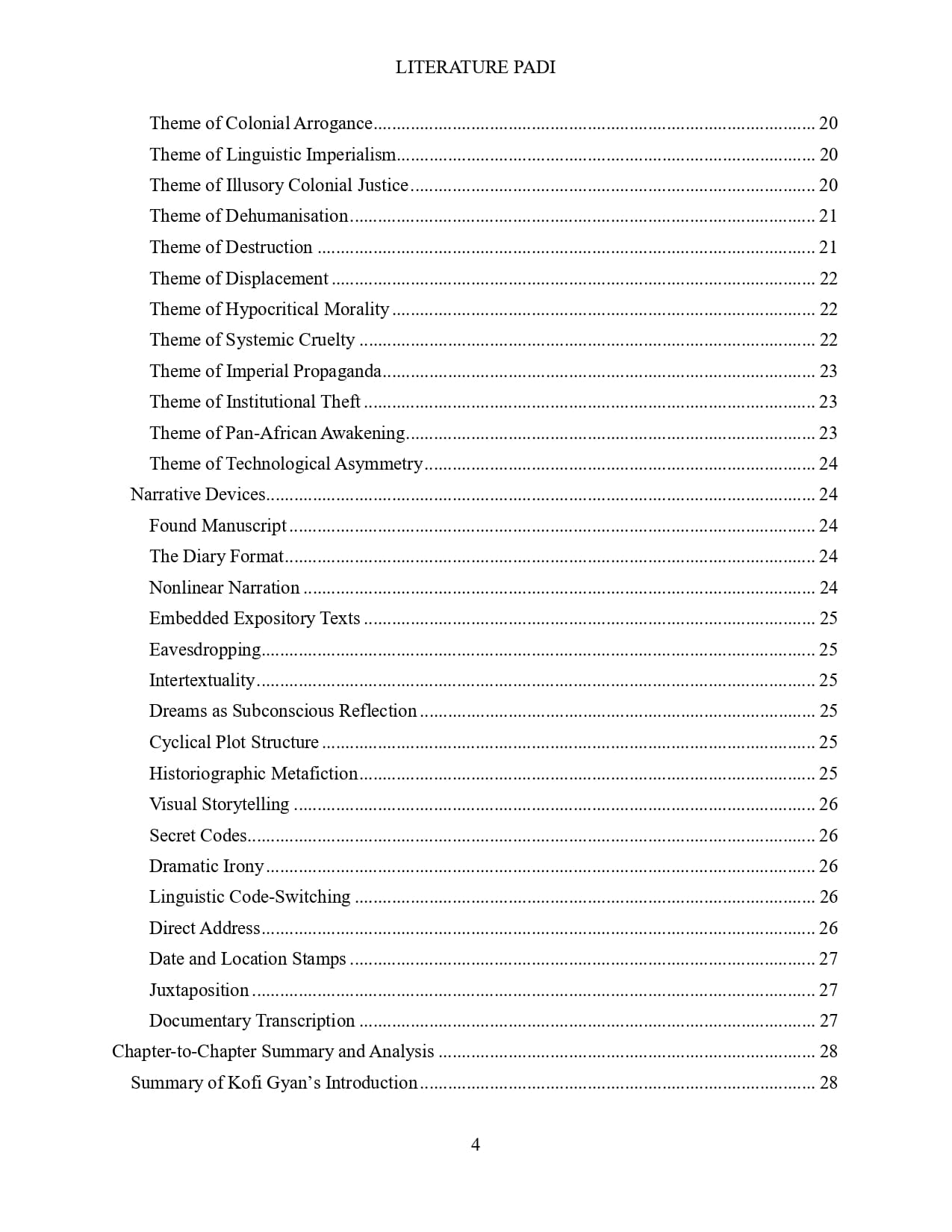
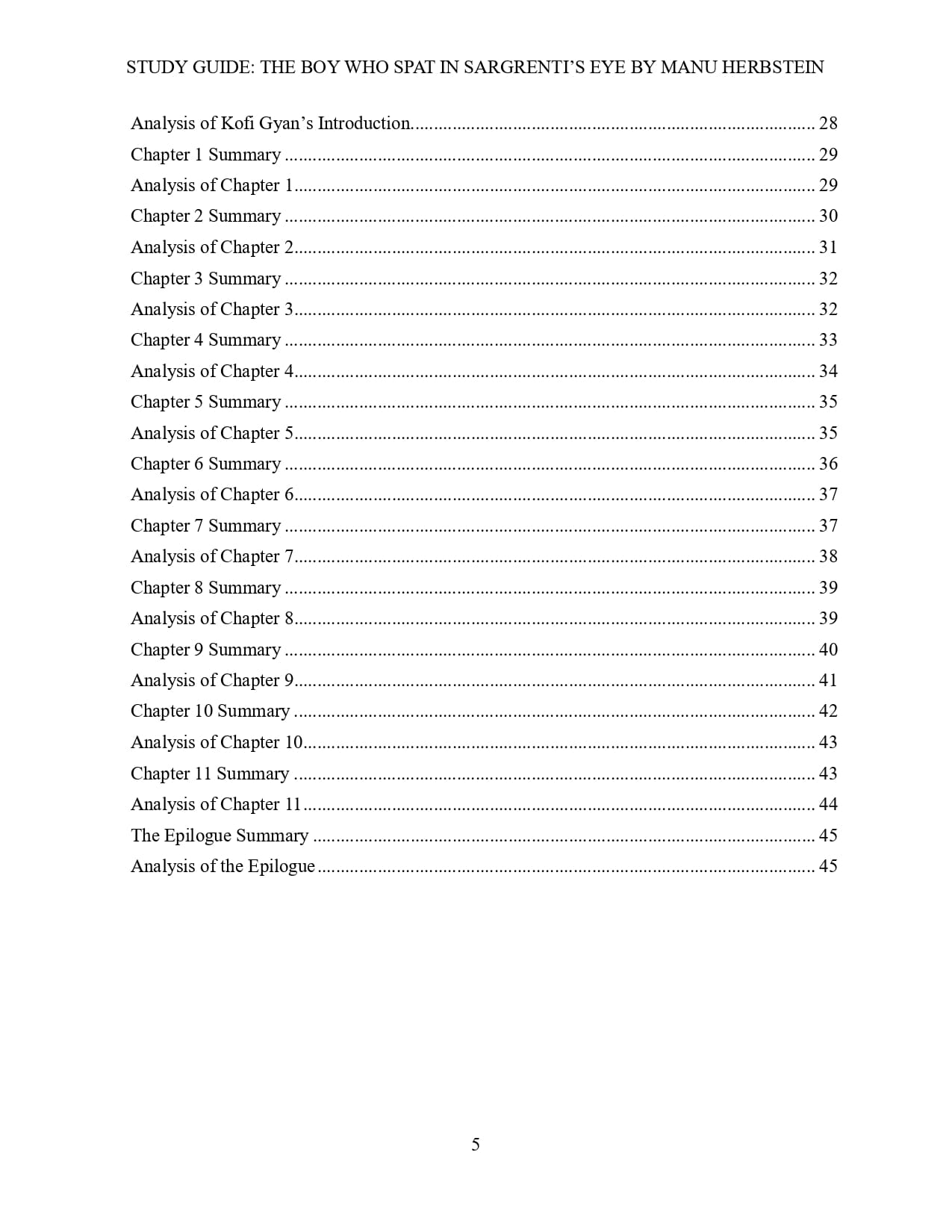
Enjoying this breakdown? What you’re reading is just part of the full experience. The premium PDF edition brings everything together in one seamless, distraction-free document that has the background, setting, plot summary, chapter-to-chapter summary and analysis, narrative devices, characters, and themes. If you’re studying seriously, this is the version you’ll want.
Chapter 2 Summary of The Boy Who Spat in Sargrenti’s Eye
Chapter 2 of The Boy Who Spat in Sargrenti’s Eye begins on New Year’s Day, 1872. It marks the start of Kofi Gyan’s formal documentation of his life. Kofi explains that his godfather, George Emil Eminsang (“Uncle George”), has gifted him a shiny black leather Dutch diary (originally dated 1869) as a Christmas present and a reward for excellent school performance. Uncle George instructs the 13-year-old Kofi to use his bilingual skills to record daily events. He predicts that they are living in “momentous times” and that a future historian or descendant might one day read his words.
To summarise his life up to this point, Kofi transcribes a school essay he wrote about the history of his town, Elmina, since his birth in 1858. Using this essay, Kofi recounts several major political and military events. First on the list is the exile of King Aggrey (1866). The British arrested and exiled King John Aggrey of Cape Coast (Kofi’s maternal great-grandfather) because he refused to surrender his stool land to them. The second event is the fort exchange (1867). The British and Dutch swapped forts along the coast without asking permission from the local chiefs. This causes a massive unrest. The British Komendas violently resisted being handed over to the Dutch; as a result, the Dutch bombard their town from the sea.
The third event is the Fante siege of Elmina (1868). The Fante Confederation, spurred by the British, besieged Elmina, in an attempt to starve the town. In response, Kofi’s grandfather (then the Ohin of Elmina) asked the new Asantehene, Nana Kofi Karikari, for military assistance. The Asantehene dispatched the famous General Akyempon Yaw, who eventually arrived and broke the siege.
The fourth event is the Dutch sell-out (1871). Rumours began circulating that the Dutch planned to sell their Gold Coast possessions to the British and leave Africa permanently. Although there are initial denials from Dutch Governor Nagtglas, the handover became official. In response, the new Elmina Ohin (Kofi’s uncle, Nana Kobena Gyan) vehemently refused to accept British rule. He boycotted the Dutch court and threatened armed resistance. An Elmina merchant, David Mill Graves, was even sent to Holland to petition against the transfer, but failed.
The chapter concludes at the end of 1871 when, in the midst of the impending doom, Kofi wins the school prize for English and awarded a boy’s adventure book titled Out On The Pampas by G. A. Henty. He also reads an 1817 book by Thomas Edward Bowdich about the Asante, in which he learns about the kostbrief (a document of ownership) and kostgeld (rent). Kofi notes the Asante argument: the Dutch have no right to sell Elmina Castle to the British because the Dutch are merely tenants paying rent (kostgeld) to the Asante, who are the true owners.
Analysis of Chapter 2
Chapter 2 of The Boy Who Spat in Sargrenti’s Eye establishes the framing device for the entire novel: Kofi’s diary. Uncle George explicitly instruct Kofi to record the “momentous times” for future generations. This task makes Kofi a conscious historian. It validates the novel’s subtitle and premise (an authentic “found manuscript”).
The author faces the challenge of explaining over a decade of complex Gold Coast history involving the shifting alliances between the British, Dutch, Fante, and Asante without boring the reader. Using Kofi’s school essay on the “history of my town” is a clever narrative tool. It allows the author to deliver a massive historical infodump in the authentic, slightly simplified voice of a bilingual teenager. It perfectly sets the political stage for the impending 1873-1874 Anglo-Ashanti War.
The historical events detailed in Kofi’s essay highlight the absolute disregard European powers had for African sovereignty. The 1867 exchange of forts between the British and the Dutch is executed without consulting the indigenous populations who actually own the land. However, the chapter strongly emphasises African resistance and agency. The Africans do not passively accept European dictates: King Aggrey goes to exile rather than surrender his land; the Komendas fight back against the Dutch fleet; and the Elmina Ohin boldly threatens war and economic boycotts against the British.
The introduction of the kostbrief and kostgeld is vital for understanding the geopolitical conflict of the novel. The British claim they are buying Elmina from the Dutch. However, the Asante claim the Dutch never owned Elmina to begin with, but were merely paying rent to the Asante Empire. This fundamental legal dispute over who truly owns the coast provides the primary catalyst for the Asante invasion that follows.
There is a brilliant moment of literary irony when Kofi receives Out On The Pampas by G. A. Henty as a school prize. In Chapter 1, Kofi has already met Mr. George Henty, who has arrived in Africa as a war correspondent. Henty was a real historical figure famous for writing pro-British Empire adventure novels for boys. In making Kofi a reader of Henty’s books, the author sets up a contrast: Henty writes the fictional, glorious myth of the British Empire, while Kofi’s diary will write the harsh, bloody reality of it from the African perspective.
Chapter 3 Summary of The Boy Who Spat in Sargrenti’s Eye
Chapter 3 of The Boy Who Spat in Sargrenti’s Eye chronicles a turbulent period from January 1872 to June 1873. It details the British takeover of Elmina and the tragic destruction of the town. The chapter opens with a bitter political rift between Kofi’s godfather, Mr. Eminsang, and Kofi’s uncle, the Ohin (King) of Elmina, Nana Kobena Gyan. Eminsang argues that the Dutch handover of Elmina Castle to the British is inevitable and that the town should cooperate to gain official positions and infrastructure. Nana Kobena Gyan vehemently refuses. He accuses Eminsang of taking bribes and insists that the people of Elmina are not property to be sold.
In April 1872, the Dutch officially transfer the Castle to the British. This transfer leaves the town in a state of high tension. Governor Pope Hennessy immediately rewards Eminsang with multiple official posts. When Eminsang attempts to distribute a farewell gift of Dutch silver to the chiefs, the young men of Elmina riot. They call him a traitor. During the clash, a Dutch officer, Lieutenant Joost, is fatally shot. Eminsang flees to Cape Coast, and the British use the murder as a pretext to assert their authority. They arrest four innocent Elmina men. After a rigged show trial with a jury made up of Eminsang’s friends, three of the men are publicly executed by hanging. Kofi disobeys his mother to watch the execution, which is botched and horrific. The execution leaves him traumatised.
Tensions escalate into 1873. The British Administrator, Harley, summons the Elmina chiefs and demands they swear an oath of allegiance to Queen Victoria. Nana Kobena Gyan delivers a powerful, defiant speech. He declares that Elmina is a sovereign town, and refuses to sign the oath. In response, the British immediately arrest him and exile him to Sierra Leone.
By June 1873, an Asante army of 10,000 arrives near Elmina to help defend the town. The British declare martial law, surround Elmina with heavily armed boats, and order the town to surrender its weapons. When the locals refuse, the British ruthlessly bombard Elmina with cannons and rockets, setting the entire town on fire and reducing it to a smouldering ruin. The Asante army attempts to attack the Castle but is decimated by superior British artillery. With their home destroyed, Kofi’s family is forced to flee by canoe to Cape Coast as refugees, passing looters who are ravaging the remains of their town.
Analysis of Chapter 3
The British deliberately employ a “divide and rule” strategy to weaken local resistance. They offer lucrative government contracts and prestigious titles to Mr. Eminsang and other merchants for the primary purpose of fracturing the unity of the Elmina elite; which they succeed at. This internal betrayal is a source of deep pain for the Ohin; it turns lifelong friends into bitter enemies.
Nana Kobena Gyan stands as a powerful symbol of African dignity and resistance. His speech to Administrator Harley is a masterful dismantling of colonial arrogance. He points out the absurdity of European powers trading African lands without the consent of the inhabitants, famously declaring, “I am not your slave… I rule it on the authority of my people who have chosen me to do so.” He embraces exile and potential death over capitulation, and refuses to legitimise the British occupation.
The British demonstrate that their legal system is merely a tool for subjugation. Following the death of Lieutenant Joost, the British arrest innocent men to act as “scapegoats.” The subsequent trial is a mockery of justice: the judge is English, the jury consists of Eminsang’s allies, and the accused are denied a lawyer. The brutal, botched public hanging of Kwaku Tawia can be classified as state-sponsored terrorism designed to force the Elmina population into submission.
The climax of the chapter shifts the conflict from diplomatic standoffs to physical annihilation. The British bombardment of Elmina reveals the sheer ruthlessness of imperial power. They use cannons and incendiary rockets to flatten a civilian town, just to prove they are willing to completely destroy the communities they claim to “govern.” The technological superiority of British weapons against both the stone houses of Elmina and the Asante warriors highlights the tragic asymmetry of the impending war.
More significantly, Chapter 3 forces Kofi out of his sheltered childhood. He is given adult responsibilities when his father secretly leaves to act as a spy in Kumase. He witnesses the gruesome reality of death when he watches the hanging at the Castle. Finally, he watches the literal destruction of his childhood home and is forced to become a refugee. The diary transitions from recording political rumours to documenting the traumatic realities of war and displacement.
Related:
- Chapter 4 to 8 Summary and Analysis of The Boy Who Spat in Sargrenti’s Eye by Manu Herbstein
- Chapter 9 to 11 Summary and Analysis of The Boy Who Spat in Sargrenti’s Eye by Manu Herbstein
Receive Literary Updates through our Social Media Channels:
- WhatsApp: Literature PADI or Literature-in-English with LP
- Telegram: Literature PADI
- YouTube: @literaturepadi
- Facebook: Literature PADI