Download our SSCE Study Guide Bundle
Chapter 9 Summary of The Boy Who Spat in Sargrenti’s Eye
Chapter 9 of The Boy Who Spat in Sargrenti’s Eye spans from January 1 to January 15, 1874, beginning at the British camp in Prasu. The camp resembles a small town with a hospital, a post office, a bakery, and water filters to serve the white troops. However, the British army faces a severe logistical crisis: Fante bearers, treated terribly, given no shelter, and forced to wait days for pay, are abandoning their posts. In response, the British resort to raiding villages and kidnapping men and women at gunpoint to serve as forced labourers. The technological terror of the British is also showcased when Sargrenti demonstrates a Gatling gun to an Asante delegation. The horrifying spray of bullets drives one Asante ambassador, Kwame Owusu, to commit suicide in despair.
On January 6, after Mr. Prior’s cook, Kojo Kom, gets into a scuffle, Sargrenti orders him to receive 36 lashes. Mr. Stanley enthusiastically administers the beating. He brutally delivers 41 strokes instead of the ordered 36. Kojo Kom spits at Prior, curses them, and escapes into the forest. During the chaotic chase, Kofi hears Ababio’s secret talking drum signal. He slips away into the bush, gives the password, and is escorted by Ababio across the Pra River to Kumase.
In Kumase, Kofi meets the Asantehene, Nana Kofi Karikari. Using notes from his diary, Kofi delivers crucial intelligence: he explains that the British plan to march straight to Kumase to loot it, but their supply lines rely entirely on vulnerable, mistreated bearers. Displaying sharp tactical awareness, Kofi advises the Asante to shoot holes in the British water filters to make the troops sick with dysentery, and to sever the telegraph wires, which he describes as the white man’s “fetish.” The Asantehene is deeply impressed by Kofi’s wisdom.
Kofi returns to Prasu on January 12 alongside Mr. Kühne, a white missionary released by the Asante. During the trek, Kühne reveals the devastating toll the war has taken on the Asante army; half of their 40,000 men died from smallpox, dysentery, and hunger, and they returned to Kumase carrying 79 boxes filled with the bones of their fallen chiefs. Upon arriving at Prasu, Kofi successfully lies to Mr. Prior. He claims he was kidnapped by Asante spies while chasing Kojo Kom and released because he acted “stupid.” Prior believes the story entirely and even copies Kofi’s secret sketches of Kumase to publish in The Illustrated London News.
The chapter concludes with a conversation among the white correspondents. Mr. Henty and Mr. Stanley argue that the war is necessary to teach the Asante a lesson. Mr. Henty insists that the British must strictly prevent modern breech-loading rifles from reaching Africa, admitting that if the Asante had equal weaponry, the British would be severely outmatched.
Analysis of Chapter 9
This chapter of The Boy Who Spat in Sargrenti’s Eye marks Kofi’s complete transition from a passive observer to an active, vital agent of the Asante resistance. When he meets the Asantehene, he doesn’t just report what he has seen; he analyses British vulnerabilities. His recommendations show a profound understanding of how heavily the British rely on industrial technology. Furthermore, his ability to confidently lie to Mr. Prior and manipulate the coloniser’s assumption of African “stupidity” proves he has mastered the art of espionage.
On the flipside, the British justify their invasion as a mission to bring “civilisation” to Africa, but their actions in this chapter expose their intense cruelty. They systematically kidnap villagers for forced labour and subject them to horrific conditions. The sadistic joy Mr. Stanley takes in delivering 41 lashes to Kojo Kom highlights the inherent dehumanisation of the colonial project. Mr. Prior actively suppresses this reality. He refuses to sketch Sargrenti in a carriage pulled by men because he knows it resembles slave labour and doesn’t want to give “ammunition” to critics back in England.
The British deeply believe in their own racial superiority, yet the novel makes it clear that their success relies entirely on technological asymmetry. The Gatling gun is so terrifyingly efficient that it drives an Asante envoy to suicide. In a rare moment of honesty, Mr. Henty admits that the Asante are just as brave as the British, and explicitly states that if the Asante possessed modern Snider rifles, the British would suffer massive losses and lose their advantage.
In addition, Mr. Prior’s reaction to Kofi’s sketches of Kumase is highly symbolic of colonial exploitation. Instead of recognising Kofi’s talent or paying him for his work, Prior immediately appropriates the drawings. He explicitly states that he will copy them “with some improvements” and send them to London as his own. The colonisers not only steal physical wealth and labour but also claim ownership over African intellectual and artistic output.
Finally, the author humanises the Asante army through the character of Mr. Kühne. The revelation that the Asante did not retreat out of cowardice, but rather were decimated by disease and starvation, frames their struggle as a profound tragedy. The image of the army returning with 79 boxes of their chiefs’ bones strips away the British narrative of the Asante as “mindless savages”; it reveals a nation in deep mourning, devastated by an asymmetrical war.
Get the Full Analysis in PDF
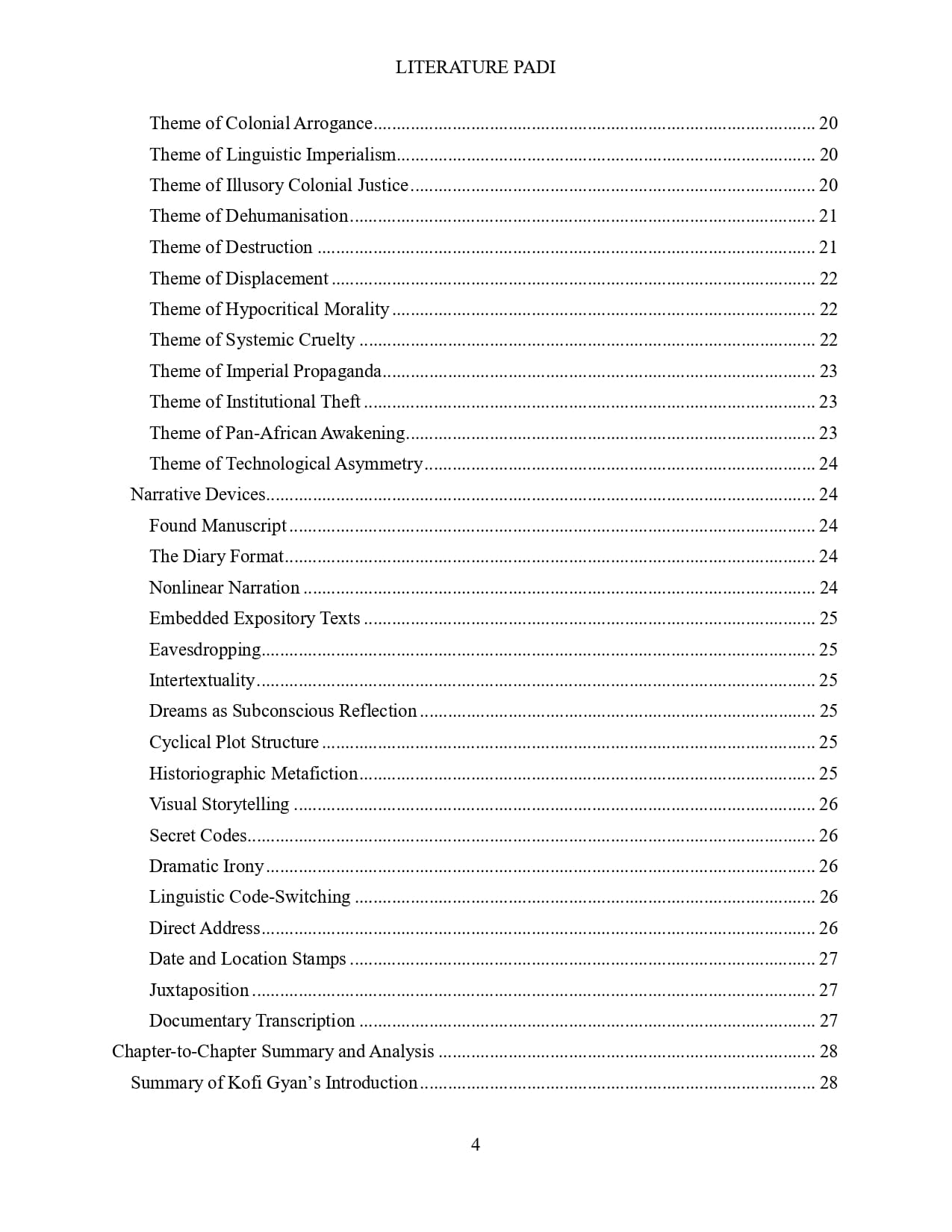
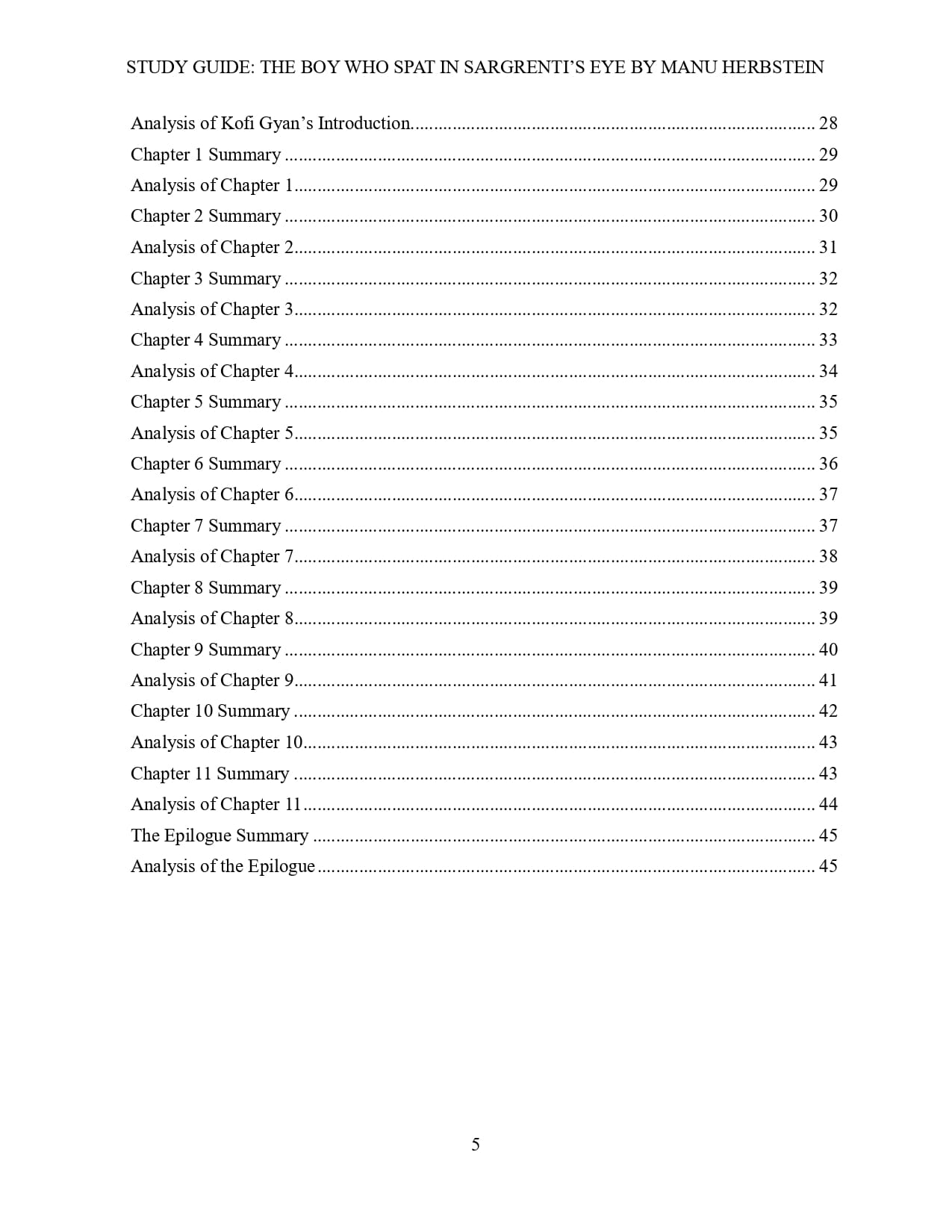
Enjoying this breakdown? What you’re reading is just part of the full experience. The premium PDF edition brings everything together in one seamless, distraction-free document that has the background, setting, plot summary, chapter-to-chapter summary and analysis, narrative devices, characters, and themes. If you’re studying seriously, this is the version you’ll want.
Chapter 10 Summary of The Boy Who Spat in Sargrenti’s Eye
Chapter 10 of The Boy Who Spat in Sargrenti’s Eye covers the rapid British advance from the Pra River to the Asante capital of Kumase. It culminates in the city’s destruction between January and February 1874. The chapter begins with Sargrenti’s forces marching into Asante territory, encountering little initial resistance. At Fomena, the British are amazed by the fine architecture of the Adansi chief’s palace. Here, the Asante release the white missionary hostages (the Ramseyers and Mr. Bonnat) without a ransom. The released missionaries bring a letter from the Asantehene begging Sargrenti to halt his advance. The war correspondents are temporarily disappointed. They fear the war might end before a major battle occurs.
However, negotiations break down, and the true violence begins. Writing retrospectively from Prasu while Mr. Prior recovers from a fever, Kofi recounts the relentless sequence of battles: Amoaful on January 31, the burning of Bekwai on February 1, the clash at Ayimamu, and the final battle at Odasu on February 4, after which Sargrenti’s forces enter Kumase.
The reality of the war is a traumatic, deafening nightmare for Kofi, who is soaked in the blood of fallen Asante warriors as he crawls behind Mr. Prior. The technological gap is devastating; the British Snider rifles and rockets slaughter the Asante, who are reduced to firing ironstone slugs from ancient flintlocks. During the chaos, Mr. Prior shoots two Asante fighters at close range—one in the chest, and the other in the back as he tries to flee—justifying it as self-defence. Kofi also witnesses the gruesome realities of the British field hospital, where a soldier’s leg is sawed off with only brandy and a tobacco pipe for pain relief.
Upon entering Kumase, Sargrenti issues a strict order that anyone caught looting will be hanged. Shortly after, a young Fante policeman is caught stealing a small piece of cloth. He is summarily hanged without a trial; he has to endure a botched, agonising strangulation from a tree branch.
In stark contrast, the British officers and Mr. Prior systematically loot the Asantehene’s palace. Kofi watches as Prior steals gold shoe buckles to make a brooch for his wife, not before swearing Kofi to secrecy. Meanwhile, British officers pack crates full of pure gold masks, silver plates, royal stools, and state umbrellas. Sargrenti later puts the correspondents on their “honour” not to steal, but Prior stays silently complicit.
On February 6, running low on food and ammunition, the British blow up the stone palace, set the entire city of Kumase on fire, and begin a hasty retreat. The heavy rains flood the Oda River, forcing the troops to wade through neck-high water. Forewarned of a search for looted goods at the Prasu bridge, Mr. Prior hides his stolen Asante gold under a blanket in his hammock and successfully avoids inspection by pretending to be severely ill with dysentery.
Analysis of Chapter 10
The starkest theme of Chapter 10 is the blatant double standard of colonial morality. Sargrenti ruthlessly executes a Fante policeman for stealing a nearly worthless scrap of cloth, subjecting him to a horrific, botched hanging. Simultaneously, the British officers and Mr. Prior engage in the wholesale looting of priceless gold, silver, and cultural artefacts from the Asantehene’s palace. The British view African “theft” as a capital crime, but frame their own massive plunder as a justified spoil of war.
Significantly, Kofi’s firsthand experience of the battles strips away the glorious, heroic narrative propagated by the British press. War is presented as a sensory overload of deafening noise, flying branches, and the horrific gore of shattered bodies. The image of a British soldier collapsing dead with his intestines hanging out, or a man having his leg sawed off without anaesthesia, exposes the grotesque reality behind the “civilising mission.”
Mr. Prior’s actions in this chapter completely shatter any illusion of his journalistic objectivity or moral high ground. He murders a fleeing Asante warrior by shooting him in the back, enthusiastically plunders the royal palace, and then cowardly fakes dysentery to smuggle his stolen gold past the British guards. Prior represents the hypocrisy of the British Empire. He enrichs himself through violence and theft yet he maintains a veneer of civilised “honour.”
The battles at Amoaful and Odasu highlight that British victory is guaranteed only by industrial weaponry, not innate superiority. The Asante fight with immense courage, halting the British advance multiple times despite being severely outgunned. The British rely on rapid-firing Snider rifles and rockets against Asante warriors armed with slow-loading muskets firing stones. This asymmetry turns the conflict from a battle into a slaughter, which the British deliberately inflict to punish the Asante.
Finally, the British justify their campaign as an effort to bring “civilisation” to savages, pointing to the Asante “grove of the dead” as proof of African barbarism. Yet, the British response is to blow up a palace renowned for its beautiful architecture and set an entire city ablaze. The burning of Kumase and every village along the retreat route reveals that the British objective was never to govern or civilise, but to inflict maximum humiliation, destruction, and terror.
Chapter 11 Summary of The Boy Who Spat in Sargrenti’s Eye
Chapter 11 of The Boy Who Spat in Sargrenti’s Eye details the immediate aftermath of the war, beginning in February 1874 as Kofi returns to Cape Coast. Although his family treats him like a hero and his mother notes he has become a man, Kofi is deeply traumatised and saddened by his experiences. His disgust with the British is solidified when he attends a church service where the chaplain proclaims that the destruction of Kumase is proof that God is on the side of the British.
The war correspondents depart, though Mr. Prior falls into a coma from sunstroke and fever and has to be carried onto the ship, leaving it doubtful whether he will survive the journey to England. Shortly after, Major-General Sir Garnet Wolseley (“Sargrenti”) returns to Cape Coast to a hero’s welcome. Kofi is sickened to watch wealthy Fante ladies who know nothing of the death and suffering caused by the war kneeling to brush Sargrenti’s boots with their foreheads.
On February 23 and 24, the British hold a public auction in the Castle to sell off the treasures they looted from the Asantehene’s palace. Kofi uses his connection to Mr. Prior to gain entry and sketch the items, which include solid gold masks, swords, and intricate royal stools. He is horrified to watch British officers and wealthy Fante women eagerly buying up the stolen goods.
The climax of the novel occurs during the second day of the auction when a beautiful bronze sculpture of the Asantehene is brought out, and a proxy bids on behalf of Sargrenti. Overcome by anger, Kofi loses control and repeatedly shouts “You thief!” at Sargrenti, publicly accusing the British of stealing the Asante nation’s wealth. When Sargrenti’s guards grab him and Sargrenti asks his name, Kofi boldly declares: “My name is Kofi Gyan, Kofi Asante, Kofi Africa.”
Furious, Sargrenti strikes Kofi twice in the face, cutting him with his ring. In the ultimate act of defiance, Kofi takes aim and spits directly into Sargrenti’s right eye, and then his left.
Kofi is thrown into a prison cell but is released after his grandfather apologises to Sargrenti. The British troops and Sargrenti finally leave the Gold Coast. The chapter concludes in late March 1874 with Kofi transcribing an article from the newly established Gold Coast Times. The editor fiercely condemns the British for their horrific, inhumane treatment of the Fante carriers during the war, noting that they were “treated but little better than dogs” and that their blood “was held cheaper than water.”
Analysis of Chapter 11
Kofi has struggled with his divided heritage throughout the novel. He is caught between his Fante mother in Cape Coast and his Elmina/Asante-allied father. In the climax of this chapter, Kofi transcends these regional divisions. When confronted by the supreme commander of the British Empire, he introduces himself as “Kofi Asante, Kofi Africa.” This represents a profound moment of Pan-African awakening. He no longer identifies merely with a specific town, but aligns himself with the entire continent against the ravages of European imperialism.
Relatedly, the auction is a powerful metaphor for the hypocrisy of the British “civilising mission.” In Chapter 10, the British brutally hanged a Fante policeman for stealing a nearly worthless scrap of cloth. Yet here, the British establish a formal, polite auction to sell off massive amounts of priceless, stolen Asante cultural heritage. The colonisers are able to magically transform the violent plunder of Kumase into a “civilised” commercial transaction. This shows that colonial law applies only to the colonised, never the coloniser.
Kofi expresses deep disgust towards the wealthy Fante merchant class and their wives. He watches them debase themselves by brushing Sargrenti’s boots with their foreheads, and then eagerly participating in the auction to buy stolen Asante gold. This highlights the effectiveness of the British “divide and rule” strategy. By enriching a select group of locals, the British successfully purchase their loyalty, blinding them to the mass death and suffering inflicted upon both the Asante warriors and the Fante forced labourers.
The titular act of the novel—Kofi spitting in Sargrenti’s eye—is a masterclass in asymmetrical resistance. Kofi is a fifteen-year-old boy, physically restrained by armed guards, standing before the most powerful military man in West Africa. Stripped of all physical power and weapons, Kofi uses the only tool of resistance left to him: absolute, visceral contempt. It is a triumphant moral victory that shatters the coloniser’s demand for submission and respect.
The inclusion of the real-world article from The Gold Coast Times at the end of the chapter validates Kofi’s entire narrative. While Kofi’s diary is a work of historical fiction, the newspaper editorial proves that the systemic cruelty, forced labour, and brutal beatings inflicted upon the locals by the British were real, historically documented facts. It dismantles the myth of the glorious British expedition, ensuring the reader understands the true, horrific cost of the empire.
The Epilogue Summary
The epilogue of The Boy Who Spat in Sargrenti’s Eye jumps forward twenty-one years to Christmas Day, 1895. Kofi Gyan is now 37 years old and an educated man, having been one of the first students to attend the newly opened Wesleyan High School in Cape Coast in 1876. He provides brief updates on the fates of the novel’s central figures: Nana Kofi Karikari was destooled and subsequently murdered in 1884, and Kofi’s mentor in espionage, Ababio, was never heard from again and likely died defending Kumase.
Nana Kobena Gyan, the Ohin of Elmina, endured over 21 years of exile in Sierra Leone. He proudly refused a British offer to return in 1877 because it required him to do so as a private citizen rather than as Ohin. He finally returned to a grand welcome in 1894 but died a year later at age 71. Defying a British ban on traditional burials, his people secretly buried him beneath his family house while sending a decoy coffin filled with sand to the Dutch cemetery.
Grandpa Christian passed away around 1880, but Kofi’s parents and his sister Esi are living peacefully in Elmina. Mr. Melton Prior survived his severe fever and returned to England; he kindly bought Kofi a lifelong subscription to The Illustrated London News and occasionally sends him postcards from his travels around the world.
The primary reason Kofi has brought out his old diary is that history is repeating itself: the British have just sent transport ships to Cape Coast to launch a new invasion of Asante. The expedition is being orchestrated from London by the very same “Sargrenti,” who is now known as Lord Wolseley. Prompted by his fellow members of the Mfantsi Amanbuhu Fékuw (Fante National Association) and his friend, the lawyer and newspaper editor John Mensah Sarbah, Kofi transcribes his childhood diary for publication to ensure the true story of the 1873-1874 war is not forgotten.
Analysis of the Epilogue
The revelation that the British transport ships Coromandel and Manilla have arrived to launch yet another invasion of Asante highlights the relentless nature of colonial aggression. Sargrenti (Lord Wolseley) orchestrating a new war 21 years later proves that the destruction of Kumase in 1874 was not a final “civilising” lesson, but rather one phase in an ongoing campaign of imperial domination.
As a 15-year-old, Kofi’s ultimate act of resistance was physical and visceral: spitting in the British commander’s eye. By 1895, Kofi’s resistance has matured into organised intellectual activism. He is an educated man who associates with early Gold Coast nationalists like John Mensah Sarbah and the Mfantsi Amanbuhu Fékuw. He fights the new invasion not with a weapon, but by delivering lectures and publishing his diary to arm his people with their own history.
The publication of the diary fulfils Uncle George’s original prediction that Kofi’s words would capture “momentous times” for future generations. Throughout the novel, Kofi watched British correspondents like Prior and Henty manufacture a sanitised, racist narrative for the European public. Kofi’s transcribed manuscript stands as a vital primary-source counter-narrative, ensuring that the African perspective survives.
After all the devastating losses suffered by Elmina and Asante, the epilogue emphasises the quiet, unyielding endurance of the colonised people. When Nana Kobena Gyan dies, the people of Elmina cleverly bypass the British ban on traditional burials. They bury a coffin full of sand in the European cemetery while secretly interring their Ohin beneath the family house. They maintain their ancient customs right under the noses of their oppressors. This act symbolises the indestructible nature of their cultural identity.
Related:
- Chapter 1 to 3 Summary and Analysis of The Boy Who Spat in Sargrenti’s Eye by Manu Herbstein
- Chapter 4 to 8 Summary and Analysis of The Boy Who Spat in Sargrenti’s Eye by Manu Herbstein
Receive Literary Updates through our Social Media Channels:
- WhatsApp: Literature PADI
- Telegram: Literature PADI
- YouTube: @literaturepadi
- Facebook: Literature PADI