
Download our SSCE Study Guide Bundle
Background of An Inspector Calls
An Inspector Calls is a three-act drama written by J. B. Priestley in 1945. It was first performed in 1946 in Manchester and published in 1947. The play is set in the dining room of the Birling family’s home in the English Midlands in 1912, just before the First World War. The story centres on Arthur Birling, a prosperous factory owner, who is celebrating two achievements: his daughter Sheila’s engagement to Gerald Croft and the anticipated honour of a knighthood. The mood of the evening is confident and self-satisfied until an unexpected visitor arrives. Inspector Goole announces that a young working-class woman has taken her own life. As he questions each family member in turn, it becomes clear that they all played a role in her downfall. When the inspector leaves, Mr Birling contacts the authorities and discovers that no officer named Goole exists. The family, relieved, assume they have been victims of a hoax until a final telephone call announces that a young woman has just died and a real inspector is on his way.
An Inspector Calls draws clear structural inspiration from The Government Inspector by Nikolai Gogol, where an unexpected visitor exposes corruption. However, Priestley’s treatment is more morally intense and politically charged. Like his earlier play Dangerous Corner, it reveals the hidden guilt and hypocrisy beneath respectable middle-class life. The play challenges capitalist complacency and insists on collective responsibility. Its dramatic impact has made it one of the most frequently studied modern plays. It was notably revived in a celebrated 1992 production directed by Stephen Daldry at the National Theatre.
In the play, time appears to fold back on itself. The police inspector seems to possess foreknowledge of events, almost as if he exists outside conventional chronological order. The ending reinforces this ambiguity: has the family been given a chance to change their behaviour before events “truly” happen? Is the evening repeating? Is the inspector a moral force moving across different points in time? Unlike the branching timelines in Priestley’s earlier play Dangerous Corner, here time functions as a moral loop. The cyclical structure suggests the inevitability of catastrophe when social responsibility is ignored by people who should reform the society. It says that if lessons are not learned, history will always repeat itself. It implies that unless the society reforms, it will continue to repeat its mistakes.
Setting of An Inspector Calls
Temporally, An Inspector Calls unfolds on a spring evening in 1912. On the surface, it is a peaceful, prosperous moment in British history. Industry is booming, class divisions are firmly in place, and men like Mr Birling feel certain that the future holds “peace and prosperity.” There is no welfare system, no safety net for the vulnerable. If someone loses their job, they can fall straight into poverty; exactly what happens to Eva Smith. Yet the audience knows something the characters do not. J. B. Priestley wrote the play in 1944–1945, after two world wars had shattered that Edwardian confidence. When Mr Birling dismisses the possibility of war or praises the “unsinkable” Titanic, modern audiences immediately recognise the tragic irony. The certainty of 1912 looks naïve and dangerous when seen through the lens of 1945.
Everything happens in one room: the Birlings’ dining room in Brumley, an industrial Midlands town. It is a solid, respectable, middle-class space. The furniture is good. The meal has been satisfying. The family feels secure. But this comfortable room slowly becomes something else. As the inspector questions each person, the dining table turns into a witness stand. The room that once symbolised celebration becomes a space of exposure. The outside world — the factories, the workers, the harsh streets — never appears on stage, yet it presses in through the inspector’s words. The audience feels the contrast between the Birlings’ comfort and Eva’s suffering.
From the lens of social setting, the society of the play is built on hierarchy. Mr Birling sees business as competition and profit as success. Even Sheila’s engagement feels like a merger between two companies. Workers, in his eyes, are part of production costs. Eva Smith’s request for higher wages is treated as rebellion. Her dismissal is justified as “good business.” Priestley shows how easily human beings can be reduced to numbers and labour.
There is also a strong current of social climbing. Mr Birling wants a knighthood. Mrs Birling guards her status carefully. She refuses to help Eva partly because the girl used the Birling name, an act she sees as an insult. For them, respectability matters more than compassion.
Historically, An Inspector Calls speaks from 1945 even though its action is set in 1912. Priestley uses hindsight to challenge the earlier generation’s complacency. The world of 1912 believes in progress and individual success while the world of 1945 knows how fragile that belief was. To a large extent, this historical setting is a moral mirror that forces audiences to ask whether they, too, are repeating old mistakes.
Psychologically, the play opens with pride and complacency. The family is pleased with itself. Mr Birling confidently lectures about self-reliance and minding one’s own business. The inspector’s arrival unsettles that certainty. One by one, the characters are forced to confront their actions. The emotional atmosphere becomes tense, uneasy, even fearful. A clear divide appears. Arthur and Sybil cling to reputation and avoid blame. Sheila and Eric, however, begin to feel genuine guilt. Sheila is shaken by her parents’ indifference while Eric becomes painfully aware of the consequences of his behaviour.
By the end of the play, the setting has transformed completely. What began as a comfortable family dinner becomes a moral reckoning. The room has not changed, but the illusion inside it has.
Plot Summary of An Inspector Calls
On a spring evening in 1912, the Birling family gather in their comfortable dining room in Brumley to celebrate Sheila Birling’s engagement to Gerald Croft. The atmosphere is warm and self-satisfied under the direction of Arthur Birling, a wealthy industrialist who prides himself on his business acumen and practical outlook. He confidently predicts a future of prosperity and lasting peace. He dismisses talk of war as nonsense, and boasts that the Titanic is unsinkable. He advises the younger generation to focus on individual success rather than social responsibility. He also rejects the idea that people owe anything to one another beyond their own interests.
The evening is interrupted by the arrival of Inspector Goole, who announces that a young woman named Eva Smith has died after drinking disinfectant. He explains that he is conducting an inquiry into her death, and he begins questioning the family about their possible involvement in her life. Gradually, it becomes clear that each of them has played a part in her misfortune.
Arthur Birling admits that Eva once worked at his factory. She had been one of the leaders of a strike demanding a small wage increase, and he dismissed her to prevent further unrest and protect profits. He insists he acted within his rights and denies any moral responsibility for what happened to her afterwards.
After losing her factory job, Eva found employment at a fashionable shop, Milwards, but was dismissed following a complaint from a customer. Sheila, visibly distressed, confesses that she was responsible for Eva’s dismissal. She had, in a moment of jealousy and insecurity, used her influence to have the girl fired simply because she felt threatened by her. Unlike her father, Sheila immediately recognises the cruelty of her action and expresses genuine remorse.
The inspector then reveals that Eva later changed her name to Daisy Renton. Gerald admits he met her at the Palace Variety Theatre, where she was vulnerable to the unwanted attention of a predatory man. He helped her escape that situation and arranged for her to stay in a friend’s apartment. He begins an affair with her afterwards. Although he claims to have cared for her, he eventually ended the relationship when it became inconvenient. Once more, the poor lady is left without security. In reaction to Gerald’s shocking revelation of cheating, a deeply hurt Sheila breaks off her engagement with Gerald.
Attention turns to Sybil Birling, who reveals that a pregnant young woman recently sought assistance from the charity organisation she helps to manage. Sybil refused her request, partly because the girl had used the name “Mrs. Birling” and would not disclose the father’s identity. She coldly insists that the father bears full responsibility and deserves punishment.
The final revelation exposes Eric as the father of the unborn child. He admits he met Eva while drunk and forced his way into her lodgings. Feeling guilty afterwards, he tried to support her financially by stealing money from his father’s office. When she discovered the money was stolen, she refused further help. Eric is ashamed and shaken by his behaviour.
Having drawn out their confessions, the inspector tells them that they are all responsible for Eva Smith’s death. He warns that society is interconnected and that ignoring this truth will lead to suffering and destruction. With that, he leaves.
In the aftermath, the family begin to question whether the inspector was genuine. Gerald discovers that no such officer exists on the local police force, and a call to the Infirmary suggests that no young woman has died that day. Arthur and Sybil feel relieved, eager to believe they have escaped a scandal that could have hampered Arthur’s chance of becoming a knight. Sheila and Eric, however, remain troubled, arguing that the moral truth of their actions does not depend on the inspector’s identity.
As the tension seems to subside, the telephone rings. A police officer informs them that a young woman has just died after swallowing disinfectant and that an inspector is on his way to question the family. An Inspector Calls ends with the chilling implication that their reckoning is about to begin again.
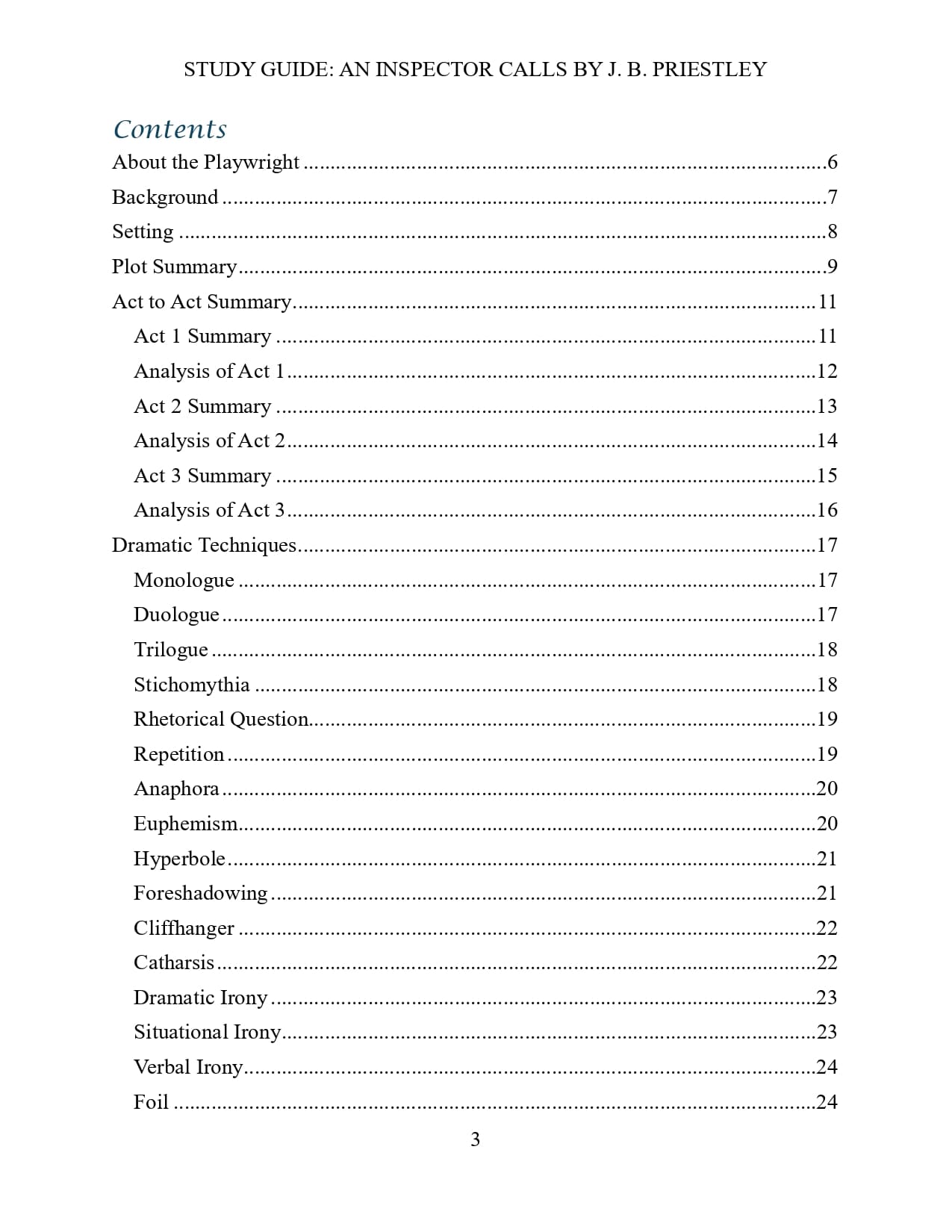
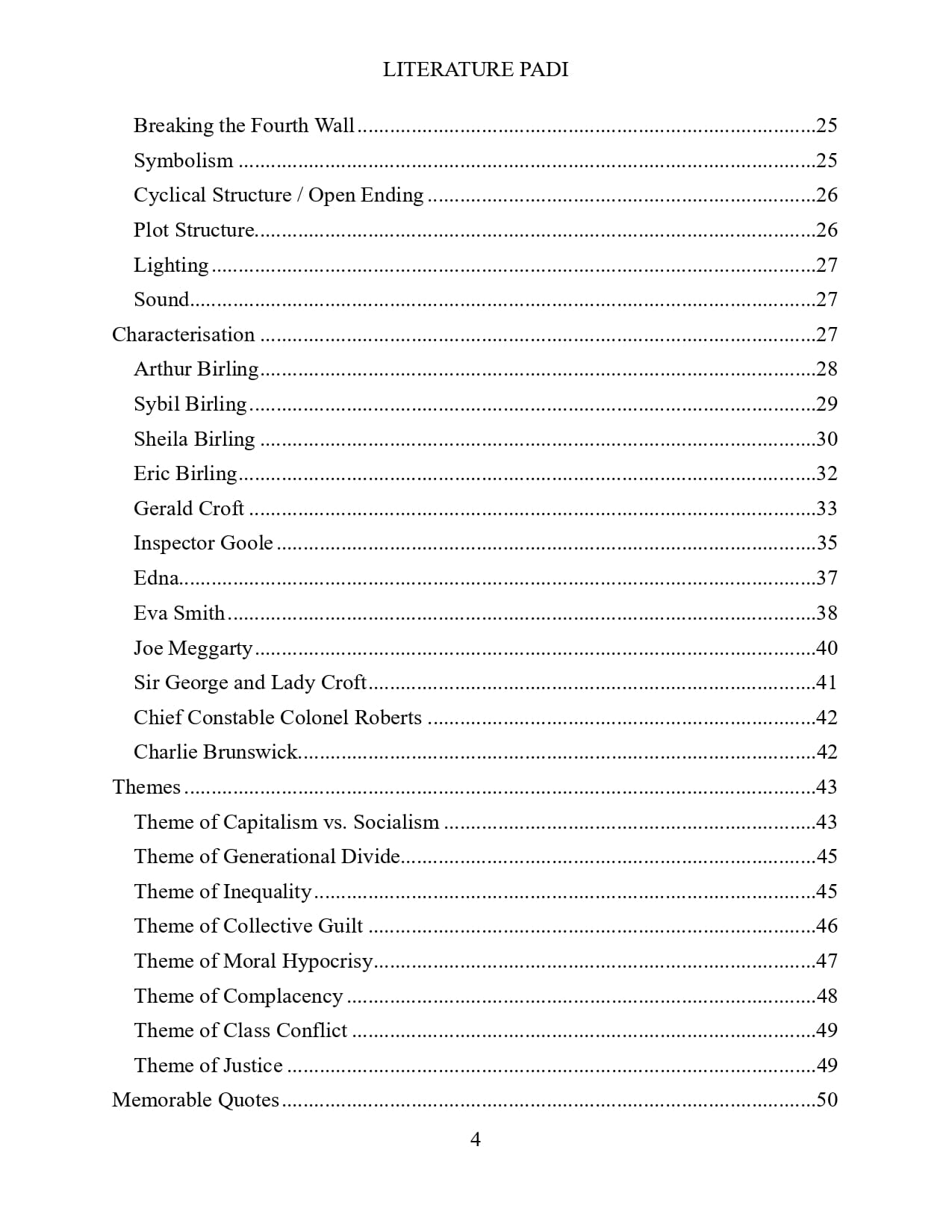
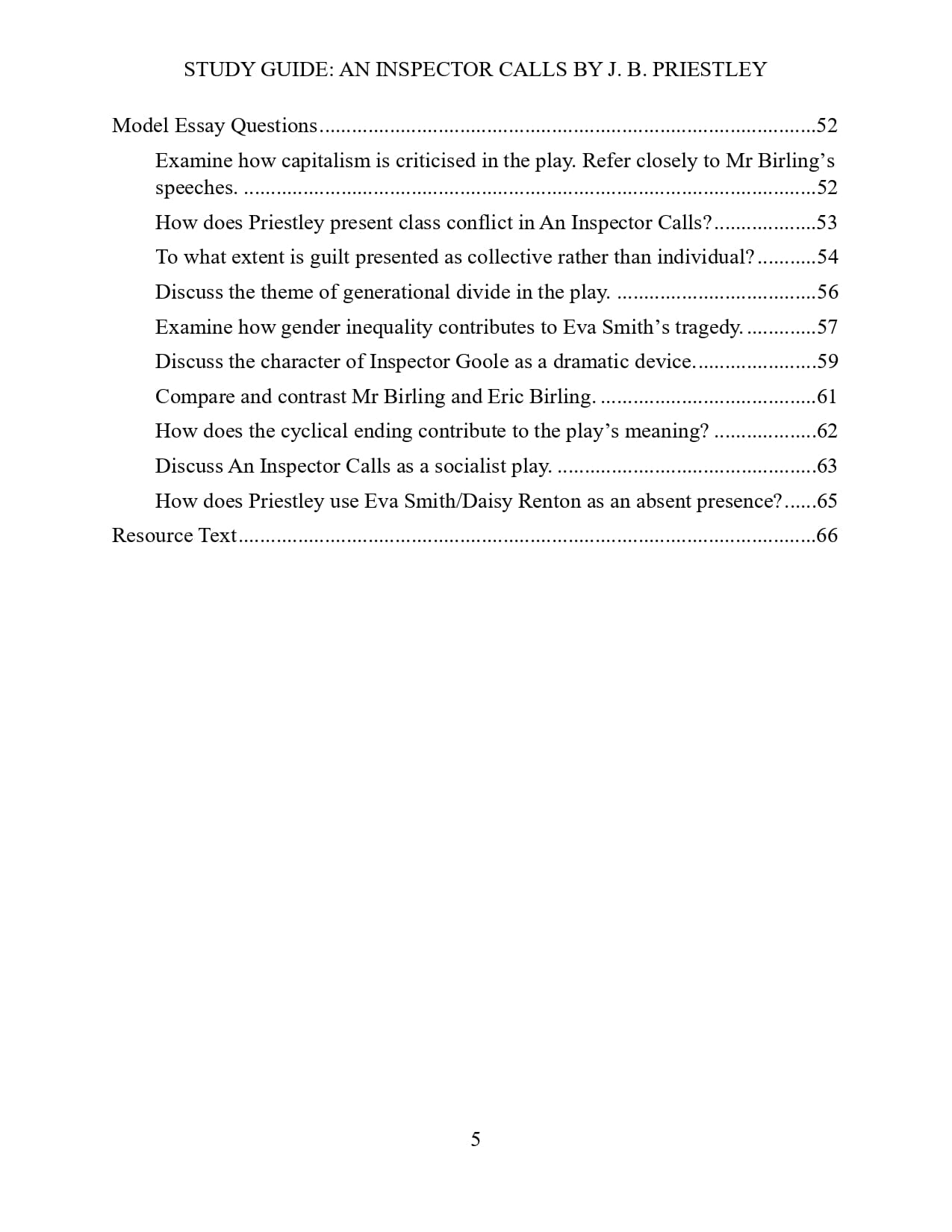
Get the Full Analysis in PDF
Enjoying this breakdown? What you’re reading is just part of the full experience. The premium PDF edition brings everything together in one seamless, distraction-free document that has the background, setting, plot summary, act-to-act summary and analysis, dramatic techniques, characterisation, themes, memorable quotes and model questions. If you’re studying seriously, this is the version you’ll want.
Plot Structure of An Inspector Calls
The exposition introduces the Birling family celebrating Sheila and Gerald’s engagement in their comfortable dining room. Here, Priestley establishes the family’s wealth and social status, Mr Birling’s aggressive capitalist ideology, and his confidence in progress and dismissal of social unrest. This opening stage sets up the moral arguments that the play will later challenge.
The rising action begins the moment Inspector Goole arrives and announces the suicide of Eva Smith. From this point onwards, tension steadily increases through a carefully structured chain of events being revealed one by one: Birling sacking her for demanding a living wage, Sheila getting her fired out of jealousy, and Gerald making her his mistress. Each confession builds suspense and shifts the emotional tone from celebration to discomfort.
The climax occurs in Act 3, when tension reaches its peak and all secrets collide. It is revealed that Eric stole money from the firm to support Eva, and that Mrs. Birling used her influence to deny charity to the pregnant girl. Eric realises his mother effectively killed her own grandchild, and the family violently turns on one another. This culminates in the inspector’s final, devastating judgment.
The falling action begins after the inspector leaves. The immediate pressure eases. The family investigates and deduces they have been “had” by a fake inspector and that no suicide took place. The older generation sighs with relief and attempts to return to normal, which sets the stage for the final structural twist when they learn an actual girl has died of suicide and a real inspector is on his way. This final twist disrupts the falling action and creates a cyclical ending. Priestley refuses to allow the unrepentant easy escape.
About the Playwright
John Boynton Priestley (widely known as J. B. Priestley or JB Priestley) was one of the most influential English novelists, playwrights, essayists, and broadcasters of the twentieth century. He is celebrated for his sharp social criticism and bold experiments with dramatic time. His surname is pronounced PREEST-lee.
J. B. Priestley was born in the industrial city of Bradford in Yorkshire on September 13, 1894. His early life in Bradford deeply shaped his socialist beliefs, as he witnessed the stark contrasts between the wealthy mill owners and the impoverished working class. This would later become central to his dramatic vision. His father, Jonathan Priestley, was a progressive headmaster who valued education and civic responsibility. His mother, Emma, died when he was very young.
Priestley was a committed advocate of democratic socialism and social reform. During the Second World War, his widely listened-to radio broadcasts helped popularise ideas that contributed to the development of the British welfare state. A fascinating aspect of his intellect was his obsession with the mechanics of time. He was profoundly influenced by the speculative theories of J. W. Dunne (specifically the concept of “serial time” outlined in An Experiment with Time) and P. D. Ouspensky. Priestley used these theories to explore themes of fate, responsibility, and alternate realities in his storytelling.
His literary output was vast and varied. In 1925, he published The English Comic Characters, a work of literary criticism that reveals his deep understanding of humour and literary tradition. His 1929 novel The Good Companions brought him national fame and was later adapted for film and stage. In 1949, he published Delight, a reflective collection of essays celebrating everyday pleasures. His 1961 fantasy novel The Thirty-First of June satirises modern advertising and Arthurian legend.
Priestley’s greatest achievements, however, lie in drama. His 1945 play An Inspector Calls is widely regarded as his masterpiece. The play, which is set in 1912 but written after the Second World War, is a gripping drawing-room thriller that dissects the hypocrisy of the Edwardian upper class. It remains a staple of literature curricula because of its masterful use of dramatic irony and its uncompromising demand for collective social responsibility.
Earlier, in 1932, he wrote Dangerous Corner, the first of his “Time Plays.” It explores how a single, seemingly innocuous remark can fracture reality and expose devastating secrets. He wrote this play utilising Dunne’s theories to split the narrative timeline.
He also wrote Mother’s Day. The brilliant comedic play explores domestic dynamics, where a neglected mother magically swaps personalities with her assertive neighbour to teach her ungrateful family a lesson in respect.
J. B. Priestley was notoriously critical of the establishment. He declined both a knighthood and a peerage during his lifetime. However, he finally accepted the Order of Merit in 1977, one of Britain’s highest honours. Priestley died on 14 August 1984. He left behind a legacy as a champion of the common man and a profound innovator of dramatic structure.
Related:
- Dramatic Techniques in An Inspector Calls by J. B. Priestley
- Characterisation in An Inspector Calls by J. B. Priestley
- Themes in An Inspector Calls by J. B. Priestley
Receive Literary Updates through our Social Media Channels:
- WhatsApp: Literature PADI or Literature-in-English with LP
- Telegram: Literature PADI
- YouTube: @literaturepadi
- Facebook: Literature PADI