Download our SSCE Study Guide Bundle
Plot Summary of Antony and Cleopatra
Antony and Cleopatra by William Shakespeare is about the consuming, world-altering romance between the Roman leader Mark Antony and the Egyptian queen Cleopatra. It follows Antony as his intense infatuation causes him to abandon his political and military duties, which inevitably sparks a catastrophic war with his rival and former ally, Octavius Caesar. The play focuses heavily on the cultural and ideological clash between strict Roman duty and lavish Egyptian passion. It culminates in the lovers’ tragic but legendary suicides.
At the beginning of the play, Mark Antony, one of the leaders of the Roman Empire (the “triple pillar of the world”), forsakes his military and political duties due to his passionate infatuation with Cleopatra, the Queen of Egypt. He ignores urgent messengers from Rome, and declares, “Let Rome in Tiber melt, and the wide arch / Of the ranged empire fall! Here is my space.”
Antony is eventually forced to return to Rome upon learning that his wife, Fulvia, has died and that Sextus Pompey is mounting a formidable rebellion against the state. Back in Rome, he attempts to repair his increasingly hostile relationship with his fellow triumvir, Octavius Caesar. To cement a new truce and unite their forces against Pompey, Antony agrees to marry Caesar’s virtuous sister, Octavia. However, Antony’s cynical but loyal officer, Domitius Enobarbus, accurately predicts that Antony will inevitably return to his “Egyptian dish,” and that this very marriage will eventually destroy the alliance between the two leaders.
The political peace quickly unravels. Caesar breaks his truces, wages war on Pompey, imprisons the third triumvir (Lepidus), and publicly criticises Antony. Antony abandons Octavia and returns to Alexandria, where he and Cleopatra crown themselves absolute rulers of the East. Caesar uses this as justification to declare war.
When Caesar’s forces approach, Antony ignores the desperate advice of his seasoned commanders to fight on land. He stubbornly insists on meeting Caesar at sea simply because Caesar dared him to. During the pivotal naval Battle of Actium, Cleopatra’s ship suddenly turns and flees. Antony, acting “like a doting mallard,” abandons his entire fleet to chase after her. This emotional decision results in a catastrophic and shameful defeat for Antony. He is overcome with despair and shame. Even he himself acknowledges that his heart is tied to her rudder, but he forgives her.
As Caesar’s army corners them in Alexandria, Antony’s situation deteriorates, and his allies begin to defect. The most devastating blow comes when his closest confidant, Enobarbus, abandons him for Caesar’s camp. But Antony refuses to be angry; instead, he takes the blame for corrupting his men and sends all of Enobarbus’s treasure after him. This staggering act of generosity completely breaks Enobarbus’s heart, and he dies of guilt in a ditch, after declaring himself “the villain of the earth.”
Antony manages to briefly rally his remaining land forces. He fights fiercely and drives Caesar’s men back to their beds. He then returns to Cleopatra triumphant, and orders a lavish celebration for his soldiers. The next day, the war resumes at sea, but Antony’s fleet immediately yields and joins Caesar’s forces. Convinced that this “foul Egyptian” has conspired with Caesar to sell him out, Antony flies into a murderous rage. He threatens to violently mutilate Cleopatra.
Terrified of his fury, Cleopatra takes the disastrous advice of her maids and locks herself in her monument. She sends her servant to falsely inform Antony that she has committed suicide. Believing her to be dead, Antony’s anger evaporates. He asks his loyal servant, Eros, to kill him, but Eros chooses to kill himself instead. Inspired by his servant’s bravery, Antony falls on his own sword. He survives the initial wound and learns that Cleopatra is actually alive. He has his guards carry his bleeding body to the monument, where he dies in Cleopatra’s arms. Before his death from his fatal wound, he advises Cleopatra to seek her safety and trust only Proculeius among Caesar’s men.
With Antony gone, Cleopatra realises that “the crown o’ the earth doth melt.” She is captured by Caesar’s men, and Caesar intends to keep her alive so that she can be paraded through Rome as the ultimate trophy in his victory triumph. A resolute Cleopatra, however, refuses to be subjected to the “sober eye” of Octavia or mocked by the “shouting varletry” of Rome. Thus, she resolves to take her own life. She arrays herself in her royal crown and robes, and declares, “I am fire and air; my other elements / I give to baser life.” A clown secretly smuggles venomous asps to her in a basket of figs. Cleopatra applies the snakes to her breast and arm, and dies a peaceful, majestic death alongside her loyal maids.
Caesar discovers their bodies and correctly deduces her method of suicide. He is so moved by her “noble weakness” that he orders that she be buried beside her lover. He concludes that “no grave upon the earth shall clip in it / A pair so famous.”
Get the Full Analysis in PDF
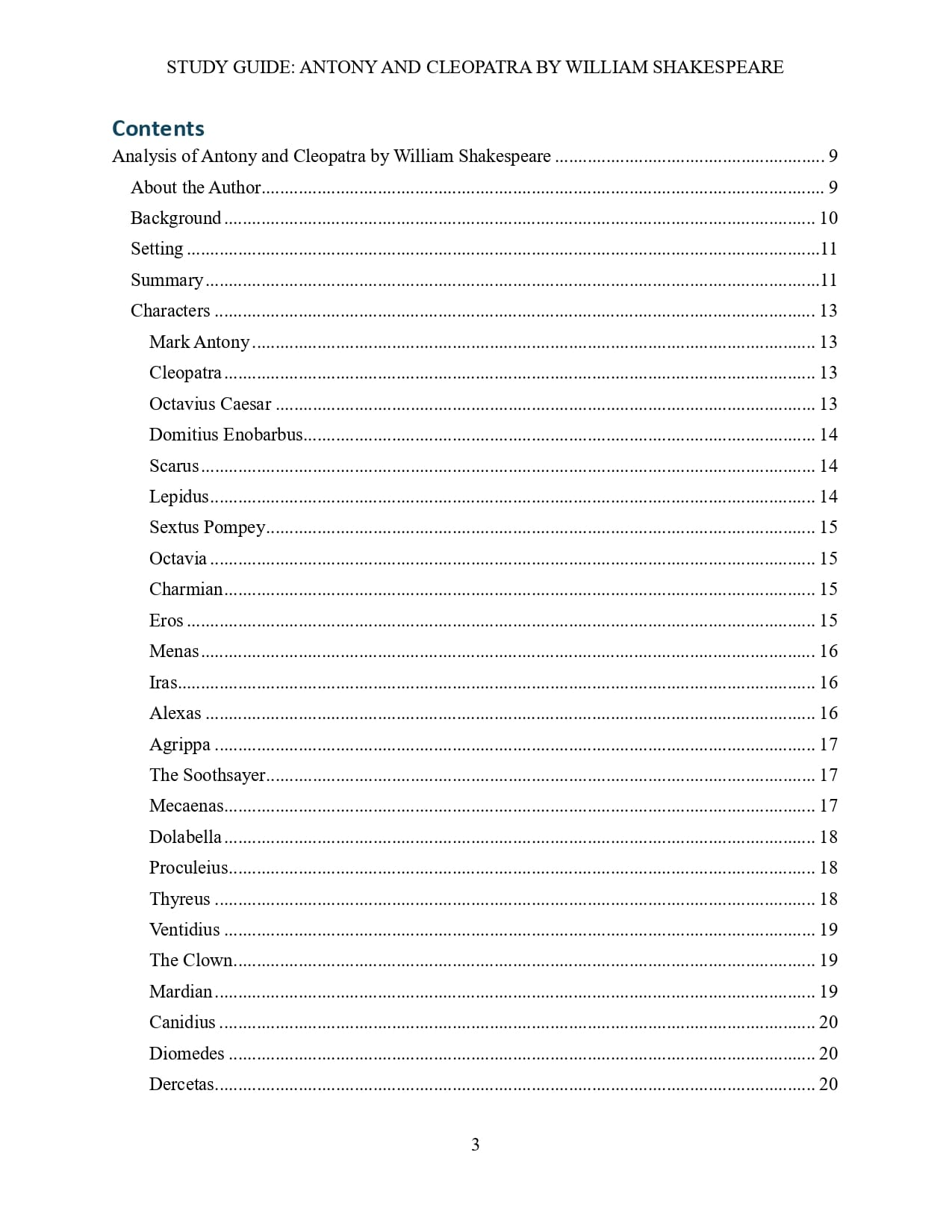
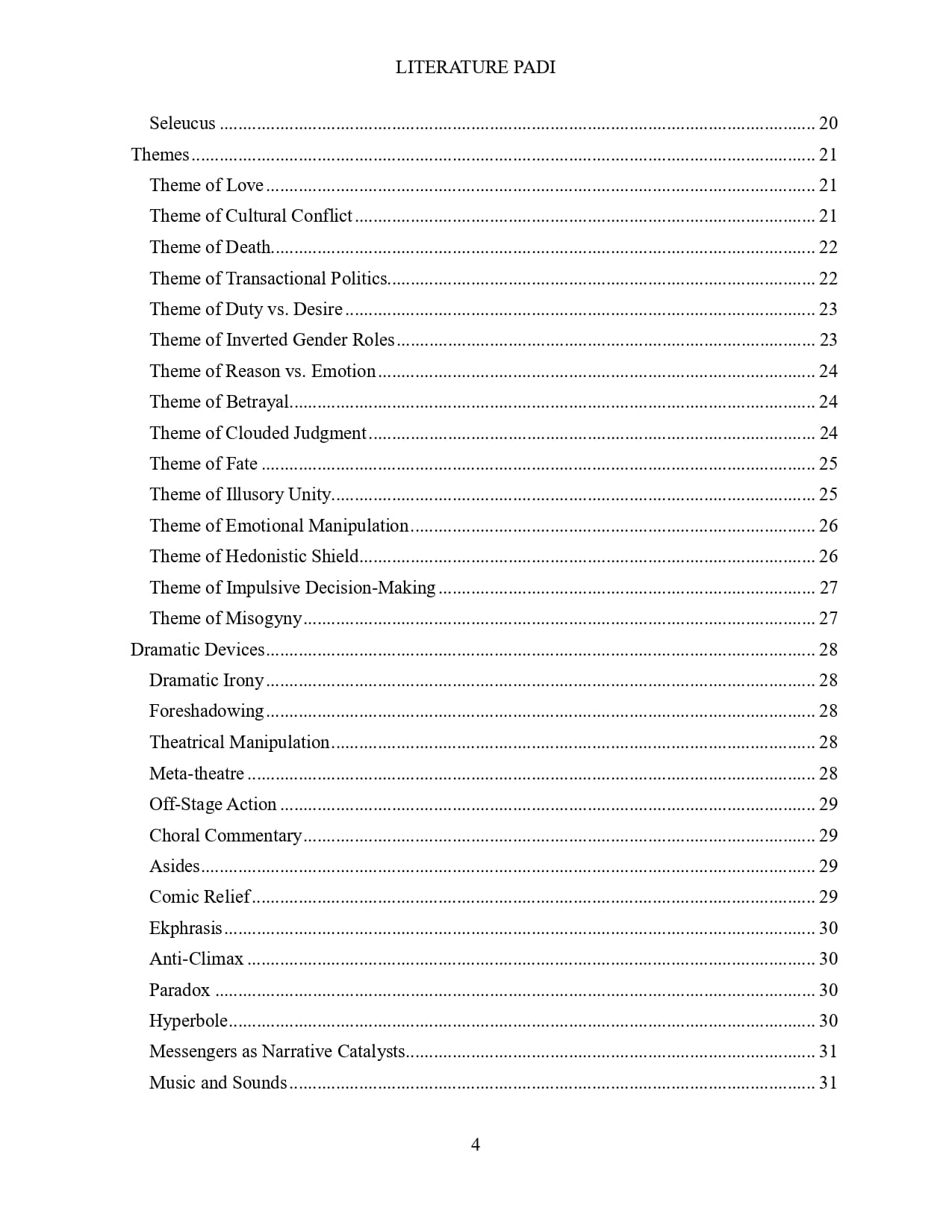
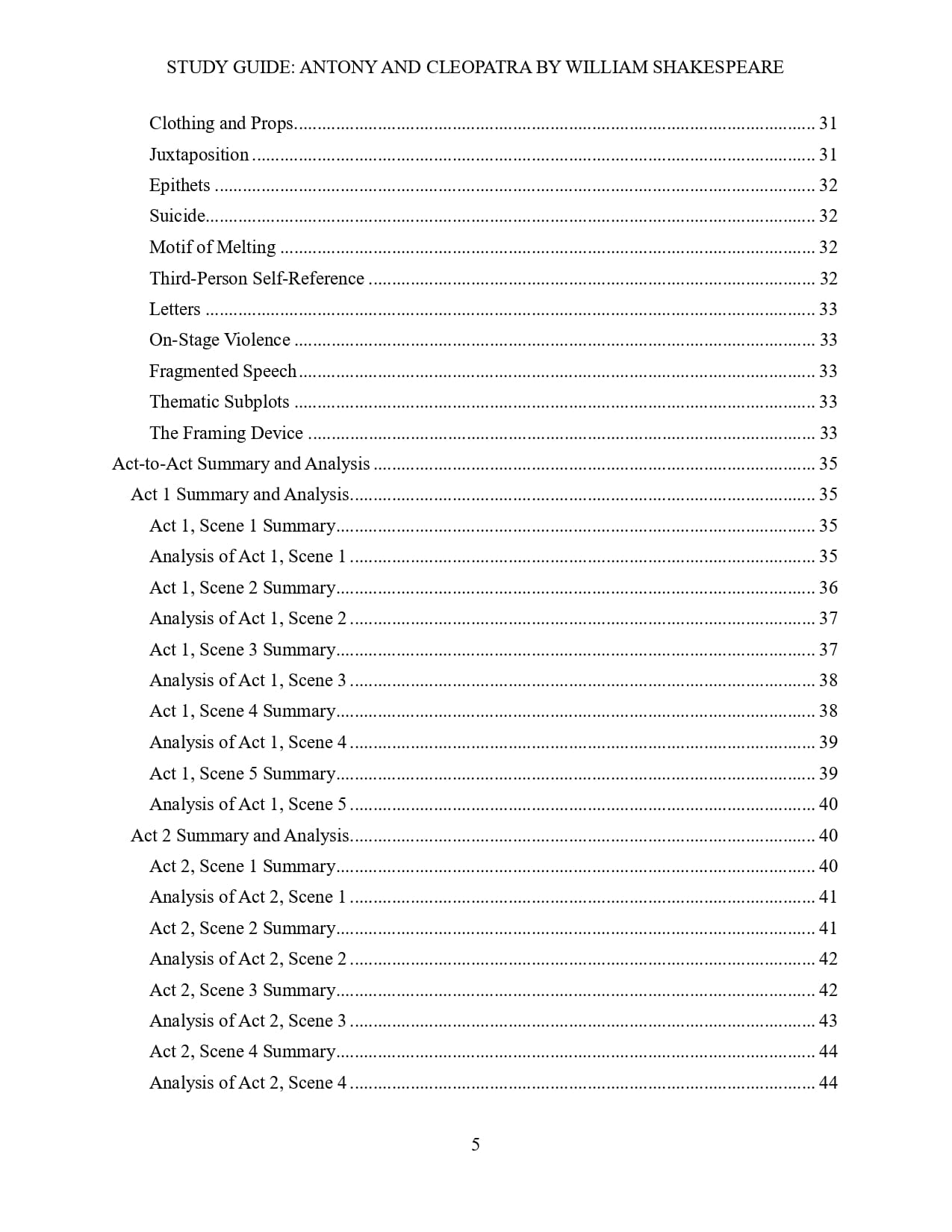
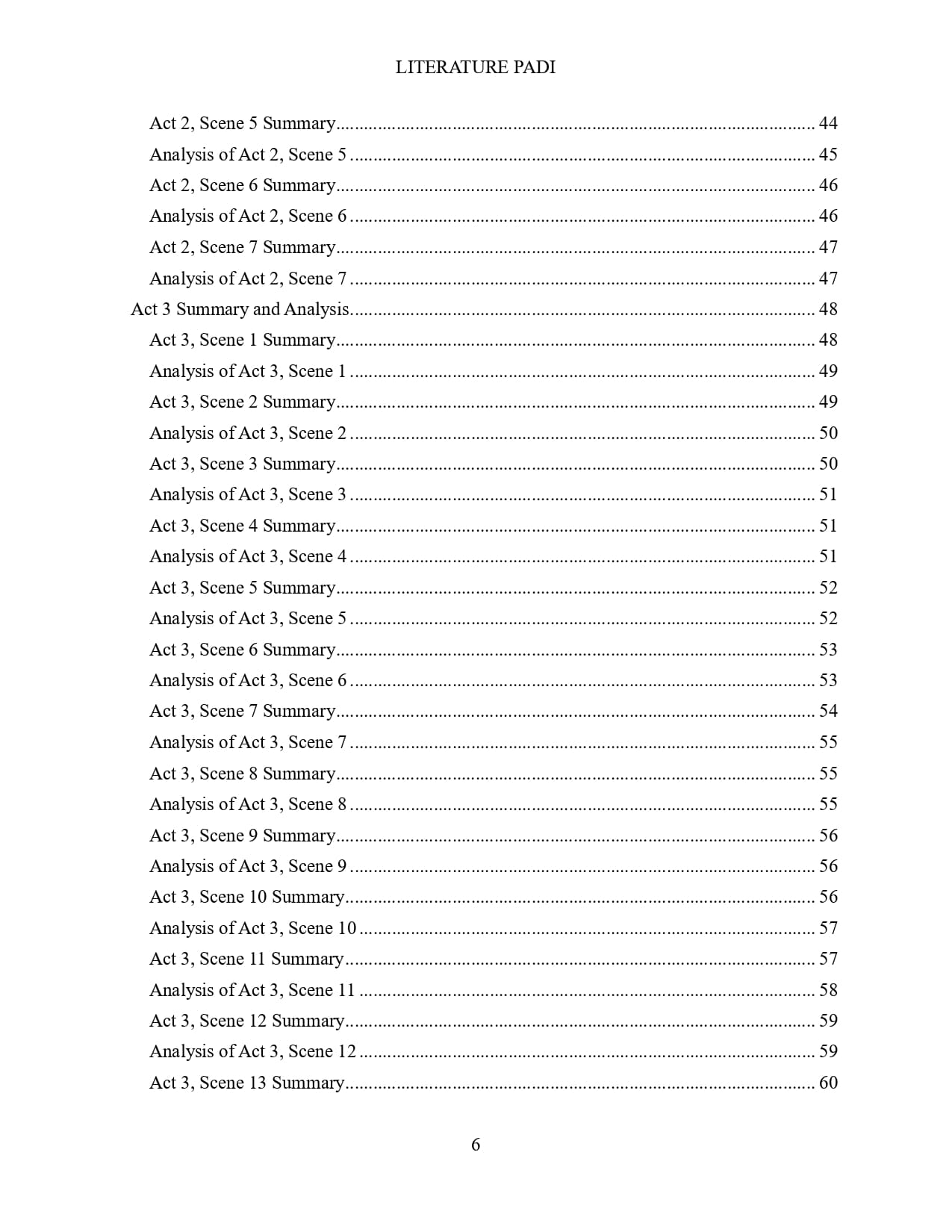
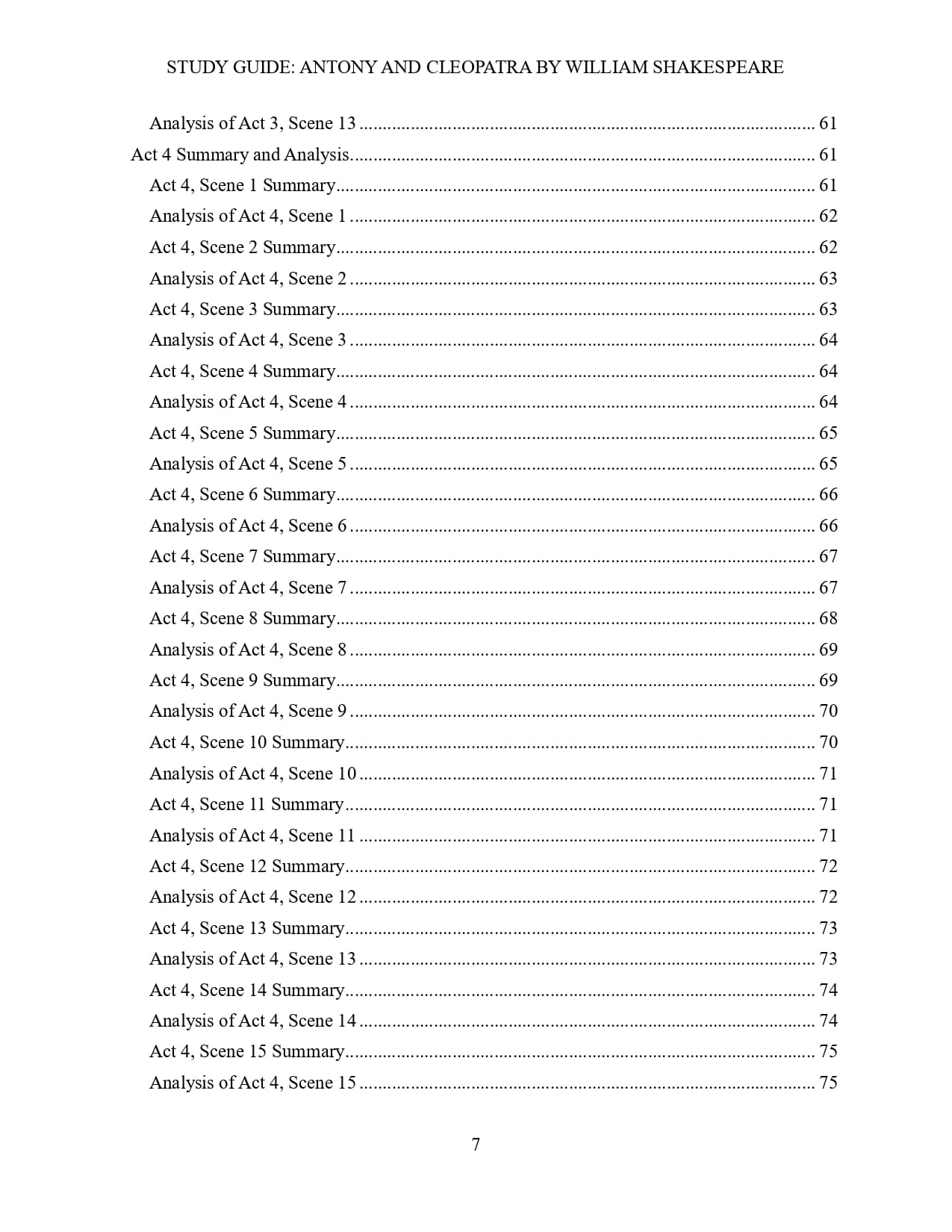
Enjoying this breakdown? What you’re reading is just part of the full experience. The premium PDF edition brings everything together in one seamless, distraction-free document that has the background, setting, plot summary, act-to-act summary and analysis, dramatic devices, characters, and themes. If you’re studying seriously, this is the version you’ll want.
Background of Antony and Cleopatra
Antony and Cleopatra can be understood through its historical setting, Shakespeare’s source materials, and the political environment of England at the time the play was written. These elements collectively shape the play’s themes of power, love, leadership, and cultural conflict. The events of the play are set in the first century BCE, during a crucial period in Roman history marked by the collapse of the Roman Republic and the rise of the Roman Empire. After Julius Caesar was assassinated in 44 BCE, political authority in Rome was shared among three leaders known as the Second Triumvirate: Mark Antony, Octavian, and Lepidus.
Although the triumvirate initially maintained stability, rivalry soon developed, particularly between Antony and Octavian. Antony governed Rome’s eastern territories and became romantically involved with Cleopatra VII, the powerful ruler of Egypt. Their relationship had significant political implications, as alliances through marriage and loyalty were essential to maintaining power in the Roman world.
The conflict between Antony and Octavian eventually led to the decisive Battle of Actium, where Octavian defeated the combined forces of Antony and Cleopatra. This victory marked the end of the Roman Republic and paved the way for Octavian to become Augustus Caesar, the first emperor of Rome. The tragedy of the lovers’ defeat and death forms the central historical foundation of Shakespeare’s play.
Beyond politics, the historical background also reflects a symbolic contrast between two civilizations. Rome was associated with discipline, order, military strength, and public duty, while Egypt was perceived as a land of wealth, pleasure, sensuality, and ancient tradition. This cultural opposition becomes a major dramatic force in the play.
Now, Shakespeare did not invent the story of Antony and Cleopatra. His primary source was the work of the Greek historian and biographer Plutarch, particularly the English translation of Lives of the Noble Grecians and Romans produced by Sir Thomas North in 1579. From this historical account, Shakespeare drew much of the plot, characters, and major events of the play. In several instances, he adapted passages directly from North’s translation into dramatic dialogue. One famous example is the vivid description of Cleopatra’s luxurious barge, which Shakespeare transformed into poetic imagery on stage.
However, Shakespeare expanded beyond Plutarch’s historical narrative by developing and deepening the characters both emotionally and psychologically. This is most prominent in the depiction of Antony. While Plutarch portrayed him largely as a noble man weakened by passion, Shakespeare presents him as a tragic hero torn between personal desire and political responsibility. Similarly, Cleopatra is not merely depicted as a seductress but as a charismatic, intelligent, and commanding queen whose identity is inseparable from her kingdom.
Besides, Antony and Cleopatra was written around 1606–1607 during the reign of James I. England at this time was expanding its global influence through exploration, trade, and early imperial ambition. Questions about leadership, loyalty, and the responsibilities of rulers were therefore highly relevant to Shakespeare’s audience.
Setting of Antony and Cleopatra
The setting of Antony and Cleopatra spans the vast geography of the ancient Mediterranean world, which, of course, reflects the immense geopolitical stakes of the play. The narrative constantly shifts back and forth primarily between two central cultural and political hubs: Rome and Egypt.
In Egypt, the setting is dominated by Alexandria, where scenes frequently take place within Cleopatra’s luxurious palace. Later, during the play’s tragic conclusion, the setting shifts to Cleopatra’s monument, a tomb where she locks herself away and commits suicide.
In contrast, the Western world of duty, reason, and political calculation is represented by Rome. Here, the action unfolds in places of power, such as Octavius Caesar’s house and the house of Lepidus.
Because the play chronicles a globe-spanning conflict for control of the Roman Empire, the action also moves rapidly across various other territories, military camps, and battlefields. These include Messina, at the house of the rebel Sextus Pompey; Misenum, where the rival leaders hold a diplomatic meeting on land and subsequently feast on board Pompey’s galley just off the coast; Syria, where Antony’s commander Ventidius marches across a plain in military triumph; Athens, which features a room in Mark Antony’s house where he briefly resides with his new Roman wife, Octavia; and finally, Actium, which is characterised by the military camps, plains, and vantage points overlooking the sea where the decisive and disastrous battle takes place.
About the Author
William Shakespeare (1564–1616) was an English playwright, poet, and actor widely regarded as the greatest dramatist in the history of English literature. He was often called the “Bard of Avon.” His writings transformed drama and poetry, and helped shape the development of the English language.
Shakespeare was born in Stratford-upon-Avon, a market town in Warwickshire, England. Although his exact date of birth is unknown, historical records show that he was baptised on April 26, 1564; by long-standing tradition, scholars accept April 23, 1564, as his birth date. He was the son of John Shakespeare, a prosperous craftsman and local official, and Mary Arden, the daughter of a respected landowning family. Shakespeare likely attended the King’s New School in Stratford, where he received a solid education in Latin grammar, rhetoric, and classical literature.
In 1582, at the age of eighteen, Shakespeare married Anne Hathaway, who was several years older than him. Their marriage produced three children: Susanna, and twins Judith and Hamnet. The death of Hamnet at the age of eleven affected Shakespeare, and many scholars believe this tragedy shaped the emotional depth of his later tragic plays.
He moved to London during the late sixteenth century, a period known as the English Renaissance, when theatre flourished as a popular form of entertainment. There, he built a successful career as both an actor and playwright. He became a member of a prominent theatre company known as the Lord Chamberlain’s Men, later renamed the King’s Men. One of his greatest achievements was his involvement in the establishment of the Globe Theatre in 1599. Many of his famous plays were first performed on this stage.
Shakespeare wrote extensively in different dramatic forms. His plays are commonly grouped into three main categories: tragedies, comedies, and histories. The tragedies include Hamlet, Othello, King Lear, Macbeth, and Romeo and Juliet; the comedies include A Midsummer Night’s Dream, Much Ado About Nothing, and Twelfth Night; while the histories include Henry V, Richard III, and Julius Caesar.
In addition to his plays, he composed 154 sonnets and several narrative poems. His writing style is notable for its vivid imagery, memorable characters, and deep exploration of human emotions such as love, ambition, jealousy, and betrayal; qualities that are clearly seen in Antony and Cleopatra.
Shakespeare retired to Stratford-upon-Avon in his later years. He died on April 23, 1616, at the age of fifty-two. He was buried in Holy Trinity Church in his hometown.
Related:
- Study Guide: Antony and Cleopatra by William Shakespeare
- Characters in Antony and Cleopatra by William Shakespeare
- Themes in Antony and Cleopatra by William Shakespeare
- Dramatic Devices in Antony and Cleopatra by William Shakespeare
- Act-to-Act Summary and Analysis of Antony and Cleopatra by William Shakespeare
Receive Literary Updates through our Social Media Channels:
- WhatsApp: Literature PADI
- Telegram: Literature PADI
- YouTube: @literaturepadi
- Facebook: Literature PADI