Download our SSCE Study Guide Bundle
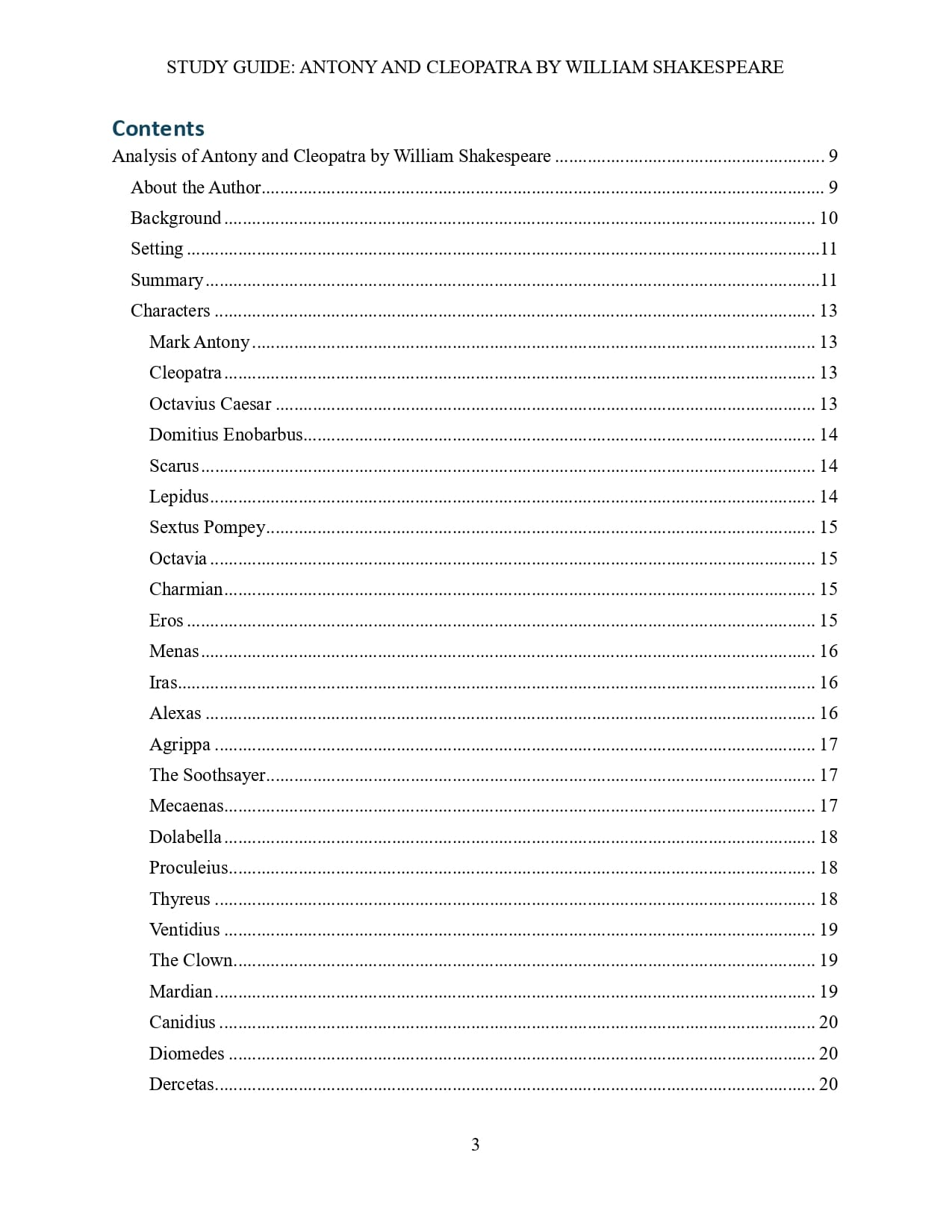
Some of the characters in Antony and Cleopatra are Mark Antony, Cleopatra, Octavius Caesar, Domitius Enobarbus, Lepidus, Sextus Pompey, Octavia, Charmian, Alexas, and Agrippa. In this section, we shall look into these characters and some other characters in William Shakespeare’s play.
Mark Antony
Mark Antony is introduced as a formerly peerless, battle-hardened Roman general who has forsaken his military and political duties due to his passionate infatuation with Cleopatra. His own soldiers lament that his “captain’s heart” has become the “bellows and the fan / To cool a gipsy’s lust.” Even when he politically marries Caesar’s sister, Octavia, Antony’s emotional surrender to Cleopatra repeatedly undermines his judgment. This total emotional surrender will lead to his catastrophic military defeats when he abandons his naval fleet to follow her retreating ship.
However, even in his tragic downfall, Antony retains a measure of his legendary nobility, such as when he magnanimously sends the defecting Enobarbus his abandoned treasure instead of punishing him. When he is faced with utter defeat and the false news of Cleopatra’s death, Antony chooses the “high Roman fashion” of suicide. He falls on his own sword and dies in Cleopatra’s arms.
Cleopatra
Cleopatra is the Queen of Egypt. She is depicted as a fiercely proud, sensual, and theatrical ruler who entirely captivates Mark Antony. She relies heavily on emotional manipulation to control Antony, as evident in how she crosses him, sends him false messages, and ultimately orders her servant to falsely report to him her suicide to cure his homicidal rage. This specific fatal miscalculation tragically backfires. It directly causes a heartbroken Antony to fall on his own sword.
While she is manipulative in nature, her love for Antony is profound; upon his death, she realises that “the crown o’ the earth doth melt” and the world has lost its meaning. Terrified of being captured and humiliated in a Roman triumph by Octavius Caesar, Cleopatra orchestrates a majestic, defiant suicide by applying venomous asps to her body. She chooses to die as a sovereign queen rather than a defeated captive.
Octavius Caesar
Octavius Caesar is the cold, calculating, and highly disciplined counterpart to Antony’s passionate and chaotic nature. As a Roman triumvir, Caesar is thoroughly pragmatic and ruthless in warfare. This quality is best demonstrated when he places Antony’s own defected soldiers on the front lines to ensure Antony spends his fury upon himself.
Caesar refuses to be drawn into unnecessary skirmishes. He carefully holds his forces in the valleys to maintain his “best advantage” and rely on his naval superiority. He is more concerned with his historical legacy and public image, which is why he seeks to capture Cleopatra alive specifically so she can be an “eternal” trophy in his victory triumph.
While he represents the cold, ordered future of the world and envisions a time of “universal peace,” he is still capable of genuine emotion. He weeps openly upon learning of Antony’s death and acknowledges the monumental loss of his “mate in empire.”
Domitius Enobarbus
Domitius Enobarbus is Antony’s most trusted lieutenant. He is the cynical, truth-telling chorus of the play. He has a sharp, objective understanding of the political reality. He accurately predicts that Antony’s marriage to Octavia will, in the end, “prove the immediate author of their variance” when Antony inevitably returns to his “Egyptian dish.”
When Antony’s cause becomes objectively doomed following a disastrous naval defeat, Enobarbus’s rational military logic finally drives him to abandon his master and defect to Caesar’s camp. However, Enobarbus quickly realises that traitors earn no honourable trust from their new masters, and he is overwhelmed by guilt for his betrayal.
When Antony responds to this defection not with rage, but by generously sending Enobarbus all of his abandoned treasure with gentle greetings, Enobarbus’s heart is completely shattered, and he wills himself to die of grief in a ditch.
Scarus
Scarus is a valiant and fiercely loyal soldier in Mark Antony’s land army. He represents the raw, passionate, and bloodthirsty dedication of Antony’s veterans, completely contrasting with the cold logic of defectors like Enobarbus.
During a rare moment of land victory, Scarus continues to fight exhilaratingly despite bleeding so heavily that a wound shaped like a “T” has been made into an “H”. He treats the deadly battle as a joyful hunt, as he urges the men to chase the retreating Romans. He even declares enthusiastically that “‘Tis sport to maul a runner.”
Antony personally commends Scarus to Cleopatra, who rewards the warrior’s valour with an armour made of solid gold that once belonged to a king.
Lepidus
Lepidus is the third member of the Roman Triumvirate. He rules Rome alongside Mark Antony and Octavius Caesar. Throughout the play, he attempts to act as a peacekeeper. He urges Antony and Caesar to “touch you the sourest points with sweetest terms” during their disputes.
His weakness as a leader is brutally mocked by the others, particularly during a feast on Pompey’s galley where he is plied with “alms-drink” until he is completely incapacitated and must be carried ashore. Enobarbus jokingly compares him to a mere beetle struggling between the two “shards” or wings of Antony and Caesar.
In the end, Lepidus is unceremoniously deposed. He is accused of abusing his high authority, and imprisoned by the ruthless Octavius Caesar.
Sextus Pompey
Sextus Pompey is a formidable rebel leader who commands the sea and enjoys the love of the discontented Roman people. He aims to avenge his father, Pompey the Great, who was defeated by Julius Caesar’s faction. Although he is initially hostile to the triumvirs, Pompey accepts a peace treaty from them in exchange for ruling Sicily and Sardinia and ridding the sea of pirates.
During a feast on his ship, his officer Menas offers to assassinate the triumvirs so Pompey can rule the world, but Pompey refuses because acting treacherously would stain his honour. This adherence to honourable rules dooms him, as Caesar eventually breaks the truce and wages war against him. Pompey is later murdered by one of Antony’s officers.
Octavia
Octavia is the sister of Octavius Caesar. She is described by Enobarbus as having a “holy, cold, and still conversation.” She is offered to Mark Antony as a bride to form an “unslipping knot” that might secure the fragile peace between Antony and Caesar.
Octavia genuinely tries to be a loyal wife and peacemaker. She agonises over the fact that her heart is “parted betwixt two friends / That do afflict each other.” Unfortunately, her cold nature is no match for the queen of Egypt, and Enobarbus accurately predicts that the marriage will drive the passionate Antony back to his “Egyptian dish.”
When Antony abandons her, she returns to Rome unannounced, appearing like a “market-maid,” which deeply angers Caesar and accelerates the final war.
Charmian
Charmian is one of Cleopatra’s most loyal and trusted waiting-women in the Egyptian court. Early in the play, she playfully begs a Soothsayer for a good fortune. She wishes to marry three kings and outlive her mistress.
When Antony is angry, Charmian pragmatically advises Cleopatra to “cross him nothing,” a strategy the queen immediately dismisses as the way to lose him. It is actually Charmian who gives Cleopatra the disastrous advice to lock herself in the monument and send word to Antony that she has died.
After Cleopatra’s majestic suicide, the fiercely devoted Charmian also applies a venomous asp to herself. She dies as she praises her mistress as a “princess / Descended of so many royal kings.”
Eros
Eros is a dedicated follower and servant of Mark Antony. He assists his master in both victory and defeat. He helps to arm him for battle with Cleopatra’s enthusiastic but clumsy assistance.
When Antony believes Cleopatra has betrayed him and faked her death, he orders Eros to fulfil a sworn oath to kill him and spare him from Roman disgrace. Rather than commit the sacrilege of striking his beloved commander, Eros draws his sword and bravely kills himself instead.
Antony is moved by this act of loyalty. He calls Eros “thrice-nobler than myself,” and attempts to follow his servant’s example by falling on his own sword.
Get the Full Analysis in PDF
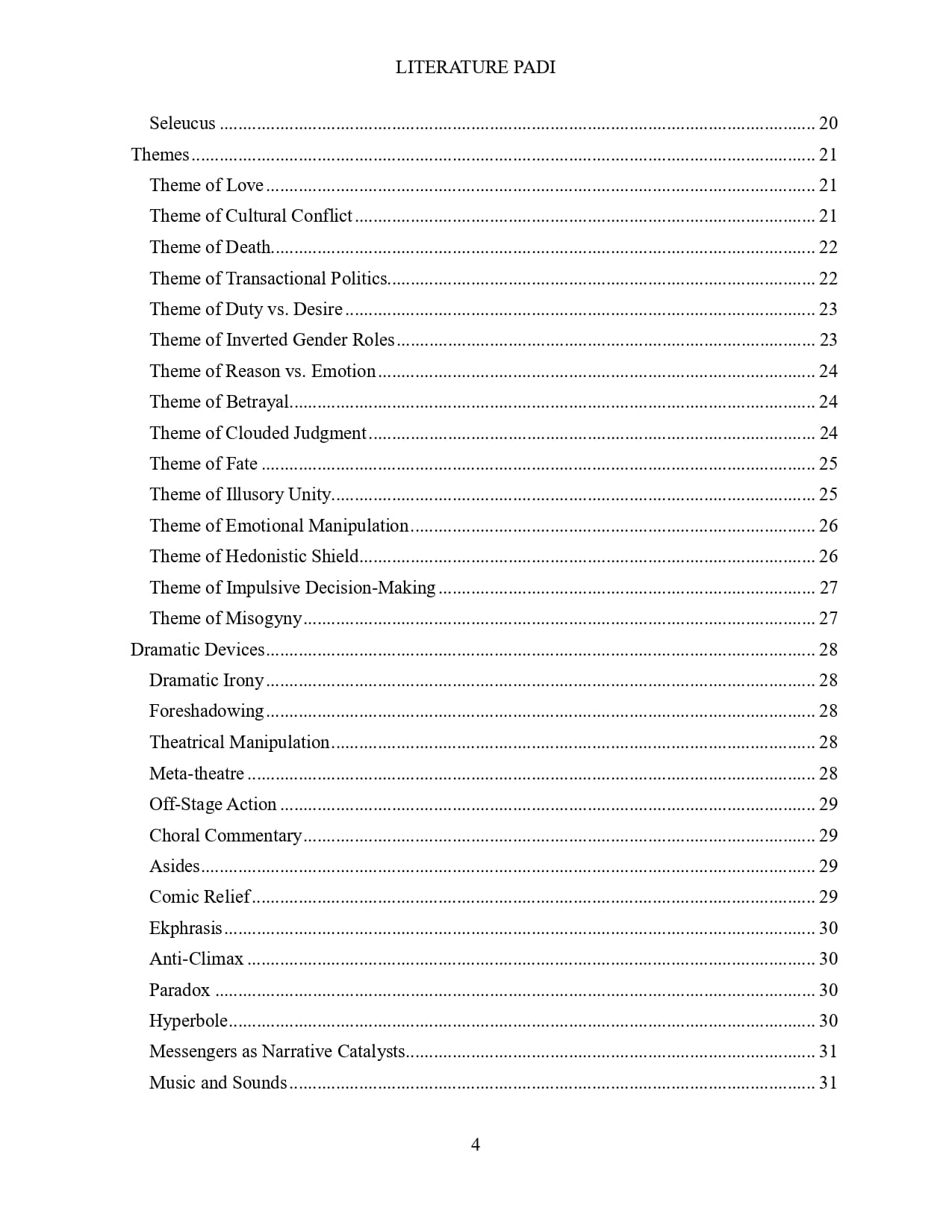
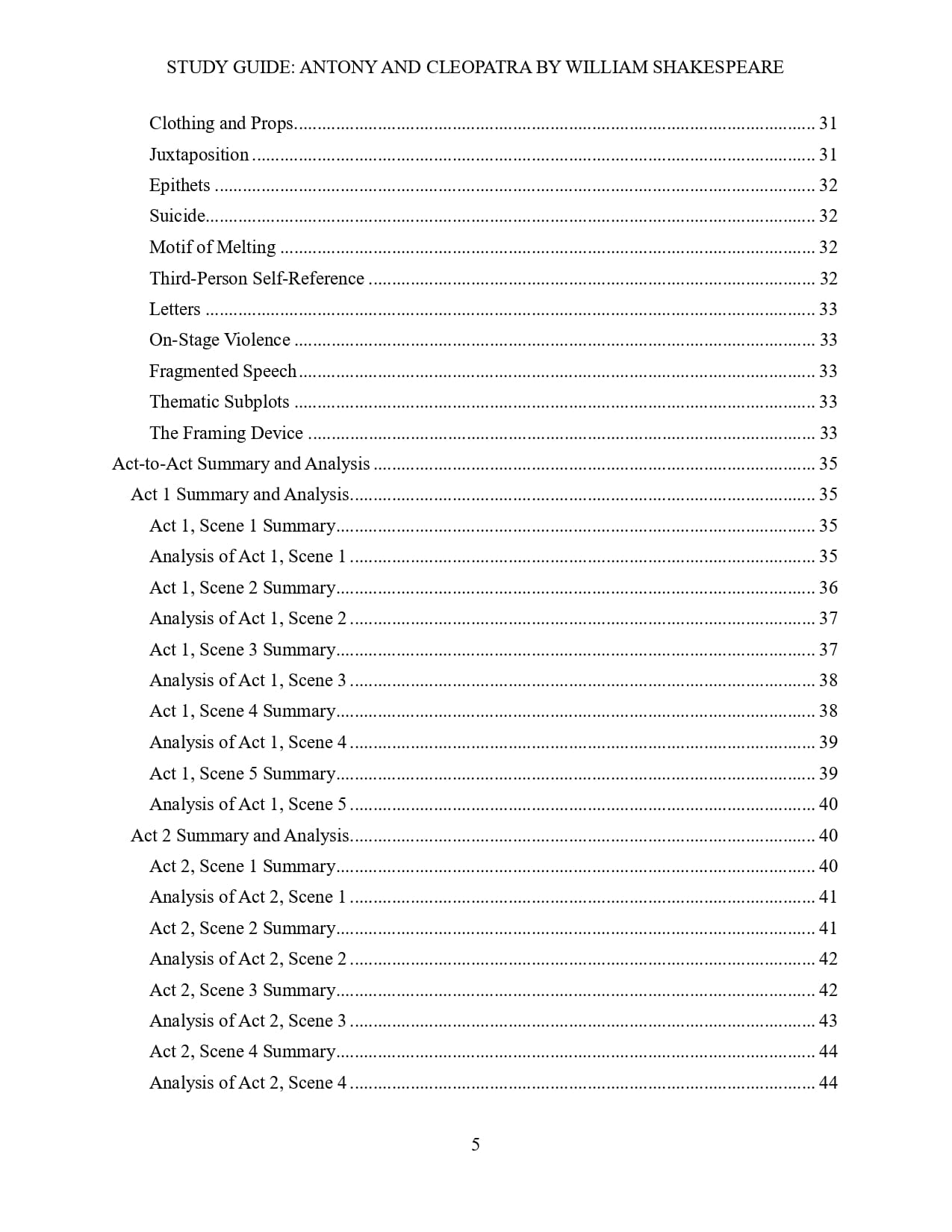
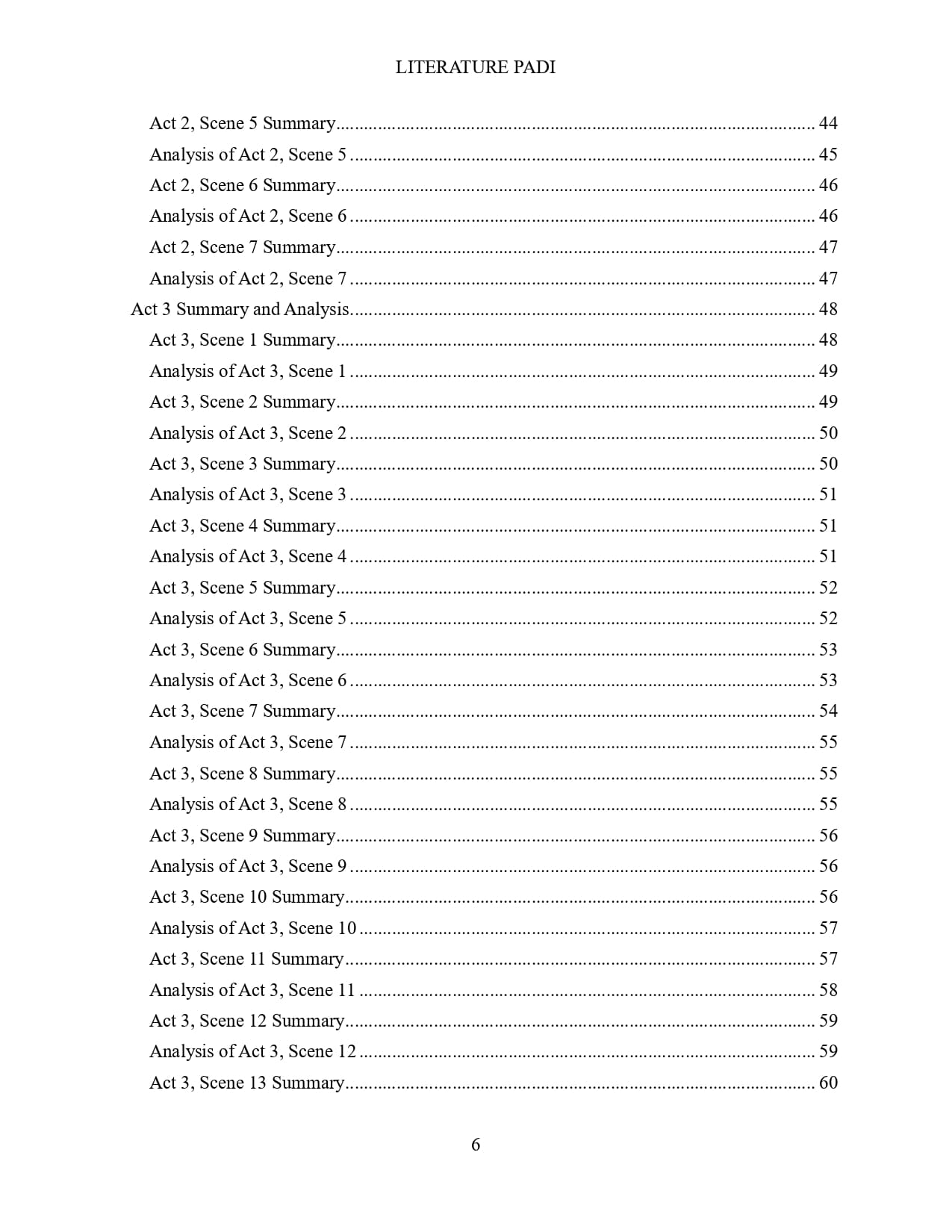
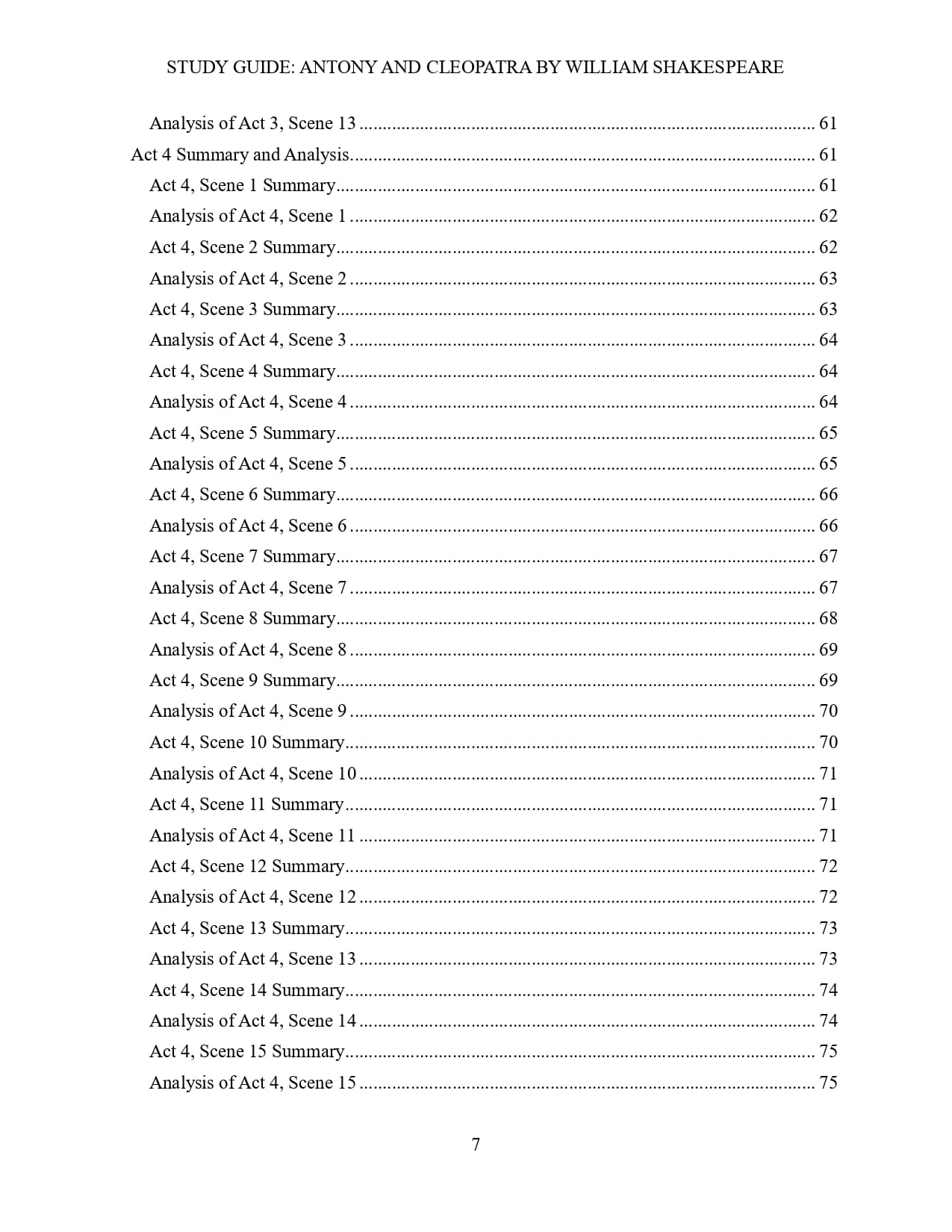
Enjoying this breakdown? What you’re reading is just part of the full experience. The premium PDF edition brings everything together in one seamless, distraction-free document that has the background, setting, plot summary, act-to-act summary and analysis, dramatic devices, characters, and themes. If you’re studying seriously, this is the version you’ll want.
Menas
Menas is a famous pirate aligned with Sextus Pompey. He has significant naval strength,. He is fiercely loyal to Pompey’s cause but deeply pragmatic. He recognises that the truce with the triumvirs means Pompey will “laugh away his fortune.”
During the feast on Pompey’s galley, Menas secretly proposes a plot to cut the ship’s cable and murder Caesar, Antony, and Lepidus, thereby making Pompey lord of the whole world. When Pompey rejects the plan because he wasn’t told about it beforehand, Menas is disgusted by his leader’s refusal to seize power. Realising that Pompey will not take the ultimate prize when it is offered, Menas resolves to abandon his “pall’d fortunes.”
Iras
Iras is one of Queen Cleopatra’s loyal waiting-women and attendants in the Egyptian court. She is introduced engaging in light-hearted banter with her fellow servant Charmian and a Soothsayer, where she playfully predicts that Charmian will paint her face when she grows old.
She remains steadfastly by her queen’s side tthroughout the play. She even flees with her to take refuge inside a secure monument when Mark Antony flies into a murderous rage.
When she is faced with the terrifying prospect of being paraded as a captive in Rome, Iras defiantly declares that she will tear out her own eyes with her nails rather than witness such a humiliation. In the end, she dies peacefully alongside her mistress. She falls lifeless to the floor immediately after receiving a final farewell kiss from Cleopatra.
Alexas
Alexas is a trusted attendant and messenger for Queen Cleopatra in Alexandria. He is tasked with delivering important items and messages between the lovers, such as when he brings Cleopatra an “orient pearl” from Antony and reports that Antony’s mood was perfectly balanced between sadness and mirth. When Antony makes his political marriage to Octavia, Cleopatra dispatches Alexas to observe the new bride and report back on her age, height, and hair colour.
Alexas eventually betrays Antony by defecting to the Romans and travelling to Jewry to persuade King Herod to ally with Caesar. However, this treacherous gamble fails miserably, as Caesar simply rewards his defection by having him hanged.
Agrippa
Agrippa is a trusted military commander and political advisor serving under Octavius Caesar. He acts as a primary strategist for the triumvirate. He is the one that proposed the marriage between Mark Antony and Octavia in the hopes of knitting their hearts together with an “unslipping knot” to ensure peace. Agrippa is also the rapt audience for Domitius Enobarbus. He listens in amazement to the famous, detailed description of Cleopatra’s magnificent, golden barge on the river Cydnus.
During the ensuing war, he commands Caesar’s vanguard but proves pragmatic enough to call a retreat when he realises his troops have overextended themselves against fierce opposition. Upon learning of Antony’s suicide, Agrippa demonstrates profound respect for his fallen enemy, acknowledging that a “rarer spirit never / Did steer humanity.”
The Soothsayer
The Soothsayer is a seer who claims to be able to read a little bit of the future in “nature’s infinite book of secrecy.” He is first seen reading the fortunes of Cleopatra’s attendants, when he correctly predicts to Charmian that she will outlive the lady whom she serves.
Later in Rome, he delivers a crucial and ominous warning to Mark Antony regarding his rivalry with Octavius Caesar. He urges Antony to return to Egypt; he explains that Caesar’s fortunes will inevitably rise higher than his own. The Soothsayer perceptively notes that Antony’s normally noble and courageous spirit becomes afraid and overpowered whenever he is in close proximity to Caesar.
Mecaenas
Mecaenas is a trusted Roman general and advisor serving under Octavius Caesar throughout the play. He is a stabilising voice of reason, given how he tries to smooth over the volatile political tensions between Caesar and Mark Antony. During the negotiations in Rome, Mecaenas advises the triumvirs to forget their past grievances. He argues that their present need to unite against Pompey should compel them to make peace.
He also demonstrates a keen interest in the legendary luxury of the East when he eagerly asks Enobarbus to recount tales of Cleopatra’s extravagant feasts and her magnificent barge on the river Cydnus. Later, as Caesar’s forces close in on Alexandria, Mecaenas advises his leader to capitalise on Antony’s enraged distraction, as he correctly observes that anger does not make a good guard for itself.
Mecaenas is present at the end of the play, during which he acknowledges the duality of Antony’s greatness and flaws when news of his death reaches Caesar’s camp. He says that his “taints and honours waged equal with him.”
Dolabella
Dolabella is an emissary and officer in Octavius Caesar’s camp who plays a brief but pivotal role in the play’s final act. When Caesar initially sends him to demand Antony’s surrender, Dolabella is diverted, but he later takes over guarding the captured Queen Cleopatra from Proculeius.
Unlike the coldly pragmatic Caesar, Dolabella shows genuine sympathy and gentleness towards the defeated Egyptian queen. He listens patiently to Cleopatra’s magnificent dream of an “Emperor Antony” whose legs bestrid the ocean, though he gently admits that such a man could never truly exist in nature.
Because of his deep pity for her situation, Dolabella inadvertently betrays Caesar’s secret intentions. He confirms to Cleopatra that Caesar plans to lead her in a humiliating triumph through Rome. This crucial piece of information cements Cleopatra’s resolve to commit suicide, and Dolabella is among the first to discover the tragic success of her plan.
Proculeius
Proculeius is a Roman soldier loyal to Octavius Caesar. He is notable for being the only man in Caesar’s camp whom the dying Mark Antony tells Cleopatra she can safely trust. However, the play quickly reveals the tragic irony of Antony’s dying advice, as Proculeius proves his primary loyalty is entirely to Caesar’s political objectives. Caesar explicitly dispatches Proculeius to the monument with instructions to speak comfortingly to Cleopatra solely to prevent her from killing herself, so he can keep her alive as an “eternal” trophy for his triumph.
While speaking soothingly to Cleopatra at the gates of her monument, Proculeius acts as a distraction so that other Roman guards can secretly scale the wall and capture her by surprise. When Cleopatra attempts to stab herself with a dagger upon being ambushed, Proculeius physically seizes and disarms her. He urges her not to abuse Caesar’s supposed “bounty.”
His actions demonstrate that in the pragmatic Roman world, military obedience supersedes personal honour. They render him completely unworthy of the trust Antony mistakenly placed in him.
Thyreus
Thyreus is a messenger employed by Octavius Caesar to use cunning diplomacy to drive a wedge between the defeated Mark Antony and Cleopatra. Caesar instructs Thyreus to promise Cleopatra whatever she requires and to invent his own offers, operating under the cynical belief that women in desperate circumstances will easily perjure their vows.
Upon arriving in Alexandria, Thyreus attempts to flatter Cleopatra. He suggests that she only embraced Antony out of fear rather than love, an excuse she seemingly plays along with. However, Mark Antony catches Thyreus kissing Cleopatra’s hand, an act that sends the humiliated and defeated general into a massive, desperate rage.
Antony orders his attendants to brutally whip Thyreus for his insolence. He uses the messenger as a scapegoat for his immense frustration at his melting authority. Thyreus is eventually sent back to Caesar bearing the physical stripes of Antony’s anger, to serve as a visceral message of defiance from the fallen Roman titan.
Ventidius
Ventidius is one of Mark Antony’s highly capable military commanders. He appears in the play leading a triumphant march across a plain in Syria after successfully defeating the Parthians and avenging the death of Marcus Crassus.
Beyond his great military success, Ventidius has a sharp, cynical understanding of the dangerous politics surrounding ambitious subordinate officers. He deliberately chooses to halt his pursuit of the fleeing enemy. He explains to his officer Silius that winning too much glory can actually anger a superior commander. Ventidius observes that a soldier who outshines his captain essentially becomes his “captain’s captain,” and he would rather forfeit further gain than risk offending Antony. His cautious, politically savvy approach to warfare provides a stark contrast to Antony’s own reckless and passion-driven military blunders later in the play.
The Clown
The Clown is a rustic, seemingly foolish Egyptian man who plays a vital, albeit brief, role in the tragic climax of the play. He arrives at Cleopatra’s heavily guarded monument carrying a basket of figs, managing to bypass the Roman guards who dismiss him as a simple “rural fellow.” Hidden inside his basket is the “pretty worm of Nilus,” the venomous asp that Cleopatra specifically requested to carry out her suicide.
The Clown engages in dark, comic banter with the queen about the deadly nature of the snake. He warns her that its bite is “immortal” and that there is “no goodness in worm.” He rambles humorously about how women are a “dish for the gods” unless the devil dresses them. He provides a moment of bizarre comic relief right before the play’s heaviest tragedy.
After wishing her “all joy of the worm,” he departs, unwittingly serving as the final instrument that liberates Cleopatra from Caesar’s grasp.
Mardian
Mardian is an Egyptian eunuch who serves Queen Cleopatra in her palace in Alexandria. When Cleopatra asks if he has affections, he confirms he does, though he can do nothing but what is “honest to be done,” yet he still thinks about what Venus did with Mars. He is frequently ordered around by the queen, such as when she suggests playing billiards with him to pass the time while Antony is away.
Most significantly, it is Mardian who is instructed by Cleopatra to deliver the fatal, false news to Mark Antony that she has slain herself. Mardian successfully carries out this deceitful task. He tells Antony that her final, groaning words were his name, which directly leads to Antony’s despair and his subsequent decision to unarm and end his life.
Canidius
Canidius is a prominent military commander serving under Mark Antony’s land forces during the war against Octavius Caesar. He desperately advises Antony against fighting Caesar by sea at Actium. He questions why his lord would do so when their advantage clearly lies on land. He laments that Antony’s military decisions are being dictated by Cleopatra. He states that “our leader’s led, And we are women’s men.”
After the disastrous naval defeat, Canidius immediately recognises that their fortune on the sea is “out of breath” and has sunk lamentably due to Antony’s gross flight. He becomes disillusioned by his commander’s disgraceful actions. He resolves afterwards to render his legions and horse to Caesar. He concedes that six kings have already shown him the way of yielding.
Diomedes
Diomedes is an attendant and messenger for Queen Cleopatra during the play’s tragic climax. After Cleopatra sends word to falsely report her suicide to Antony, she realises the terrible consequences this lie might provoke and sends Diomedes to tell him the truth.
Diomedes arrives at Antony’s side to explain that her “prophesying fear” drove her to send the false word, but he tragically admits he arrived “too late.” He finds Antony mortally wounded by his own sword and, following Antony’s request, summons the guard to help transport the dying general.
Diomedes then acts as a go-between at the monument. He informs Cleopatra that Antony’s death is upon him but he is not yet dead, which facilitates the lovers’ final reunion.
Dercetas
Dercetas is a Roman guard who is present when Mark Antony makes his fatal attempt at suicide. When Antony falls on his sword but fails to die immediately, he begs his guards to dispatch him and make an end to his suffering. Rather than fulfilling his dying commander’s request, Dercetas opportunistically steals Antony’s blood-stained sword. He decides to bring this sword and the tidings of Antony’s death directly to Octavius Caesar in hopes of winning favour with the new ruler of the world.
Upon arriving at Caesar’s camp, Dercetas presents the sword and confirms that Antony has “splitted the heart” with his own hand. He thereby delivers the momentous news that deeply moves the Roman generals.
Seleucus
Seleucus is Queen Cleopatra’s treasurer. He is responsible for managing and accounting for her immense wealth. After Cleopatra is captured, she presents Octavius Caesar with a manifest that supposedly lists all her money, plate, and jewels. However, when she calls upon Seleucus to verify the inventory upon his peril, he bluntly betrays her by revealing she has kept back enough “to purchase what you have made known.”
This betrayal sends Cleopatra into a furious rage; it prompts her to call him a “slave, soulless villain, dog!” and to physically threaten him. While some interpretations suggest his betrayal might be part of Cleopatra’s own ploy to trick Caesar into thinking she intends to live, Seleucus’s explicit actions expose the shifting loyalties in a fallen court.
Related:
- Study Guide: Antony and Cleopatra by William Shakespeare
- Plot Summary and Setting of Antony and Cleopatra by William Shakespeare
- Themes in Antony and Cleopatra by William Shakespeare
- Dramatic Devices in Antony and Cleopatra by William Shakespeare
- Act-to-Act Summary and Analysis of Antony and Cleopatra by William Shakespeare
Receive Literary Updates through our Social Media Channels:
- WhatsApp: Literature PADI
- Telegram: Literature PADI
- YouTube: @literaturepadi
- Facebook: Literature PADI