Download our SSCE Study Guide Bundle
Plot Summary of The Lekki Headmaster
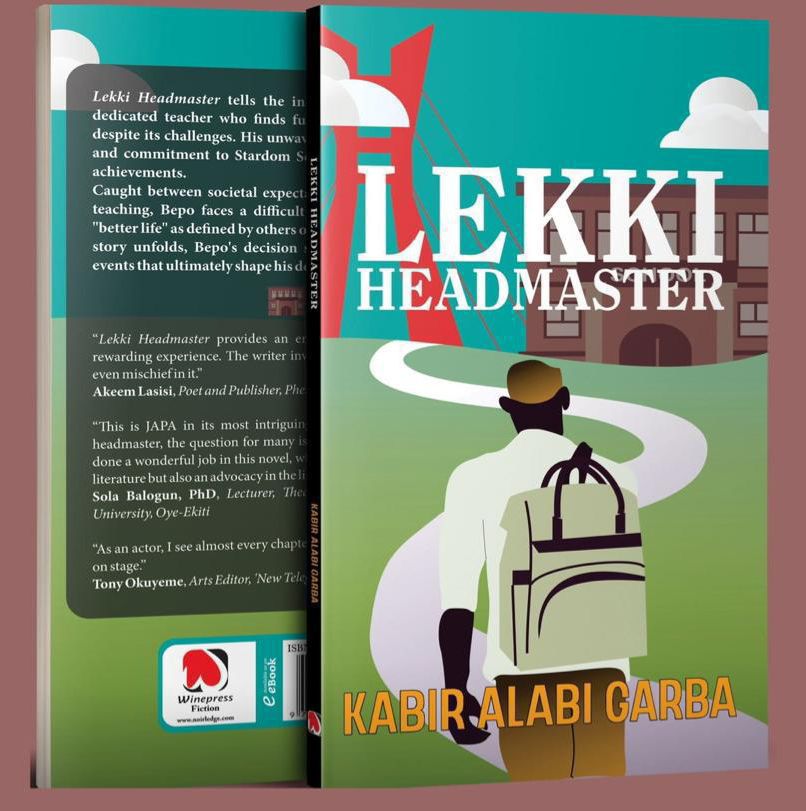
The Lekki Headmaster by Kabir Alabi Garba is a contemporary Nigerian novel that tells the story of the personal struggles of a dedicated educator with the socio-economic phenomenon of the Japa (migration) syndrome. The novel opens with a shocking scene at Stardom Schools, an elite institution in the posh heart of Lekki, Lagos. Mr. Bepo Adewale, the tall, charismatic, and deeply beloved principal (fondly nicknamed “The Lekki Headmaster” and “Principoo”) walks to the podium for the morning assembly but is entirely unable to speak. Instead, he drops the microphone and begins to weep uncontrollably in front of his bewildered staff and students.
After days of probing, the root of his emotional collapse is revealed. Bepo has finally succumbed to intense family pressure and agreed to relocate to the United Kingdom. His wife, Seri, who already lives in the UK with their two daughters, has pushed their marriage to the brink, forcing Bepo to abandon his beloved students, his patriotic ideals, and his dreams of retiring to become an entrepreneur in Nigeria. While his colleagues view his relocation as a highly enviable opportunity to escape the “feeble naira” and earn “heavy British pounds,” Bepo is tormented by the prospect of abandoning a developing nation to serve an already developed one.
As Bepo prepares for his departure, the narrative explores the stark realities driving the mass exodus of Nigerians. Bepo listens to “migration tales” that contrast the alluring promises of hard currency and superior Western infrastructure (like rapid emergency medical responses and free schooling) with the harsh, humbling realities of life abroad. He reflects on professionals losing their dignity to do menial jobs, the high cost of foreign taxes, and marriages crumbling under the stress of survival.
The novel also highlights the systemic dysfunction in Nigeria that makes Japa so appealing. Bepo personally experiences bureaucratic extortion when he attempts to renew his expired passport. He is forced to travel to Ibadan and pay a racketeer N100,000 for a process that officially costs N70,000, only to have his imminent travel date threatened by ridiculous “network glitches” at the NIN office.
Interwoven with Bepo’s impending departure are several incidents that underscore his moral courage and indispensable value to the school. The narrative exposes the toxic, hyper-commercialised environment of elite private education. One such incident is when a wealthy parent, Mr. Guta, wrongly assumes a senior English teacher (Mr. Fafore) made a grammatical error in his son’s notebook. The school’s Managing Director (Mrs. Ibidun Gloss) instantly orders the hardworking teacher sacked to appease the paying customer. Bepo courageously steps in to correct his boss after he proves that the teacher’s sentence (“Ade as well as Jide comes…”) is flawless Standard English. Hence, he saves the man’s career.
Another incident is the management’s classist paranoia, which is revealed when the MD discovers that the staff cooperative society has empowered teachers enough to buy their own cars. The board maliciously views this financial independence as a “snake in the roof” and aggressively caps their borrowing power to keep them subjugated.
Bepo also tries to manage a disastrous, highly monetised student prefect election where an SSS 2 student, Banky, publicly attacks his opponent, Tosh, by calling his father an “ex-convict”. This mirrors the bitter, partisan political rivalries of the students’ wealthy parents.
Away from these incidents, the emotional core of Bepo’s internal conflict is rooted in his patriotism. Through his robust excursion programs, he has taken his students across Nigeria to instil a love for their fatherland. During a past trip to the Heritage Slavery Museum in Badagry, Bepo made a painful connection: he views the modern Japa wave as a voluntary “new slavery,” where Nigerians desperately sell their properties and fast for visas just to become an “ever-weeping race” serving their former colonial masters.
This historical trauma violently resurfaces during his grand farewell party at the school. While watching the traditional Badagry Canoe dance, Bepo slips into a vivid hallucination of tortured, naked slaves being whipped, leading to another tearful breakdown at the podium when the MD presents him with a parting gift of foreign currency.
On the Saturday of his departure, Bepo heads to the Murtala Muhammed International Airport to board his 10:00 pm Emirates flight to London. While waiting at the boarding gate, he dozes off and has a terrifying nightmare. He dreams he is back at the Point of No Return in Badagry. A White slave master points to a ship packed with seven million captive Africans and commands Bepo to “Enter!” Bepo wakes up screaming “Noooo!” in sheer panic, a visceral rejection of his impending relocation.
The following Monday, Stardom Schools is shrouded in grief over their beloved principal’s departure. Suddenly, a familiar shout of “Principoo!” rings out. To everyone’s absolute shock and explosive joy, Mr. Bepo appears at the assembly ground, grinning. He had abandoned his flight. Surrounded by his ecstatic, celebrating students, Bepo declares: “I am back!… I am not going again! My heart is here! This is where my heart is! I am here to complete my mission!” He ultimately chooses his passion for teaching and his love for his country over the societal illusion of a “better life” abroad.
Background of The Lekki Headmaster
The Lekki Headmaster was first published in Nigeria by Winepress Publishing in 2023, with a special edition released by BASMALLAH COMMS. LTD. in 2024. The author frames the novel as a tribute to educators. He dedicates it to “all teachers committed to the cause of sound education,” whom he describes as the “real builders of the nation.”
The novel is firmly rooted in a contemporary, post-pandemic Nigeria, with specific events occurring around the “first quarter of 2022,” a period when the world was recovering from COVID-19.
The central backdrop of the novel is the pervasive Japa syndrome, which is the desperate, mass emigration of Nigerians seeking to relocate to Western countries like the UK, the US, and Canada. The story is driven by a harsh socio-economic climate characterised by severe inflation, where a single US dollar exchanges for as much as N1,600 on the black market. This massive currency disparity fuels a societal desperation where highly skilled professionals like doctors, bankers, and educators, are willing to sell their properties, abandon their careers, and take up menial jobs abroad just to earn hard currency.
Thematically, the novel functions as “an advocacy in the line of patriotism,” as it explores the intense psychological conflict between following societal expectations to secure a “better life” overseas and staying to build one’s own developing nation.
Furthermore, the novel portrays several everyday realities of modern Nigeria. One is the commodification of education. It exposes the massive class divides and commercial nature of elite private institutions in places like Lekki, where teachers are severely underpaid and lack job security despite catering to the wealthy. Another is bureaucratic corruption. The novel captures the frustrating infrastructural and systemic failures of the country, such as the chaotic, extortion-filled process of renewing a passport at government immigration offices. The novel also portrays urban challenges. It incorporates real-world civic issues like the paralysing Lagos traffic and the government’s ban on commercial motorcycles (Okadas) which were previously relied upon to navigate it.
Setting of The Lekki Headmaster
The Lekki Headmaster is set primarily in contemporary Nigeria, with the narrative anchored in Lagos State but extending to other parts of the country and conceptually overseas.
Temporally, the events of the novel take place in the modern, post-pandemic era. The novel explicitly references the “first quarter of 2022” and notes that it is a time when the “COVID-19 set in” and subsequently “lost its war against humanity.” It captures a specific socio-economic climate in Nigeria characterised by the Japa (migration) syndrome, the ban on commercial motorcycles (Okadas) in Lagos, and severe inflation, where a dollar exchanges for N1,600 on the black market.
The physical setting of the novel, for the most part, is Stardom Schools, Lagos. The school is described as an “A-List school” located in the “posh heart of Lekki,” a wealthy area in Lagos. Much of the plot unfolds within the school’s walls. The novel opens on the school’s assembly ground with Mr. Bepo’s emotional breakdown, and it concludes there with his joyous return. Mrs. Ibidun Gloss issues sack orders and interrogates staff in the admin building, located on the second floor. The staff room is where the teachers gossip, debate the economics of migration, and face the daily anxieties of job insecurity in a private institution. And the secret staff park, which is a fenced plot of land acquired by the school located five minutes from the back gate, is where the teachers secretly hide their vehicles from the management.
Other key Lagos locations in the novel include Adeniyi Jones, Ikeja, the neighbourhood where Mr. Bepo resides in a rented apartment; Badagry, a historic coastal town in Lagos State; the departure hall and boarding gates of Murtala Muhammed International Airport (MM2), the setting for Bepo’s final send-off and his eventual decision to abandon his flight to London; GRA, Lagos, the upscale neighbourhood where the wealthy Ladele family lives; and Iyana Ipaja, a crowded, low-income suburb featured in a flashback to Bepo’s days of joblessness in a “face-me-I-face-you” house. Badagry, in particular, is a significant excursion site for the students, the home of the Heritage Slavery Museum and the Point of No Return. It later becomes the vivid, terrifying setting of Mr. Bepo’s climactic nightmare about the “new slavery”.
For a brief moment, the setting of the novel moves outside Lagos to Ibadan, Oyo State. Bepo travels along the newly reconstructed Lagos-Ibadan Expressway to reach the Agodi-Gate passport office in Ibadan. Neighbouring towns of Ifo, Sango, and Mowe in Ogun State are also spotlighted. These are towns where many Stardom teachers like Mr. Fafore and the CRK teacher, Mr. Oyelana, are forced to build homes or rent apartments because they cannot afford the exorbitant two-million-naira rent in the Lekki area. In the same vein, Jos, Plateau State is vividly described during a student’s speech as a city of “acrobatic beauty,” cool weather, and rocky landscapes.
While the physical action remains in Nigeria, the United Kingdom (specifically London and Manchester) and the United States loom massively over the narrative. These Western countries are the idealised destinations driving the Japa wave. They are the locations where Bepo’s wife (Seri), his former colleague (Sola), and other characters currently reside. They represent the allure of hard currency, reliable infrastructure, and the harsh realities of migrant labour.
About the Author
Kabir Alabi Garba is a Nigerian journalist, editor, and author known for his contributions to arts and culture journalism. He has built his professional career primarily in the Nigerian media industry, where he has specialised in reporting on literature, education, and cultural affairs.
Garba worked for many years at the media organisation, The Guardian Nigeria, where he served as Arts and Culture Editor. In that editorial role, he coordinated coverage of literary events, book publications, cultural festivals, and creative industry developments. His work in journalism positioned him within Nigeria’s cultural reporting community and gave him sustained engagement with writers, educators, and artists.
In addition to his journalism career, Garba has an academic background in communication studies. He earned a Doctor of Philosophy (Ph.D.) in Mass Communication from University of Lagos, one of Nigeria’s major universities.
Garba is the author of the novel The Lekki Headmaster, which focuses on the professional and personal life of a school administrator in Lagos. The narrative addresses issues connected to the Nigerian education system, migration decisions among skilled workers, and the social pressures facing middle-class professionals.
The novel gained national attention after it was selected as the official prose text for the Joint Admissions and Matriculation Board (JAMB) Unified Tertiary Matriculation Examination (UTME) for the 2025 and 2026 examination cycles. This selection placed the work on reading lists for secondary school candidates preparing for university entrance examinations across Nigeria.
Related:
- Characters in The Lekki Headmaster by Kabir Alabi Garba
- Chapter 1 to 3 Summary and Analysis of The Lekki Headmaster by Kabir Alabi Garba
Receive Literary Updates through our Social Media Channels:
- WhatsApp: Literature PADI
- Telegram: Literature PADI
- YouTube: @literaturepadi
- Facebook: Literature PADI