

Download our SSCE Study Guide Bundle
Some of the themes in Antony and Cleopatra are love, cultural conflict, death, transactional politics, duty vs. desire, inverted gender roles, reason vs. emotion, betrayal, clouded judgment, fate, illusory unity, emotional manipulation, hedonistic shield, impulsive decision-making, and misogyny.
In this section, we shall discuss these themes in Antony and Cleopatra.
Theme of Love
Love is depicted in Antony and Cleopatra as an overwhelming force that defies rational boundaries; it causes Mark Antony to risk losing himself entirely in “dotage”. The intense romance between Antony and Cleopatra is characterised by an almost mythological grandeur, with Cleopatra recalling a time when “eternity was in our lips and eyes.” Their passion is so intoxicating that Enobarbus famously declares that Antony will never leave her. Unlike ordinary women who satiate the desires of men, Cleopatra’s magnetic allure is a paradox, as she “makes hungry / Where most she satisfies.”
However, their love is also volatile and destructive. It frequently oscillates between fierce devotion and toxic rage, such as when Antony believes Cleopatra has betrayed him to the “young Roman boy” Octavius Caesar.
In spite of these betrayal(s) and suspicions, their love transcends their earthly defeats; it culminates in a poignant reunion where the dying Antony uses his final breaths to beg for one last kiss from the Queen. For Cleopatra, Antony’s death signifies the loss of the entire world’s meaning. It prompts her to mourn that “the crown o’ the earth doth melt.” In her final moments, she completely intertwines the concepts of love and death, as she eagerly anticipates her reunion with her “curled Antony” in the afterlife.
Theme of Cultural Conflict
The overarching geopolitical narrative of the play revolves around the severe cultural clash between the strict, disciplined world of Rome and the luxurious, emotionally driven world of Egypt. Mark Antony finds himself continually torn between these two opposing forces. He recognises early on that he must break his “strong Egyptian fetters” or risk abandoning his martial duties.
The Roman perspective is intensely pragmatic and focused on governance, as seen when Antony and Octavius Caesar coldly debate their respective military manoeuvres and their “contestation” in Italy. By contrast, the Egyptian world prioritises sensual and theatrical excess; it causes Romans to view Cleopatra with deep xenophobia and suspicion. This prejudice infects Antony himself during his downfall. He furiously denounces Cleopatra as a “witch” and a “spell” when he suspects she has sold him out to his Roman enemies.
The cultural conflict forces a tragic resolution when Cleopatra realises she cannot exist within the cold confines of Caesar’s Roman “bounty”. She explicitly voices her dread of being paraded as a captive before the “sober eye / Of dull Octavia” and mocked by the “shouting varletry / Of censuring Rome.” To permanently deny Rome its ultimate triumph over Egypt, Cleopatra decides to conquer Caesar’s intentions by executing a majestic suicide in the “high Roman fashion.”
Theme of Death
Death is presented not merely as an end to life, but as an expression of personal agency, theatrical triumph, and romantic reunion. When faced with the absolute ruin of his political and military power, Antony views suicide as his only honourable escape, He declares that he will be a “bridegroom in my death” and run towards it as if to a “lover’s bed.” He deliberately shapes his final legacy in his dying breaths, as he proudly proclaims to Cleopatra that he perishes not basely, but as “a Roman by a Roman / Valiantly vanquish’d.”
Following his demise, Cleopatra determines that she has “no friend / But resolution, and the briefest end.” She too actively seeks death to escape Roman captivity. She subverts the grim reality of mortality by embracing death with remarkable sensual tenderness, utilising the venom of a snake smuggled to her by a simple countryman. As she applies the deadly asp to her body, she equates the lethal poison to a “lover’s pinch, / Which hurts, and is desired.” With this perspective, she is able to transform a brutal end into an erotic victory.
Her fiercely loyal attendants, Iras and Charmian, share this theatrical devotion to death. They willingly follow their queen and die at her side. Even the coldly calculating Octavius Caesar is deeply moved by the tragic majesty of their demise. He honours Cleopatra’s “noble weakness” and decrees that “no grave upon the earth shall clip in it / A pair so famous.”
Theme of Transactional Politics
In the geopolitical landscape of the play, human relationships and loyalties are continuously treated as calculated, transactional exchanges rather than genuine bonds. This is most explicitly demonstrated by the marriage arranged between Mark Antony and Octavia, which Agrippa proposes solely to “knit your hearts / With an unslipping knot” and secure a fragile political alliance. Octavius Caesar views his own sister as a mere “piece of virtue” functioning as the “cement” of their political love. This goes to show how women are used as political currency.
However, the perceptive Enobarbus recognises the deeply cynical nature of this transaction. He accurately notes that Antony “married but his occasion here” and predicts that this very marriage will eventually strangle their amity.
Furthermore, political truces are made and broken based purely on shifting advantages, such as when Octavius later deposes their fellow triumvir Lepidus by claiming he abused his high authority and was too cruel. Even personal loyalty becomes transactional in the face of defeat, as Enobarbus debates abandoning the sinking Antony, reasoning that remaining loyal to a “fall’n lord” turns faith into mere folly. Caesar also attempts to engage in transactional diplomacy directly with Cleopatra; he sends Thyreus to offer her grand promises and the ability to make her own edicts if she simply betrays Antony and aligns with the Romans.
Theme of Duty vs. Desire
The tension between the rigid demands of political duty and the intoxicating pull of personal desire serves as the central internal and external conflict for Mark Antony. From the very beginning, Antony explicitly prioritises his passion for Cleopatra over his Roman obligations when he dismisses urgent messengers by declaring, “Let Rome in Tiber melt, and the wide arch / Of the ranged empire fall! Here is my space.” This blatant abandonment of duty deeply disgusts his Roman peers, with Octavius Caesar sharply criticising Antony for wasting his time in revelry, tumbling on the bed of Ptolemy, and acting like boys who “rebel to judgment” rather than mature leaders. Antony occasionally attempts to reclaim his sense of duty. He acknowledges that his “idleness doth hatch” ten thousand harms and that the “strong necessity of time” commands his return to Rome.
However, his attempts to balance his military role with his romantic desires fail catastrophically during the conflict at Actium. As Enobarbus observes, Antony allows his romantic will to become the “Lord of his reason.” It makes him to abandon his naval fleet simply to chase after Cleopatra’s retreating ships. This total triumph of desire over military duty destroys his public standing; it leaves a devastated Antony to mourn that he has “offended reputation” with a “most unnoble swerving.”
Theme of Inverted Gender Roles
The traditional Roman expectations of masculinity and femininity are constantly subverted primarily through the dominating presence of Cleopatra and the perceived softening of Mark Antony. Octavius Caesar expresses profound disdain for this inversion. He complains that Antony “is not more man-like / Than Cleopatra; nor the queen of Ptolemy / More womanly than he.”
Cleopatra assumes roles traditionally reserved for male leaders. She insists on being present in person on the battlefield to oversee her forces. This subversion causes great anxiety among the Roman soldiers. It prompts Enobarbus to bluntly warn that her presence will “puzzle Antony.” Enobarbus further notes the humiliating rumours circulating in Rome, which claim that a eunuch and Cleopatra’s maids currently “manage this war.”
Even in the realm of bravery and death, gender expectations are flipped when Antony receives the false news of Cleopatra’s suicide. He laments that he, a world-conquering general, must “condemn myself to lack / The courage of a woman,” as he finds her mind more noble than his own because she boldly chose death over dishonour.
In her final moments, Cleopatra elevates herself beyond typical gender confines. She decides to reject the helpless position of a captive and instead meet death bravely “after the high Roman fashion.”
Theme of Reason vs. Emotion
The structural foundation of Antony and Cleopatra is the dichotomy between Roman reason and Egyptian emotion. Octavius Caesar embodies cold, calculating Roman reason. He sees Antony’s emotional indulgence as a severe failure of maturity where he pawns his experience to his present pleasure and rebels against judgment.
Conversely, Antony operates almost entirely on emotion and passion whenever he resides in Alexandria. His loyal officer Enobarbus explicitly identifies this fatal flaw during the war stating that Antony tragically made “his will / Lord of his reason.” This unchecked emotional attachment causes him to abandon all military logic, such as when he leaves his navy gazing to blindly follow Cleopatra’s fleeing flags at the Battle of Actium. The Romans view this emotional excess as deeply irresponsible; that it reduces a formerly great general to a man who wastes his time tumbling “on the bed of Ptolemy” and engaging in “lascivious wassails.”
While Enobarbus claims Cleopatra’s passions are made of the “finest part of pure love” rather than mere cunning, this intense emotion is exactly what pulls Antony away from his rational duties. In the end, while cold Roman reason wins the geopolitical war and secures the empire, the lovers’ emotional devotion transcends their earthly defeat in the realm of myth.
Theme of Betrayal
Betrayal permeates the political and personal landscapes of the play. It depicts the fragile and shifting loyalties of a world at war. The most poignant example is the defection of Domitius Enobarbus, Antony’s previously loyal lieutenant and the voice of objective truth. Upon realising the severity of his betrayal against a master who was “nobler than my revolt is infamous,” Enobarbus is immediately consumed by fatal guilt. He refers to himself as a “master-leaver and a fugitive.” He prays for the poisonous damp of night to fall upon him so that his heart might break against the “flint and hardness” of his fault.
Antony also experiences the agonising sting of perceived romantic betrayal when he catches Caesar’s messenger kissing Cleopatra’s hand. He furiously denounces her as a “boggler” who has abused him.
Political alliances are equally susceptible to betrayal, with Caesar angrily accusing Antony of breaking the “article” of his oath by denying him required military aid. Even in the play’s final moments, Cleopatra faces betrayal from within her own household when her treasurer, Seleucus, exposes her hidden wealth to Caesar. This final treachery underscores how the loss of power completely dissolves loyalty and leaves the defeated vulnerable to those seeking favour with the new regime.
Get the Full Analysis in PDF
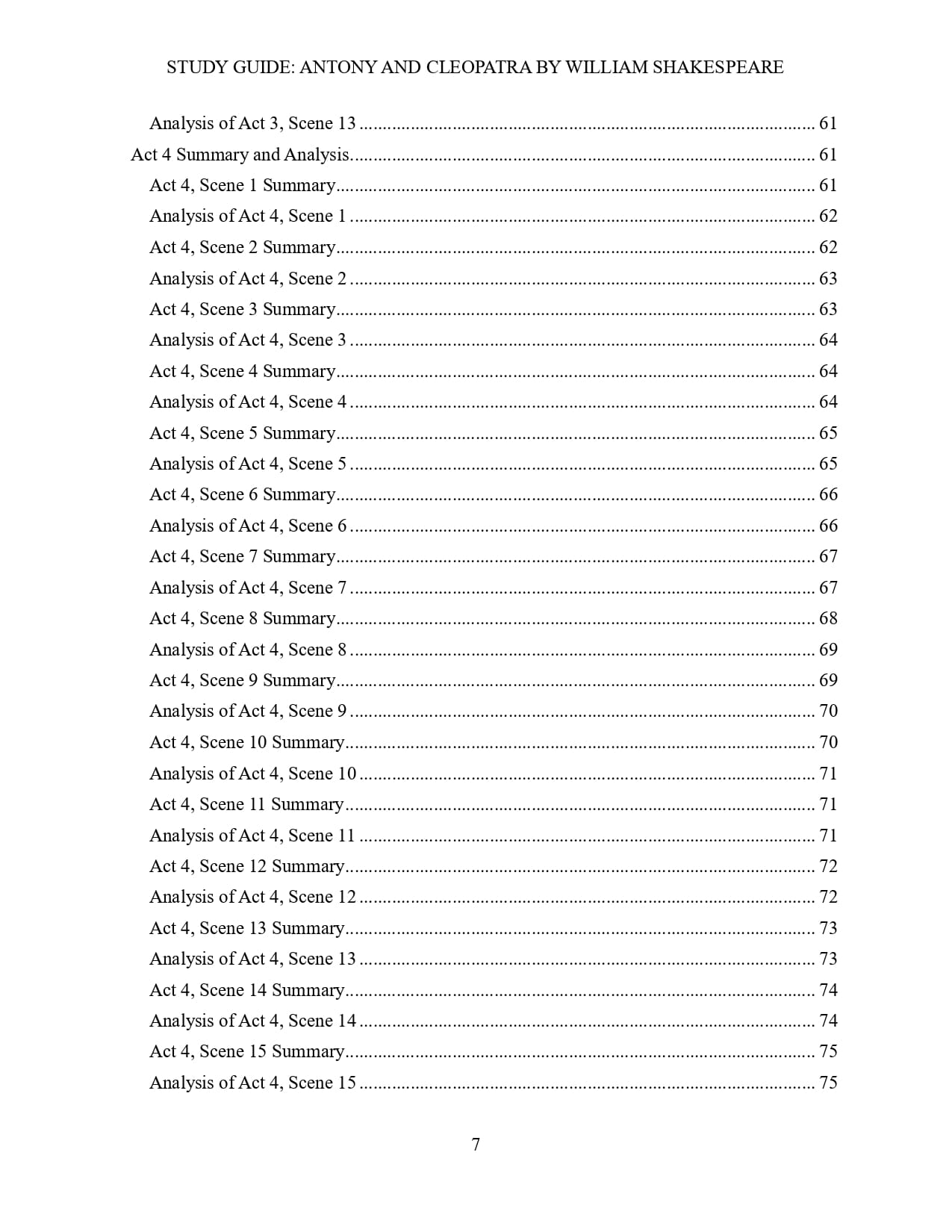
Enjoying this breakdown? What you’re reading is just part of the full experience. The premium PDF edition brings everything together in one seamless, distraction-free document that has the background, setting, plot summary, act-to-act summary and analysis, dramatic devices, characters, and themes. If you’re studying seriously, this is the version you’ll want.


Theme of Clouded Judgment
The theme of clouded judgment is well illustrated through Mark Antony’s tragic descent from a highly respected military tactician to a man blinded by his infatuation. Octavius Caesar is continually disgusted by Antony’s lack of clarity. He criticises him for filling his vacancy with voluptuousness and rebelling against sound judgment.
This cognitive blindness reaches its most disastrous climax during the naval conflict, where Antony’s affection completely overrides his strategic mind. Enobarbus forcefully laments that the “itch of his affection” undermined his captainship; that it causes him to abandon a world-defining battle simply to chase after Cleopatra’s sails.
Antony himself eventually becomes agonisingly aware of his compromised mental state following his defeat and perceived betrayals. He bitterly reflects that when mortals grow entrenched in their vices, the wise gods seal their eyes and drop their “clear judgments” into their own filth. He acknowledges that this divine punishment makes men adore their own errors; that it leads them to strut blindly towards their own confusion and ruin. By the time his judgment clears enough to fully recognise his military and political reality, his power has already melted away.
Theme of Fate
The inescapable power of fate and destiny constantly overshadows the political manoeuvres and personal desires of the characters in the Antony and Cleopatra. This theme is explicitly vocalised by a Soothsayer, who ominously warns Antony to return to Egypt because his fortunes will never rise higher than those of Octavius Caesar. The Soothsayer explains that Antony’s guiding spirit is naturally noble and courageous, but becomes overpowered and fearful whenever Caesar is near.
Antony realises the truth of this prophecy. He acknowledges that whether by art or chance, Caesar consistently beats him against the odds in every game or sport. Octavius Caesar himself seems fully aware of his alignment with destiny as he advises his sister Octavia to let “determined things to destiny / Hold unbewail’d their way” when the war becomes inevitable.
As his military fortunes collapse, Antony attempts to fight against his fate. He furiously declares that he will contend even with death’s “pestilent scythe”. However, the inevitability of his downfall is confirmed by supernatural omens, such as the eerie “music i’ the air” that his soldiers correctly interpret as the god Hercules finally abandoning him.
In the end, the characters are forced to accept that their individual wills are no match for the overarching sweep of historical destiny that mandates the rise of Caesar’s empire.
Theme of Illusory Unity
The political landscape depicted in Antony and Cleopatra is defined by illusory unity, where alliances and truces are merely temporary conveniences rather than genuine bonds. The Second Triumvirate itself is a deeply fractured entity, with its leaders constantly bickering, trading accusations of broken oaths, and barely masking their mutual distrust. Lepidus, the weakest member of the triumvirate, constantly begs his partners to touch their “sourest points with sweetest terms”; he desperately tries to maintain a facade of brotherhood that none of them truly feel.
In a desperate attempt to patch their quarrel, Agrippa proposes that Antony marry Caesar’s sister, Octavia, hoping to knit their hearts together with an “unslipping knot”. While the leaders publicly celebrate this union as the foundation of perpetual amity, the cynical Enobarbus immediately recognises it as a profound illusion. He predicts that the marriage, intended to be the very strength of their friendship, will actually “prove the immediate author of their variance” because Antony will inevitably return to Cleopatra. Similarly, the peace treaty forged with the rebel Sextus Pompey is a hollow charade, celebrated with a drunken feast on his galley where his officer Menas secretly plots to slit the throats of the triumvirs.
Every attempt at formal unity in Antony and Cleopatra crumbles under the weight of ambition and passion. Apparently, true partnership is entirely impossible in this ruthless struggle for global dominance.
Theme of Emotional Manipulation
Emotional manipulation is a primary tool of power and survival in the play, most heavily wielded by the Egyptian Queen, Cleopatra. She carefully calculates her every move and mood to maintain her intoxicating grip on Mark Antony’s heart. For example, she explicitly asks her attendants to observe Antony’s disposition so she can perfectly tailor her own reactions to him.
When Antony prepares to leave for Rome, Domitius Enobarbus highlights her theatrical tendencies. He reveals to Antony that he has seen her “die twenty times upon far poorer moment” just to manipulate her lover. This constant emotional stagecraft eventually culminates in her fatal decision to send false word of her suicide to cure his homicidal rage, a calculated lie that disastrously backfires.
However, she is not the only manipulator; Octavius Caesar also uses calculated emotional manoeuvres to deceive his enemies. He attempts to manipulate Cleopatra after Antony’s death. He speaks to her with gentle promises to extenuate her faults because he desperately wants to keep her alive to display her in his Roman triumph.
Theme of Hedonistic Shield
The theme of a hedonistic shield permeates Antony and Cleopatra. It highlights how the characters use luxury, feasting, and pleasure to block out the grim realities of their political duties and impending wars.
In Alexandria, Antony surrounds himself with extravagance, using it as an absolute barrier against the pressing, cold demands of the Roman Empire. His rival, Octavius Caesar, harshly condemns this behaviour; he expresses disgust that Antony chooses to “tumble on the bed of Ptolemy” and trade “a kingdom for a mirth.” Caesar notes that Antony spends his days reeling in the streets and participating in “lascivious wassails” instead of acting like a mature leader.
Even his enemies recognise the power of this hedonistic shield to neutralise him as a military threat. Pompey actively prays that the “charms of love” and “witchcraft” of Cleopatra will keep Antony tied up “in a field of feasts.” Pompey hopes that “Epicurean cooks” will constantly sharpen Antony’s appetite so that “sleep and feeding may prorogue his honour” into a dull oblivion.
Because Antony prioritise these sensual escapes, his empire crumbles around him. This shows that unchecked hedonism is a fatal distraction for a ruler.
Theme of Impulsive Decision-Making
Impulsive decision-making repeatedly dictates the tragic trajectory of the play. It demonstrates how disastrous it is when leaders allow passion to override reason. Mark Antony is the primary victim of his own impulsivity, as he frequently abandons long-term strategy for immediate emotional gratification.
As noted in our previous discussions, his impulsive choice to abandon his naval fleet and chase after Cleopatra’s fleeing ship at Actium entirely destroys his military standing. Even when reflecting on his own “viciousness,” Antony realises that his judgment has been clouded. He laments how the gods drop men’s “clear judgments” into filth and make them “adore our errors.”
His impulsive rage is equally destructive; upon catching a messenger kissing Cleopatra’s hand, he furiously and irrationally orders the man to be brutally whipped. He violently lashes out at “this Jack of Caesar’s.” Enobarbus observes this psychological breakdown; he notes that Antony’s judgment has been completely subdued and that his mind is shooting “odd tricks” of sorrow. Antony’s most impulsive act yet is his decision to fall on his sword immediately upon hearing the false news of Cleopatra’s death. It seals his doom before he can discover the truth.
Theme of Misogyny
Misogyny is deeply embedded in the cultural and political fabric of the Roman world depicted in the text. It shapes how the male characters view and treat women. Roman leaders consistently degrade women. They see them either as political commodities or as dangerous, corrupting forces.
Octavius Caesar expresses his utter contempt for Antony’s degradation by insulting his masculinity. He complains that Antony “is not more man-like / Than Cleopatra; nor the queen of Ptolemy / More womanly than he.”
When Antony’s impulsive passion leads to his defeat, he quickly adopts the misogynistic language of his peers. He viciously turns on Cleopatra. He reduces the queen of Egypt to a “witch,” a “spell,” and a “monster-like” creature. He blames her entirely for his own failures and threatens to let Octavia “plough thy visage up / With her prepared nails.”
Even Enobarbus, while loyal, casually dismisses the value of women. He callously suggests that “under a compelling occasion, let women die” because “between them and a great cause, they should be esteemed nothing.”
Furthermore, women like Octavia are used merely as transactional tools to cement political alliances between men. The pervasive misogyny of the Romans drives Cleopatra’s majestic suicide, as she refuses to be paraded in Rome and subjected to the “sober eye” of Octavia or the “censuring” mock of the Roman crowds.
Related:
- Study Guide: Antony and Cleopatra by William Shakespeare
- Plot Summary and Setting of Antony and Cleopatra by William Shakespeare
- Dramatic Devices in Antony and Cleopatra by William Shakespeare
- Characters in Antony and Cleopatra by William Shakespeare
- Act-to-Act Summary and Analysis of Antony and Cleopatra by William Shakespeare
Receive Literary Updates through our Social Media Channels:
- WhatsApp: Literature PADI or Literature-in-English with LP
- Telegram: Literature PADI
- YouTube: @literaturepadi
- Facebook: Literature PADI


