

Download our SSCE Study Guide Bundle
Chapter 29 Summary of To Kill a Mockingbird
Chapter 29 of To Kill a Mockingbird opens with the adults reacting to Sheriff Heck Tate’s announcement that Bob Ewell is lying dead under the tree with a kitchen knife stuck in his ribs. Atticus is in profound shock; his usual instinctive courtesy fails him, and for the first time, his age truly shows in his face, with tell-tale creases forming and his jaw line melting a little. Aunt Alexandra feels terrible guilt. She remembers her earlier premonition when she said “somebody just walked over my grave,” but Mr. Tate reassures her that people cannot live their lives guided by such feelings.
Mr. Tate asks Scout to explain what happened while it is still fresh in her mind. Sitting in Atticus’s lap, Scout recounts how she and Jem were walking home in the pitch dark. She explains that they heard footsteps following them but initially assumed it was Cecil Jacobs trying to scare them again. When the footsteps turned into a run, the attack began.
As Scout tells her story, Mr. Tate asks to see her crushed ham costume. Examining the painted chicken wire, Mr. Tate points out a clean, shiny cut on the dull wire, noting that Bob Ewell had meant business and that the ridiculous costume had likely saved Scout’s life. Atticus, still struggling to comprehend the malice, says he thought Ewell had gotten all his anger out the day he threatened him and could not conceive of a man who would go after children. Mr. Tate bluntly corrects Atticus’s idealism, stating that Ewell was a “low-down skunk” who had enough liquor in him to make him brave enough to attack children in the dark, but was too cowardly to ever face Atticus to his face.
Scout continues her narrative. She describes how Jem yelled, then someone pulled Ewell off of her, and then she heard a man panting and coughing violently. She tells Mr. Tate that she thought Atticus had come to help them and had gotten worn out.
When Mr. Tate sharply asks who the man was, Scout says, “Why there he is, Mr. Tate, he can tell you his name,” pointing to the silent man standing in the shadowy corner of Jem’s room. As Scout looks at the man, she notes his sickly white hands, his hollow cheeks, his wide mouth, and his colourless grey eyes. The man gives a sudden, timid smile, and Scout’s image of him blurs with sudden tears as she realises exactly who it is. She simply says, “Hey, Boo.”
Analysis of Chapter 29
This chapter of To Kill a Mockingbird forces Atticus to confront the limits of his own extreme empathy. Throughout the novel, Atticus has operated on the belief that placing yourself in someone else’s shoes can explain away their bad behaviour. He rationalised Bob Ewell’s threats as the temporary anger of a man who needed to save face. Heck Tate, however, acts as the voice of harsh reality, explaining that some men are simply evil and “ain’t worth the bullet it takes to shoot ’em.” Atticus’s inability to conceive of a man cowardly enough to murder children in the dark highlights his fatal flaw: his profound goodness makes him dangerously naive to pure malice.
Harper Lee uses Scout’s humiliating ham costume to deliver a masterful stroke of irony. Throughout the evening, the cumbersome chicken-wire contraption was a source of embarrassment and physical restriction for Scout. Yet, it serves as literal armour, given that it absorbed the fatal blow of Bob Ewell’s switchblade. The absurdity of the costume contrasts sharply with the grim reality of the murder attempt. This grounds the dark climax of the novel in the innocent world of childhood.
Scout’s introduction to Boo Radley is one of the most poignant moments in literature. After three years of neighbourhood legends, childhood terror, and imaginative games, Boo is finally revealed not as a monster, but as a fragile, timid, and sickly man. Scout’s reaction demonstrates her immense growth. Instead of screaming or acting afraid, she looks at him with wonder and instant empathy. She greets him with a gentle, casual, “Hey, Boo.” By shedding her childhood superstitions and recognising his humanity, Scout perfectly embodies the novel’s central theme of compassion.
Chapter 30 Summary of To Kill a Mockingbird
Chapter 30 of To Kill a Mockingbird begins with Atticus formally introducing Scout to the man in the corner: Mr. Arthur (Boo) Radley. Scout is stunned but manages to greet him politely. Dr. Reynolds arrives and shoos them out of Jem’s room so he can examine him. Atticus suggests they go to the front porch rather than the living room, because he realises that the bright lights of the living room would be too harsh for Boo, who has spent his life in the dark. Scout leads Boo by the hand to a chair in the deep shadows of the porch.
On the porch, Atticus and Sheriff Heck Tate begin to discuss Bob Ewell’s death. Atticus stubbornly assumes that Jem killed Ewell in self-defence during the struggle. He insists that the case must go to court and be dealt with entirely in the open. Atticus refuses to cover it up. He explains that if he compromises his integrity and helps his son dodge the law, he would lose the moral authority to be a father to his children.
Mr. Tate repeatedly corrects Atticus. He stubbornly insists that Jem did not kill Bob Ewell. Tate asserts, “Bob Ewell fell on his knife. He killed himself.” Atticus believes Tate is just trying to protect Jem from the ordeal of a trial, and the two men find themselves in a tense standoff. To demonstrate his point, Tate pulls a switchblade from his pocket—which he claims he took off a drunk man earlier—and pantomimes how Ewell, stumbling in the dark, could have fallen on the kitchen knife found in his ribs.
Tate finally loses his temper and makes his true meaning clear. He tells Atticus that he is not trying to protect Jem; he is trying to protect the man who actually killed Bob Ewell and saved the children: Arthur Radley. Tate explains that dragging a painfully shy man like Boo into the limelight—even as a hero—would be a sin, as the town’s women would inevitably swarm him with attention and baked goods. Tate declares, “There’s a black boy dead for no reason, and the man responsible for it’s dead. Let the dead bury the dead this time.” He definitively states that his official report as sheriff will say Bob Ewell fell on his knife.
Atticus finally understands and accepts Tate’s decision. He turns to Scout to see if she comprehends this complicated legal and moral lie. Scout reassures him that she understands perfectly. He says that exposing Boo to the town would “be sort of like shootin’ a mockingbird, wouldn’t it?.” Deeply moved, Atticus embraces Scout, then walks over to Boo Radley and simply says, “Thank you for my children, Arthur.”
Get the Full Analysis in PDF
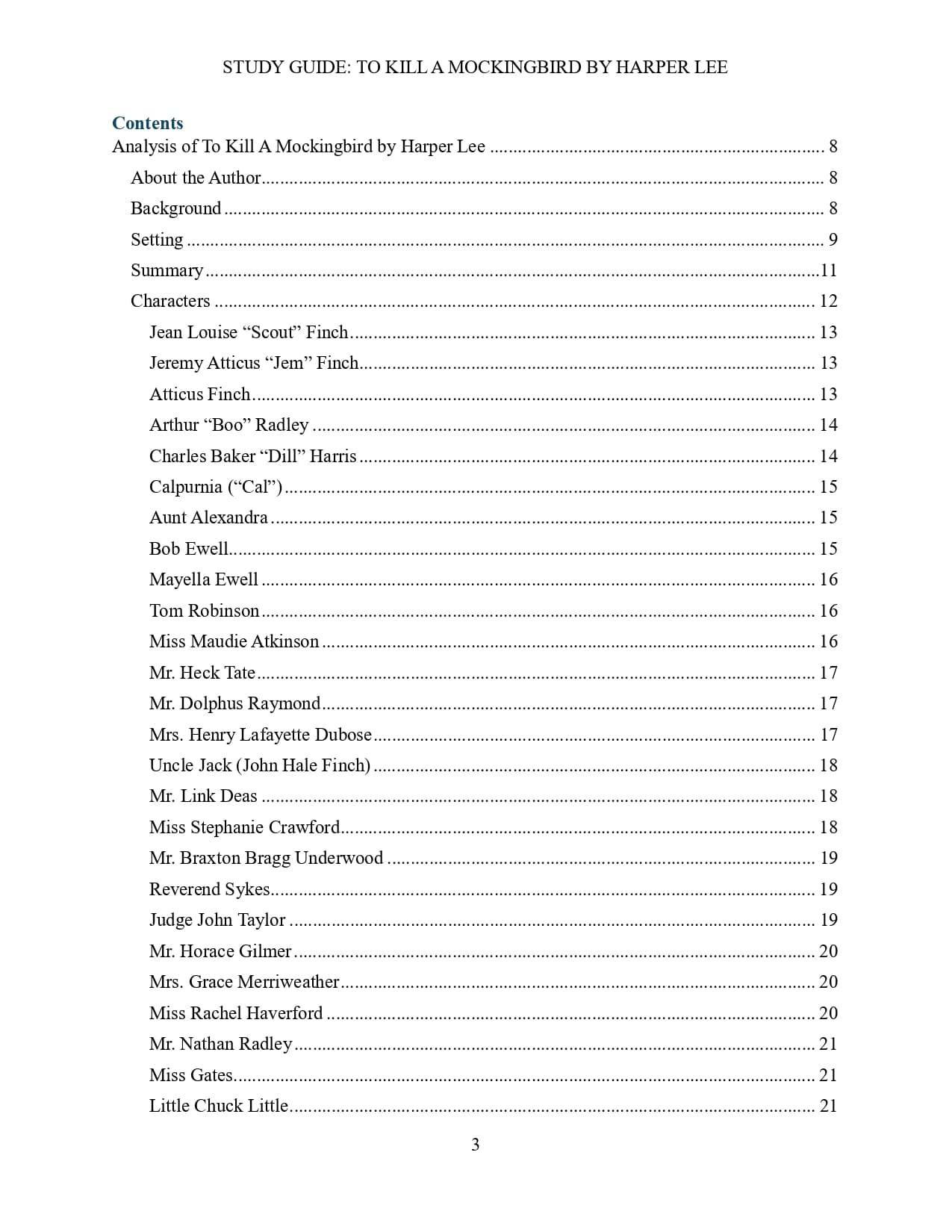
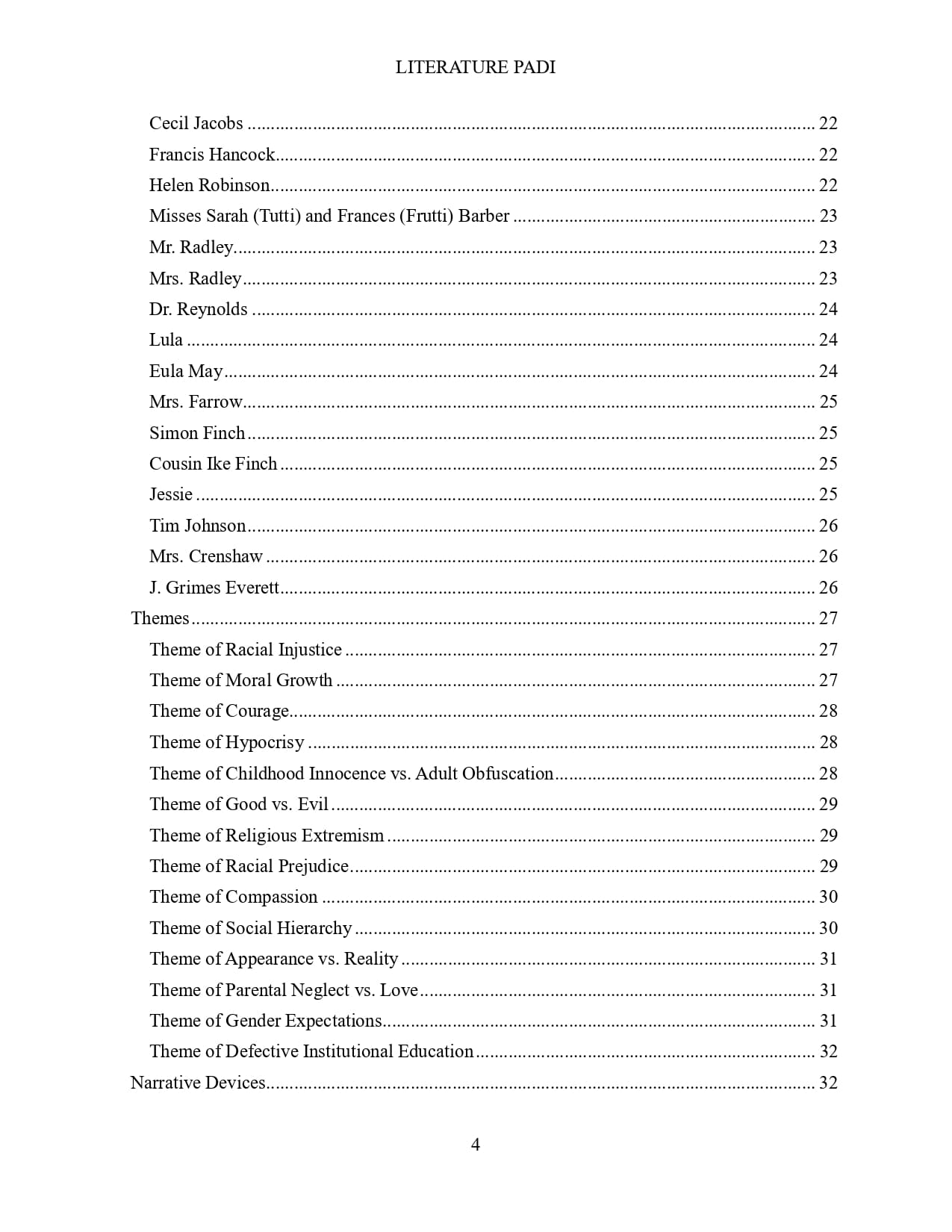
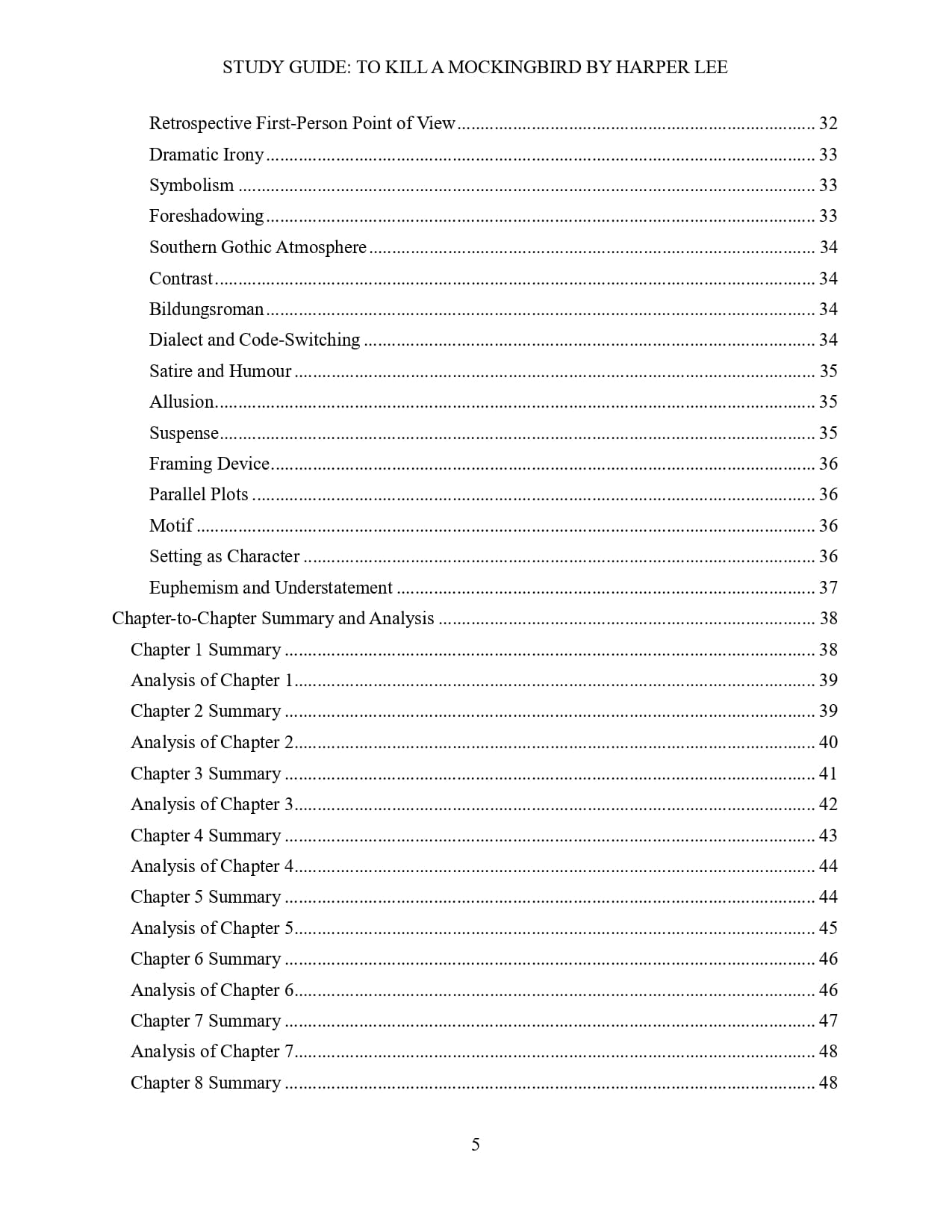
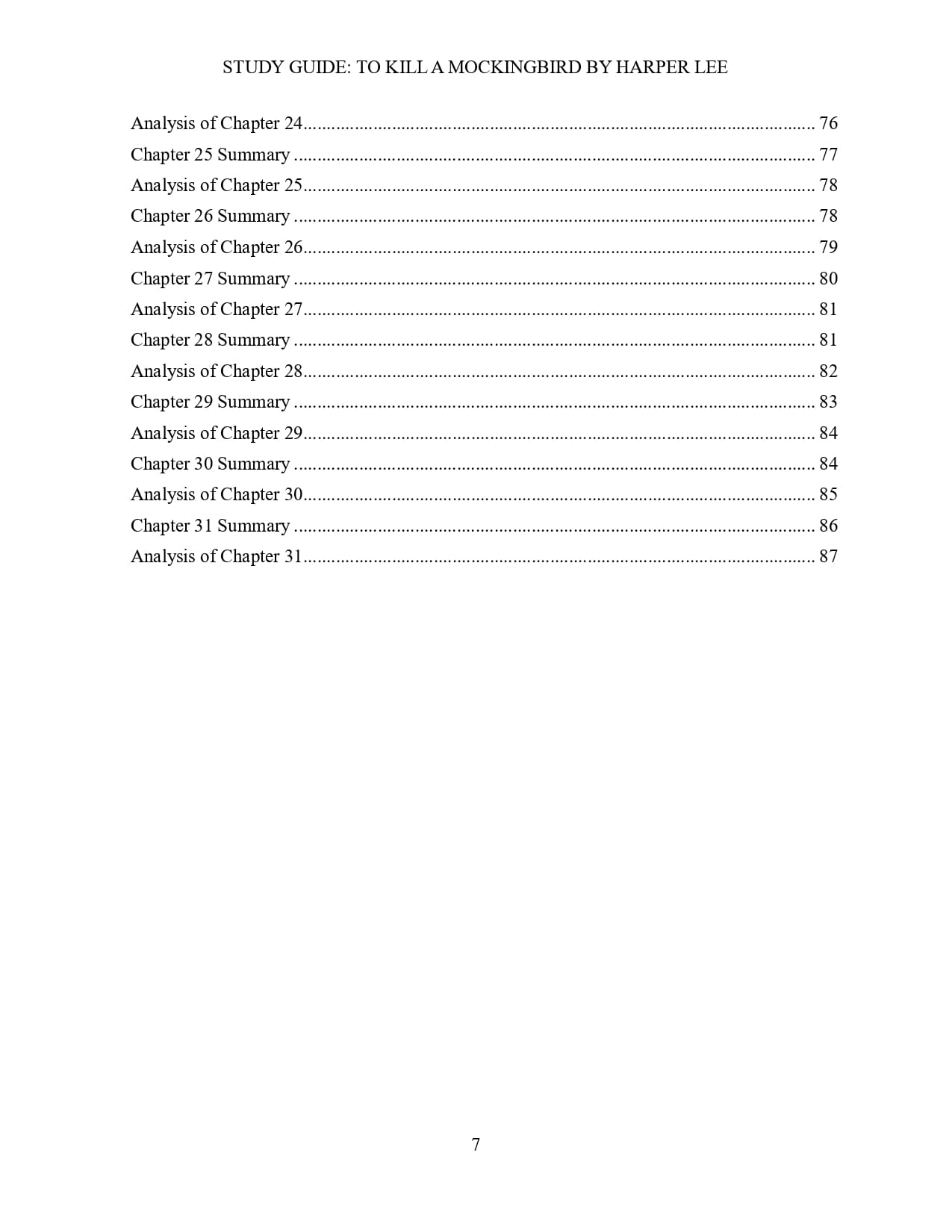
Enjoying this breakdown? What you’re reading is just part of the full experience. The premium PDF edition brings everything together in one seamless, distraction-free document that has the background, setting, plot summary, chapter-to-chapter summary and analysis, narrative devices, characters, and themes. If you’re studying seriously, this is the version you’ll want.

Analysis of Chapter 30
This chapter of To Kill a Mockingbird brings the novel’s central metaphor to its thematic climax. Boo Radley is the ultimate “mockingbird.” Like the bird that does nothing but sing for people, Boo has done nothing but leave gifts for the children, fix Jem’s pants, put a blanket over Scout, and ultimately risk his own life to save them. Dragging him into the harsh, judgmental spotlight of Maycomb’s society—even for a heroic act—would destroy his fragile existence. Scout’s ability to instantly connect Atticus’s lesson about the mockingbird to Boo Radley proves that she has fully internalised her father’s moral teachings.
Then, the chapter opens up on Atticus’s moral crisis. Throughout the novel, Atticus is the unshakeable pillar of legal and moral integrity. He is fully prepared to put his own son on trial because he refuses to live a hypocritical life (“I can’t live one way in town and another way in my home”). He believes that secrets and evasions poison a society. However, this chapter forces Atticus to realise that rigid adherence to the letter of the law can sometimes cause profound moral harm. He has to bend his strict legalistic code to protect an innocent man. He accepts Sheriff Tate’s lie for the greater good.
Moreover, Sheriff Heck Tate steps up as the moral arbiter in this chapter. He operates on a practical, frontier-style sense of justice rather than strict legality. By decreeing that “Bob Ewell fell on his knife,” Tate creates a legal fiction to protect Boo Radley. Tate sees a profound cosmic justice in the night’s events: Bob Ewell caused the death of an innocent Black man, and now Ewell has paid for it with his own life. To Tate, the scales are balanced (“Let the dead bury the dead”), and no further innocent lives (like Boo’s) should be ruined.
Noticeably, Scout’s behaviour on the porch demonstrates how much she has matured. She instinctively recognises Boo’s vulnerability and treats him with profound empathy. She treats him like a normal, welcomed guest (“Won’t you have a seat, Mr. Arthur?”) and seats him in the comforting shadows. Furthermore, she grasps the complex moral nuance of Tate and Atticus’s decision without needing it explained to her, showing that she has successfully transitioned from a naive child into a morally aware young person.
Chapter 31 Summary of To Kill a Mockingbird
Chapter 31 of To Kill a Mockingbird begins with Boo Radley in the Finch living room. He looks incredibly uncomfortable and uncertain in the light. After coughing into a handkerchief, he nods towards the front door, indicating his desire to leave. Scout realises he wants to see Jem before he goes, and she leads him down the hall.
In Jem’s room, Boo stands far back in the corner until Scout gently takes his hand—which she notes is “surprisingly warm for its whiteness”—and pulls him closer to the bed. Boo looks at the unconscious Jem with an expression of “timid curiosity,” as if he has never seen a boy before. With Scout gently encouraging him to “go ahead,” Boo reaches out and lightly strokes Jem’s hair.
Boo’s hand tightens around Scout’s, and he asks her in a near-whisper, like “a child afraid of the dark,” if she will take him home. Scout leads him to the front porch, but she insists that he bend his arm so she can slip her hand into the crook of it. She does this intentionally so that if Miss Stephanie Crawford is watching from her window, she will see Arthur Radley escorting Scout down the sidewalk “as any gentleman would do.”
They walk to the street light, and Scout enters the Radley gate for only the second time in her life. Boo goes inside, shuts the door, and Scout notes that she never saw him again. As she turns to leave, she feels a deep sense of sadness, with the realisation that Boo had given them two soap dolls, a broken watch and chain, a pair of good-luck pennies, and their lives, but they had never given him anything in return.
Before heading home, Scout turns around and looks at the neighbourhood from the vantage point of the Radley porch. In a profound moment of realisation, she visualises the events of the past few years—the seasons changing, the children playing their games, the mad dog, the fire—exactly as Boo must have seen them from behind his shutters. She realises that Atticus was right: “you never really know a man until you stand in his shoes and walk around in them.” For Scout, just standing on the Radley porch is enough to finally understand her neighbour.
Walking home in the fine rain, Scout feels “very old” and thinks there isn’t much left for her and Jem to learn, except perhaps algebra. She goes into Jem’s room and finds Atticus sitting by the bed, reading one of Jem’s books, The Gray Ghost. Scout crawls into Atticus’s lap and asks him to read it aloud. She claims she wasn’t actually scared that night because “nothin’s real scary except in books.”
Scout drifts off to sleep while Atticus reads, and he eventually carries her to her own bed. Half-asleep, Scout mumbles about the plot of The Gray Ghost. She notes that the characters in the book had chased the accused man without knowing what he looked like, and when they finally saw him, he hadn’t done any of the terrible things they suspected. In fact, he was “real nice.” Atticus gently pulls the covers up around her chin and replies, “Most people are, Scout, when you finally see them.” Atticus turns out the light and returns to Jem’s room, where he will wait all night for his son to wake up.
Analysis of Chapter 31
This chapter of To Kill a Mockingbird represents the thematic climax of the novel. Throughout the story, Atticus has continually tried to teach his children the importance of empathy; specifically, climbing into another person’s skin and walking around in it. By literally standing on the Radley porch and viewing the neighbourhood through Boo’s eyes, Scout finally achieves this profound level of understanding. She realises that Boo has not been a malevolent phantom, but a silent, loving guardian who watched them grow up and eventually stepped into the world to save their lives.
Scout’s treatment of Boo Radley in this chapter demonstrates her complete maturation. Despite his bizarre, ghostly appearance and his childlike fear of the dark, she treats him with immense respect. For one, she actively protects his dignity by arranging her arm so that it appears Boo is escorting her down the street. She ensures that if the town’s gossip (Miss Stephanie) is watching, Boo will be seen not as a monster or a freak, but as a proper Southern gentleman.
Harper Lee uses the children’s book The Gray Ghost as an allegory for Boo Radley’s entire arc. Scout’s sleepy summary of the book—about a character who is wildly misunderstood, blamed for crimes he didn’t commit, and ultimately revealed to be “real nice” when people finally take the time to see him—perfectly mirrors their experience with Arthur Radley. Atticus’s final lesson (“Most people are, Scout, when you finally see them”) serves as the thesis statement for the entire novel. It urges the reader to look past prejudice, fear, and town gossip to recognise the shared humanity in others.
The closing image of the novel is deeply comforting and symbolic. After guiding his children through the harrowing trials of racism, mob violence, and a physical attack, Atticus sits quietly by Jem’s bed, ready to watch over him for the rest of the night. It cements Atticus not just as a crusader for social justice, but as an eternally dependable, loving father whose quiet strength anchors his family.
Related:
- Chapter 1 to 3 Summary and Analysis of To Kill a Mockingbird by Harper Lee
- Chapter 4 to 6 Summary and Analysis of To Kill a Mockingbird by Harper Lee
- Chapter 7 to 9 Summary and Analysis of To Kill a Mockingbird by Harper Lee
- Chapter 10 to 12 Summary and Analysis of To Kill a Mockingbird by Harper Lee
- Chapter 13 to 15 Summary and Analysis of To Kill a Mockingbird by Harper Lee
- Chapter 16 to 21 Summary and Analysis of To Kill a Mockingbird by Harper Lee
- Chapter 22 to 24 Summary and Analysis of To Kill a Mockingbird by Harper Lee
- Chapter 25 to 28 Summary and Analysis of To Kill a Mockingbird by Harper Lee
Receive Literary Updates through our Social Media Channels:
- WhatsApp: Literature PADI or Literature-in-English with LP
- Telegram: Literature PADI
- YouTube: @literaturepadi
- Facebook: Literature PADI



 Radley.)