Download our SSCE Study Guide Bundle
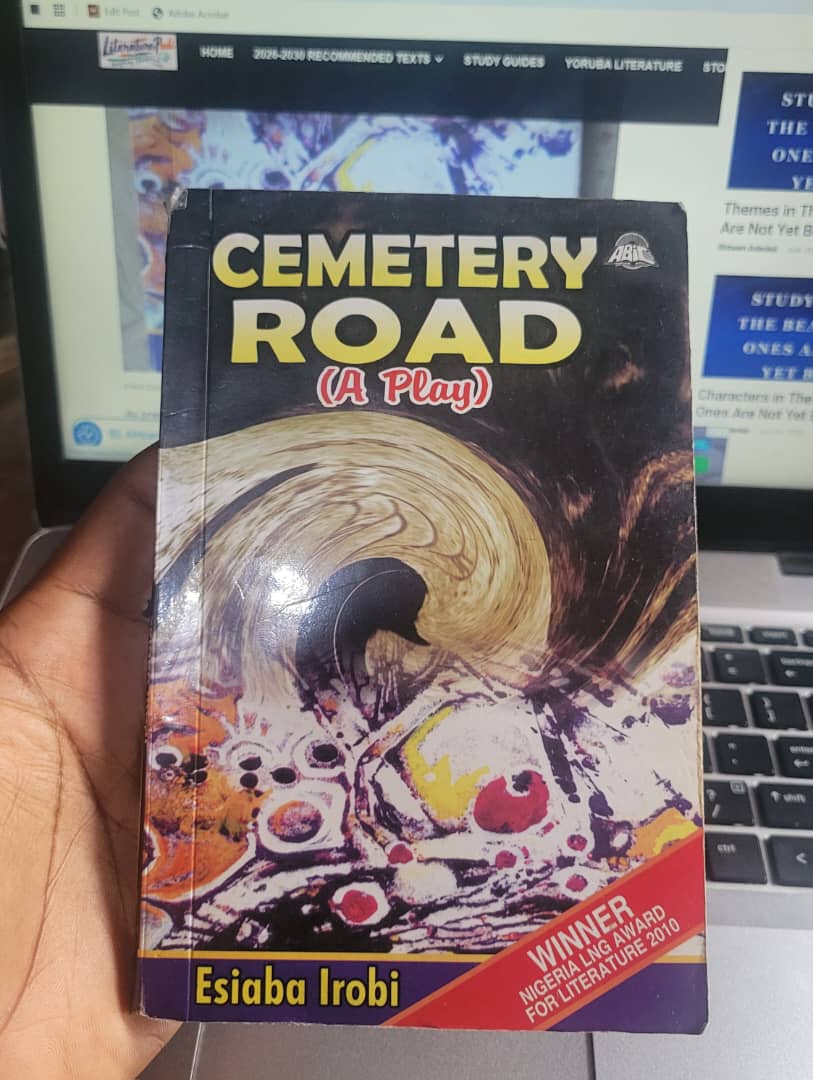
Some of the characters in Cemetery Road by Esiaba Irobi include Mazeli, Somadina, Fatima, Amina, Madubunjoala, and Lawani. Other characters in Cemetery Road include Dogon, Rigor Mortis, Douglas, and Hazel. In this section, we shall look into these characters.
Dr. Mazeli Anyanwu
Dr. Mazeli Anyanwu is an uncompromising university lecturer in Film and Theatre Arts who earned his PhD from Manchester. He is known to his community and students as “The Rising Sun” (Anyanwu Ututu). He is the ideological and moral centre of the play. Mazeli is a radical intellectual who decorates his Abuja apartment at 13 Cemetery Road with portraits of revolutionary leaders like Che Guevara, Thomas Sankara, and Queen Amina. He puts his Marxist beliefs into practice through his Community Theatre project in the impoverished resettlement village of Kudingi, where he works alongside disenfranchised peasants to dramatise their struggles against state exploitation.
Mazeli’s dedication to his people brings him into direct conflict with both local military authorities and Western institutions. He clashes with BBC director Douglas Powell in particular. He refuses to allow the Kudingi documentary to be sanitised into a light, palatable comedy for British viewers, and instead confiscates the videotape to protect the “beauty of resistance” from neocolonial exploitation. This act of defiance, combined with false intelligence fed to the military by his envious department head, Professor Madubunjoala, makes Mazeli a target of the State Security Service (SSS).
Even with the threat of state violence, then an actual tear gas attack on his home, and his mother’s emotional pleas to surrender the tape, Mazeli remains steadfast in his refusal not to release the tape. This stubbornness of his of course comes a long way from his childhood trauma of witnessing his Baptist minister father being slaughtered during the 1966 Kano City pogrom.
Mazeli is eventually arrested and taken to the SSS torture chamber, where he undergoes horrific abuse under Colonel Dogon Burra, who staples his palm, attempts to force acid-laced gruel down his throat, and applies electric shocks to his body. To make matters worse, the soldiers mockingly crown him with barbed wire and inject him with a slow-acting, lethal poison before releasing him due to massive student protests. The poison is meant to destroy his liver within a year.
Fully aware of his impending death, Mazeli decides to try his hands at political martyrdom. He intends to wear a sacred, four-faced ritual mask during a command performance for the President at the Nicon Neo Niga Hotel and stab the dictator to death. However, his mission is cut short at his apartment when his childhood friend, SSS officer Lawani Turenchi, attempts to call security headquarters to cancel the play and save Mazeli’s life. Believing Lawani is betraying the revolution, Mazeli lunges at him with a knife; in the ensuing struggle, Lawani sidesteps, and Mazeli is accidentally stabbed with his own blade, dying in the arms of his fiancée, Somadina.
Somadina
Somadina is a principled, 30-year-old journalist for The Trumpet and the pregnant fiancée of Dr. Mazeli Anyanwu. She is the intellectual and moral equal of Mazeli. She holds a Master’s degree in Mass Communication from the University of London, where she wrote her dissertation on “The Image of Black Women in the British Media”. Somadina is a woman of immense strength and courage who refuses to be intimidated by the violent military regime, resolving to stand “unbroken even among the broken places”.
All through the play, Somadina is Mazeli’s anchor. She helps him hide the controversial BBC videotape. She also promises to write an exposé in her newspaper to reveal the regime’s atrocities. When military intelligence officers raid their home and threaten their lives, she stands her ground, slapping a soldier who attempts to physically violate her. She later defies her own mother’s pleas to flee the apartment as she chooses instead to remain with Mazeli and face the state’s wrath.
Somadina’s integrity is mostly tested by the arrival of Lawani Turenchi, her former university lover turned corrupt SSS officer. Lawani attempts to exploit her pregnancy and financial vulnerability by offering her expensive Harrods wedding gifts, a luxury wedding at Dodan Barracks, and bank statements showing millions of dollars stashed in foreign accounts. Somadina rejects his advances with disgust. She labels him a “trousered ape”, a “worthless thing” with “no honour and no shame”, and violently sweeps his expensive gifts and portfolio off the table.
She exposes the cowardice of those who sell out their nation for personal survival under the guise of pragmatism. When Mazeli returns from the SSS chamber bleeding and poisoned, Somadina is devastated but remains fiercely protective of his legacy. After Mazeli’s tragic death in her arms, she is left grieving amidst the wreckage of their shared dreams.
Mrs. Fatima Akintola
Mrs. Fatima Akintola is the departmental secretary at the university. She is introduced in the play as a middle-aged, slightly plump woman dressed in traditional aso-oke. She is a proud married woman with a husband and four children. She is also a vital whistleblower who exposes both the sexual harassment and the administrative corruption running rampant within the academic institution.
Her primary conflict is with the Head of Department, Professor K. G. B. Madubunjoala, who threatens her job unless she submits to his sexual advances. Fatima courageously recounts how the Professor called her into his office, groped her under her skirt, and grabby-handedly rumpled her blouse. She slapped him twice across the face in retaliation, yet he shamelessly dismissed the blow as “foreplay” and invited her to his chalet at the Nicon Neo Niga Hotel. He further harassed her in her own office where he made graphic remarks about her body and stated that the only “sugar” he wanted as a diabetic was between her thighs. Fatima, however, rejects him with the point that her religion does not tolerate adultery and that she has absolutely no need for his “sixty-year-old rusty equipment”.
Moreover, Fatima fights back by stealing and smuggling out Dr. Mazeli Anyanwu’s academic file after discovering that Madubunjoala and another senior colleague planned to make it “disappear” to block Mazeli’s promotion to HOD. She delivers the file to Mazeli and drafts a formal petition to the university senate’s Disciplinary Committee. She also reveals that the Professor’s erratic behaviour stems from his personal life; that he began disintegrating and “cracked up” after his English wife left him and took their two children back to England.
Fatima’s resistance extends to the military state as well. When Mazeli is arrested, she mobilises the students to write protest placards. When Madubunjoala orders her to bring the classroom keys to his hotel chalet, she hurls the keys at his chest and kicks him in the buttocks, sending him sprawling flat on his face.
Later, at Mazeli’s apartment, she types Somadina’s newspaper exposé on the word processor. She is found defending herself against the SSS officer Lawani. She draws a knife on him when he attempts to touch her. During a drug-fuelled debate between Lawani and BBC correspondent Douglas Powell, she interjects to condemn Western exploitation. She calls Douglas a “modern slave trader”. At the play’s tragic climax, she is the one who checks Mazeli’s pulse to confirm his death and identifies his killer to the arriving students.
Amina
Amina is a politically conscious drama student under Dr. Mazeli Anyanwu. In the play-within-a-play recorded by the BBC in Kudingi Village, she plays the role of the Third Peasant. Amina uses her performance to channel her own harrowing real-life trauma of being detained and tortured by the military regime.
During an interview with BBC assistant Hazel Blunt, Amina recounts being imprisoned for three months. She details the horrific physical and sexual torture she survived. Police officers sprayed tear gas into her private parts, attached naked electric wires to her nipples, and used razor blades to sign their signatures on her breasts. When BBC director Douglas Powell callously cuts her off to sanitise the documentary, Amina walks off the set in protest. She bluntly tells the camera that the torture left her urinating blood.
Amina is also depicted playing the role of Amina Dan Fodio during the Kudingi Village land compensation scene. In this sequence, she fiercely rejects the insulting 150-naira compensation sheet handed out by a corrupt government official. She hurls the money at his chest and demands, “Me, a beggar?”. When the official—played by a final-year drama student named Abubakar—makes a crude, sexually suggestive proposition to her, she stands her ground with defiance.
In the real-world timeline of the play, Amina remains fiercely loyal to Mazeli. After his release from SSS custody, she is the first to examine his bleeding head wounds, smelling the blood to expose his lie that it is merely “stage blood”. When Mazeli outlines his plan to assassinate the dictator during their command performance, Amina bravely asks what will happen to the students afterwards. She admits that while they do not fear death, they simply do not want to die.
When Mazeli is tragically killed in his apartment, Amina frantically runs out to secure a taxi to take him to the hospital, only to return and find him dead. She is so overcome with grief and rage that she confronts Lawani at the scene. She even rejects his claims that the stabbing was an accident. She declares that Lawani’s own death will also be “an accident” and leads the vengeful student mob in cornering and stabbing the SSS officer to death.
Get the Full Analysis in PDF
Enjoying this breakdown? What you’re reading is just part of the full experience. The premium PDF edition brings everything together in one seamless, distraction-free document that has the background, setting, plot summary, dramatic devices, characters, and themes. If you’re studying seriously, this is the version you’ll want.
Professor K. G. B. Madubunjoala
Professor K. G. B. Madubunjoala is a pompous and envious Professor of Drama who serves as the university’s Head of Department. He is introduced in the “Opening Glee” wearing his Oxford PhD academic gown and speaking with an exaggerated Oxford accent. He got his doctorate in 1964 with a dissertation titled “Caliban, Cannibalism and Colonialism in William Shakespeare’s The Tempest”.
Madubunjoala is a tragicomic figure of extreme intellectual decay and professional insecurity. In his opening monologue, he admits that in his thirty-two years as an academic, he has never written a single play or critical book on dramatic theory. He confesses that he became a professor using only two papers plagiarised from his own former lecturer. He is consumed by intense jealousy of Mazeli’s prolific academic success and popularity. This is why he nicknames Mazeli “Prince Henry the Navigator” and has historically blocked his career advancement. He is also widely gossiped about for sexually harassing fifteen-year-old female undergraduates whom he invites into his air-conditioned office.
Madubunjoala is committed to destroying Mazeli. He acts as an informant for the brutal military regime. He feeds false intelligence to Military Intelligence, claiming that Mazeli’s Kudingi Community Theatre project is a front to train anti-government guerrillas in the forest. Within the department too, he steals Mazeli’s CV and promotion file from the administrative office to prevent him from becoming the next HOD.
At some point, Madubunjoala interrupts Mazeli’s student rehearsal to accuse him of “indoctrinated revolutionary whims”. Mazeli confronts him in retaliation. He grabs the HOD by the neck and labels him an “intellectual tumour” and a “spy”. It is in fact during this struggle that the students discover that the Professor has been secretly recording their rehearsals on a tape recorder. He is chased out of the classroom in disgrace, during which he mutters elitist contempt that Oxford and Cambridge were right to never establish Drama departments.
Madubunjoala seeks final revenge by bringing SSS soldiers directly to the university campus to arrest Mazeli. He hands over his tape recording to the military officers as “evidence” of subversion. He then attempts to disperse the protesting students by threatening to fail them in their degree exams regardless of their actual academic grades.
His academic tyranny and personal corruption collapse when he orders Fatima to deliver the classroom keys to his hotel chalet for a sexual tryst. Fatima boldly hurls the keys at his chest and kicks him flat on his face to humiliate him in front of his own students.
Lawani Turenchi
Lawani Turenchi (codenamed “Hannibal”, Agent 666) is a State Security Service (SSS) officer and the Chief Security Officer (CSO) to the President. He is a key thematic foil to Dr. Mazeli Anyanwu. In their university days, Lawani and Mazeli were inseparable best friends who shared a room, wore each other’s clothes, and passionately championed Marxist-revolutionary ideals. During his youth, Lawani was a fiery radical who wore a red beret, a red shirt, patched jeans, black military boots, and a prophetic beard while reciting the Communist Manifesto to gather a following. However, after graduating, he faced a year of demoralising unemployment. Under the pressure of poverty, and after being rejected by his university sweetheart, Somadina—who told him that “romance without finance is a nuisance”—Lawani abandoned his Marxist convictions to pursue wealth and power. He secured his military intelligence role through nepotism (“man-know-man”) via an uncle who was a government contractor.
In his current role, Lawani is a wealthy double agent who faxes daily military council deliberations to the CIA and MI6. For this espionage, he is paid £5,000 a week by the British and $15,000 a week by the Americans. His espionage allows him to stash millions in foreign bank accounts across London, New York, and Switzerland, and even purchase luxury homes in Wimbledon and Finchley. When tasking himself with Mazeli’s “private detention” under a warrant signed by the President, Lawani attempts to win back Somadina’s affection by bringing her expensive wedding gifts from Harrods and offering a lavish wedding at Dodan Barracks. He is met with her absolute disgust as she labels him a “trousered ape” who has sold out his country.
Lawani, to an extent, harbours residual affection for Mazeli. When students stage a massive protest that threatens to embarrass the President on the global stage, Lawani uses his authority to order Colonel Dogon Burra to immediately release Mazeli from the torture chamber. At the play’s climax, upon realising that Mazeli has been slow-poisoned and is embarking on a suicide mission to assassinate the President, Lawani desperately tries to stop him by calling SSS headquarters to cancel the command performance. As a result, Mazeli lunges at him with a knife; Lawani instinctively sidesteps, grabs Mazeli’s wrist, and accidentally turns the blade into Mazeli’s body. The arriving students refuse to believe his pleas of an accident, corner him, and stab him to death in a fit of rage.
There are 2,524 words waiting beyond this point.
You’ve just read part of the characterisation. What follows is a further 2,524 words that complete this segment. If this portion has been useful so far, the continuation delivers the full character analysis. Continue reading to unlock the remaining 2,524 words.
Related:
- Plot Summary and Setting of Cemetery Road by Esiaba Irobi
- Themes in Cemetery Road by Esiaba Irobi
- Dramatic Devices in Cemetery Road by Esiaba Irobi
Receive Literary Updates through our Social Media Channels:
- WhatsApp: Literature PADI or Literature-in-English with LP
- Telegram: Literature PADI
- YouTube: @literaturepadi
- Facebook: Literature PADI