Download our SSCE Study Guide Bundle
From Zia, with Love is a profound political satire that uses a non-linear, surreal structure to critique the brutality of military dictatorships. The play explores several interconnected themes centred around systemic corruption, retroactive justice, anti-intellectualism, cyclical violence, and Orwellian manipulation. In this section, we are going to discuss these themes and more.
Theme of Systemic Corruption
Systemic corruption in From Zia, with Love is depicted as a foundational element of the military dictatorship that permeates every level of the Nigerian society. The most glaring example of this hypocrisy is the Wing-Commander, a high-ranking member of the “Eternal Ruling Council” who orchestrates the smuggling of fifty kilograms of prime-grade cocaine into the country. While hidden loudspeakers constantly blare state propaganda demanding that citizens support the “Battle Against Indiscipline” and expose drug dealers to protect the “soul of your fatherland,” the Wing-Commander brazenly uses a “special Presidential consignment” of fertiliser to safely bypass customs inspections and move his cartel’s product.
In addition, the playwright utilises the invasive water hyacinths choking the Lagos lagoon as a potent physical metaphor for this inescapable, systemic rot. The crime lord Sebe Irawe explicitly links his criminal underworld to the government’s failings. He notes that these deadly weeds thrive on the “excrement which they flush into the lagoon.” This symbolises how organized crime feeds directly off the moral filth and corruption generated by the ruling elite.
The state’s legitimate institutions are shown to be so entirely broken that citizens must rely on the criminal underworld for basic bureaucratic functions. When a desperate Woman Suppliant seeks to recover her aunt’s stolen property, she pays an extortionate ten-thousand-naira fee to Sebe Irawe, who notes that the actual police do not even “bother to open a file” and simply send victims directly to his criminal syndicate.
Inside the prison, systemic corruption is clearly satirised through the General Cell’s mock military cabinet, which perfectly mirrors the actual junta’s corrupt and useless bureaucracy. The criminal Commandant harangues his fellow inmates about maintaining an “open government” in perfect synchronisation with a military radio broadcast. This visually proves that the rhetoric of the state and the rhetoric of a prison gang are indistinguishable.
Even low-level state employees are deeply infected by this culture of greed and extortion. This is evident when a corrupt prison warder attempts to extort twelve thousand naira from the terrified political detainees by selling them a fake bandufu invisibility charm to prey on their desperation right before their execution.
Theme of Retroactive Justice
The theme of retroactive justice operates as the mechanism of state terror and the primary engine of tragedy in From Zia, with Love. The play specifically focuses on the agonising plight of three detainees (Miguel, Detiba, and Emuke) who face execution by firing squad for offenses that were not capital crimes at the time they were committed. Emuke highlights this gross injustice by recalling that his original crime carried a maximum sentence of “no to seven years,” but while he was out on bail, the military tribunal abruptly changed the decree to a capital offense and applied it backwards.
To expose the sheer absurdity of this system, Detiba compares the regime’s actions to a completely lawless game of football. He argues that the military’s retroactive decree is exactly like a referee deciding halfway through a match that the rules have changed, suddenly declaring that a “corner kick which took place ten minutes ago should now be a penalty kick.”
From the perspective of the oppressors, this terrifying retroactive power is proudly celebrated rather than hidden. It operates as what the Wing-Commander repeatedly calls the “ultimate time-machine.” In a surreal musical sequence, the Wing-Commander raps about how the military does not “operate in linear time”; he boasts that they can go “backwards and forwards at will” to invent laws and exact lethal retribution on any previous crime.
The play traces the ideological inspiration for this cruelty directly to the Pakistani dictator General Zia, whom the corrupt Wing-Commander deeply admires. The Wing-Commander specifically praises Zia for using newly applied Islamic Law to orchestrate a retroactive “fair trial” and hang a former civilian Prime Minister. Zia’s model of justice becomes the ideological blueprint for the Nigerian junta’s own state-sponsored murders.
Furthermore, the play emphasises the complete impotence of logic, public outcry, and international law against a state wielding retroactive justice. Before their execution, Miguel and Detiba read newspapers filled with widespread condemnation from Amnesty International, the National Bar Association, and a former Chief Justice, who explicitly argue that the state cannot legally take a life “under a law which did not exist at the time of a presumed offence.” Despite this massive groundswell of protests, the regime’s retroactive decrees remain absolute and inescapable. The dictatorship secretly strips the men of any right to an appeal via a fake “Review Panel” and marches them directly to the stakes to be shot in the prison yard. In fewer words, retroactive justice permanently destroys the very concept of civilian innocence.
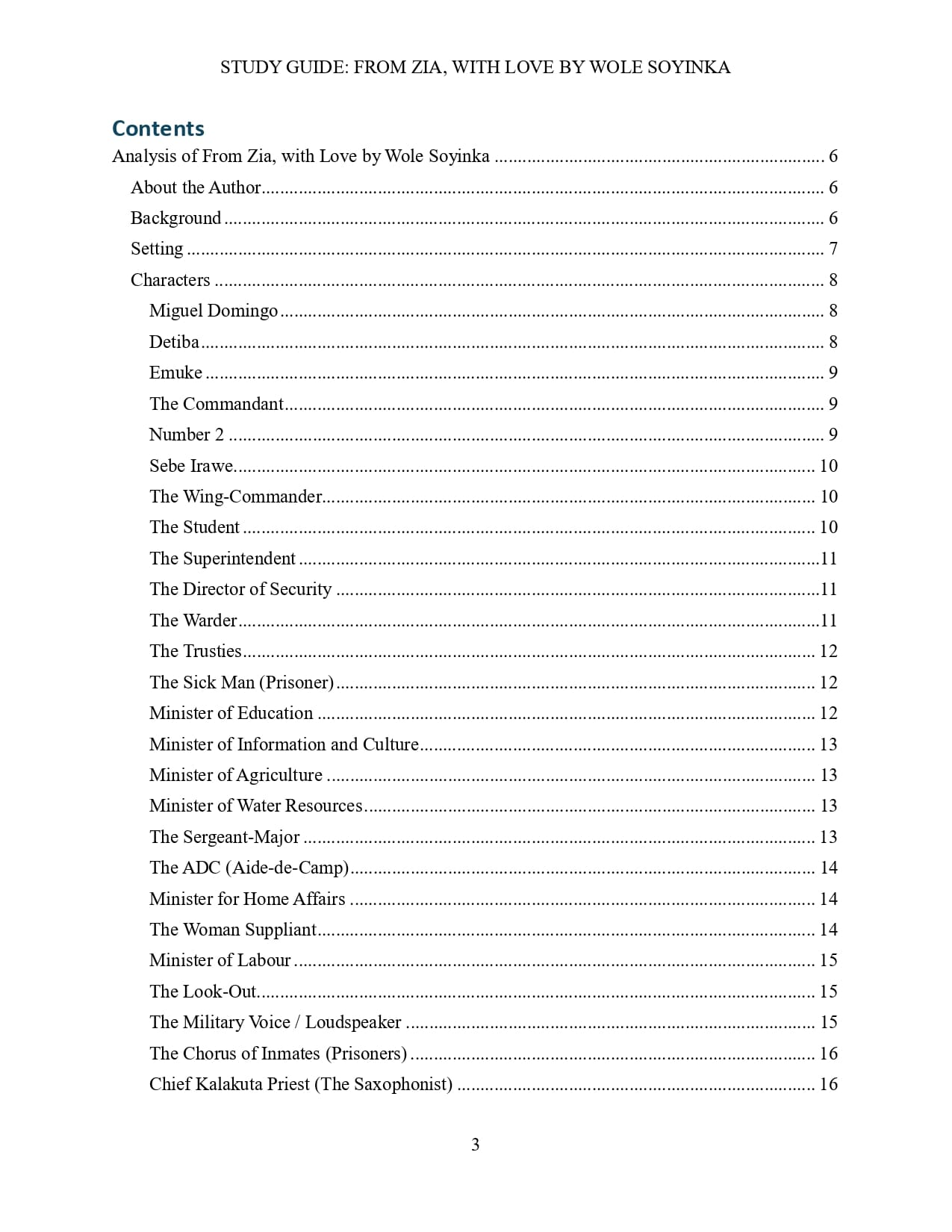
Get the Full Analysis in PDF
Enjoying this breakdown? What you’re reading is just part of the full experience. The premium PDF edition brings everything together in one seamless, distraction-free document that has the background, setting, plot summary, act summary and analysis, dramatic devices, characters, and themes. If you’re studying seriously, this is the version you’ll want.
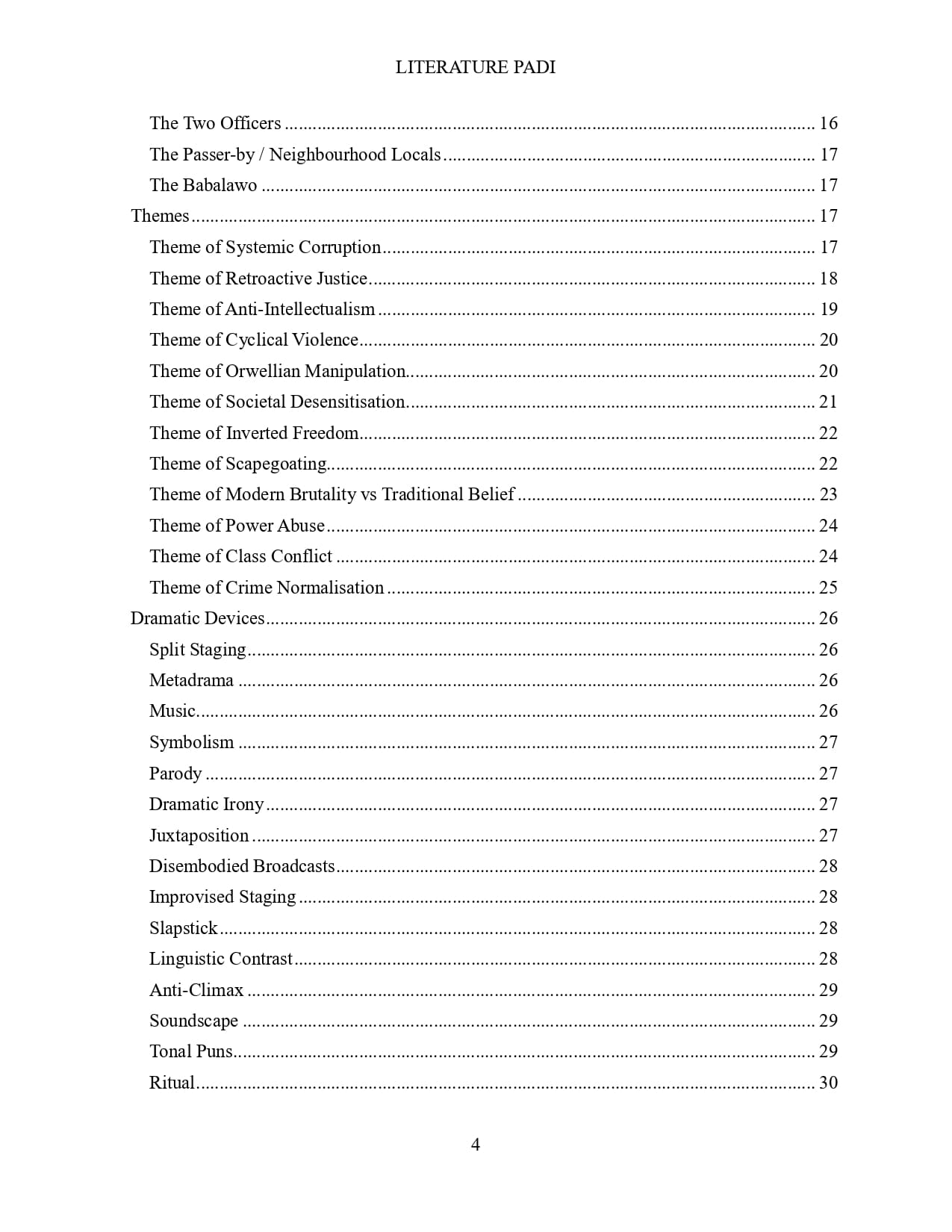
Theme of Anti-Intellectualism
Both the actual military junta and its criminal counterpart in the prison view academic institutions, critical thinkers, and educated citizens as direct threats to their power. This deep-seated paranoia is vividly embodied by the General Cell’s Commandant, who violently rejects the idea of returning the country to civil rule or a democracy. During a volatile mock cabinet meeting, the Commandant explodes in a manic rant against academia. He complains about “the damned universities where they have six professors per department” who “only profess, they do not teach.” He fiercely warns his Director of Security, Major Awam, not to “play your university games with me.” In other words, his authoritarian mind equates intellectualism with subversion and deceit. The Commandant further expresses an intense, violent hatred for political dissidents. He dismisses human rights advocates, “radicals,” and “bleeding hearts” as mere “Eunuchs! Impotents! Incompetents! Agitators!” who have no right to question the army’s eternal revolution.
This anti-intellectual aggression is also physically weaponised against the educated political detainees. When Miguel Domingo, a wealthy and educated “colonial aristocrat,” fails to understand the absurd, unwritten rules of the prison gang, the Commandant mockingly calls him “uneducated” and accuses him of lacking “culture”. He then orders his Sergeant-Major to deliver a “barrage of slaps” to Miguel; he perversely frames this brutal physical assault as a necessary “education” for the intellectual elite. Similarly, the mock Minister of Education haughtily lectures Miguel, expressing disappointment that an “educated man” could be so ignorant of their violent bureaucratic protocols.
Outside the prison walls, the high-ranking Wing-Commander displays an identical disdain for academic and philosophical debate. When the crime lord Sebe Irawe asks him to explain the moral difference between various global dictators, the Wing-Commander dismissively tells him to pose the question to his “garrulous eggheads.” In other words, the officer reduces intellectual inquiry to a useless, bothersome pursuit. He also mocks Sebe’s critical questioning by telling him he is “beginning to sound like all these university types,” which further proves that the ruling junta despises any form of analytical thought.
Finally, the state’s anti-intellectual crusade extends to the violent suppression of artistic expression, as seen when the military brutally silences a saxophonist identified as the “Chief Kalakuta priest,” who represents the real-life dissident intellectual and musician Fela Kuti. The Wing-Commander orders his goons to “muffle his Afro-beat,” explicitly declaring that “no air-wave may vibrate except to army symphony,” which perfectly encapsulates the regime’s desire to eradicate all independent thought, critical discourse, and intellectual freedom through brute force.
Theme of Cyclical Violence
The theme of cyclical violence is portrayed as an endless, inescapable loop of political instability, military coups, and state-sponsored executions that plague post-colonial African nations. This destructive cycle is most explicitly discussed through the character of Emuke, who recounts his past experiences as a deckhand in Ghana witnessing the bloody aftermath of successive military takeovers.
Detiba explains that the initial trigger for this violence was severe civilian corruption. He claims that the Ghanaian government had secretly sold off nearly one-third of the nation’s cocoa harvest and deposited the wealth into overseas accounts. However, the military’s violent response did not solve the systemic issues, as the subsequent juntas simply “lined up and shot” people after the “second coup. Or third. Or fourth.” He critically observes that the infamous “Ghana bloodbath” did not actually target the truly guilty, but was instead used by the armed forces arbitrarily to “settle old scores” under the guise of national redemption.
The play highlights that the failures of civilian politicians act as the direct catalyst for this cyclical bloodshed, with Detiba pointing out that civilian mismanagement is exactly “what leads the army into temptation” to seize power violently. Emuke cuts to the heart of the tragedy with his argument that soldiers have no business running governments. According to Emuke, “make soja man change to civilians if ‘e wan do gov’men.” He further laments that the nation is permanently trapped oscillating between “civilian mess and soja mess.” Both forms of leadership rely on corruption and brutality that continuously “dabaru [ruin] nonsense” for the common man.
The Nigerian military junta perpetuates this cycle of violence in the play’s present timeline by utilising retroactive decrees to legally murder citizens to ensure that the state’s machinery of death is never idle. The ideological justification for this ongoing violence is drawn directly from other global dictatorships like the one of Pakistani General Zia.
Theme of Orwellian Manipulation
The theme of Orwellian manipulation is woven into the very fabric of the military dictatorship in the play. It functions through extreme language distortion, state propaganda, and the terrifying weaponisation of the law. The regime forces a profound state of doublethink upon the populace by broadcasting incessant, moralistic propaganda while its highest officials engage in the exact crimes they publicly condemn. For example, a hidden loudspeaker constantly blares decrees demanding citizens support the “Battle Against Indiscipline” and expose drug dealers to “protect the soul of your fatherland”. This rhetoric acts as an Orwellian smokescreen, explicitly designed to distract the public while leaders like the Wing-Commander use diplomatic channels to smuggle cocaine into the country.
Besides, the dictatorship distorts language to sanitise its absolute tyranny and mimic transparency. In the General Cell, the criminal Commandant perfectly parrots the state’s twisted reality, as he shouts in synchronisation with a military radio broadcast that his squalid, violent prison cell is actually a “paradise before the apple of knowledge” and an “open government” with “nothing to hide.”
The most terrifying form of Orwellian control in the play is the regime’s use of retroactive justice, which effectively allows the state to rewrite history and alter objective reality to eliminate any perceived enemies. This legislative tyranny makes past misdemeanours that originally carried a maximum sentence of only seven years now punishable by firing squad. It allows the state entirely abolish the concept of civilian innocence in what is reflective of the terrifying reality-control seen in Orwell’s 1984.
Theme of Societal Desensitisation
Societal desensitisation is illustrated by how prolonged exposure to brutal military dictatorship completely commodifies human suffering and normalises state-sponsored violence. Inside the General Cell, the normalisation of suffering is immediately apparent in how the hardened inmates treat a dying man. As a sick prisoner shivers and continuously coughs near the cell door, the mock Minister of Health coldly reduces him to a bureaucratic statistic, predicting his death by morning and stating it is “too late” unless he is taken to a hospital. The Commandant further dismisses the tragedy of a deadly prison epidemic that has already claimed seven lives by callously defining the situation as a “model patient… condition critical but stable.”
Furthermore, the military regime and its desensitised citizens treat profound human trauma as mere theatrical entertainment. When the terrified political detainees arrive in the cell, the Commandant forces them to perform their “curriculum vitae.” He demands that they sing, dance, or preach the agonising details of their crimes in “juju, talazo, fuji or disco style” for the amusement of the gang. He proudly likens his role as an interrogator to the late theatrical maestro Hubert Ogunde, as he entirely erases the solemnity of the men’s impending executions for personal entertainment.
This institutional desensitisation extends to the prison warders, who view the final hours of the condemned exclusively as an opportunity for financial extortion. For instance, the corrupt warder Amidu attempts to negotiate a bribe simply to deliver Miguel’s final farewell letter to his mother. He has absolutely no empathy for the grieving family. In an even more grotesque display of exploitation, this same warder attempts to sell the terrified men a counterfeit bandufu invisibility charm for twelve thousand naira.
The absolute climax of this thematic desensitisation occurs in the play’s epilogue, immediately after Miguel, Detiba, and Emuke are marched out to be slaughtered. Three privileged prisoners, known as Trusties, instantly enter the vacated cell armed with buckets and scrubbing brushes to ruthlessly scavenge the dead men’s discarded belongings. The scavengers are utterly numb to the state-sponsored murder of innocent citizens; instead, they treat the execution merely as a disappointing business venture. The Third Trusty discovers a twenty-naira note in a shirt collar and chillingly remarks that he doesn’t mind the bullet holes in the victims’ clothes because “holes can be mended,” but complains only that “it’s having to clean off all that blood.” Here portrayed is a society where citizens bicker over the bloody clothes of the executed rather than rebelling against the injustice of their deaths.
Theme of Inverted Freedom
The theme of inverted freedom vividly illustrates how the brutal military dictatorship has transformed the ostensibly free outside world into a perilous, lawless void, while paradoxically turning the maximum-security prison into a twisted sanctuary. The most direct and ironic example of this inversion is the character of the Student, a drug courier who intentionally commits a “slight misdemeanour” to get himself arrested and thrown into gaol simply “for his own safety.” Having double-crossed the lethal cartel run by Sebe Irawe and the corrupt Wing-Commander, the Student realises that the “free” streets of Lagos offer no protection from state-sponsored assassins. This makes for him the squalid prison cell the “safest place to hide.”
For the condemned political detainees like Miguel and Detiba, the outside world is stripped of any true liberty because it operates in what Miguel accurately describes as a “lawless time.” Freedom on the outside is entirely illusory for ordinary citizens because the military’s use of retroactive decrees means a citizen can be entirely law-abiding today but retroactively declared a capital offender and executed tomorrow. Conversely, true, unrestrained freedom in this society is reserved exclusively for the most ruthless criminals and military elites who commit crimes with absolute, unchecked immunity. The playwright underscores this bitter irony through the ‘Song of the Diplomatic Bag,’ which reveals that the only truly free and “sovereign state” is the illicit drug trade operating under the absolute protection of government officials.
There are 1,729 words waiting beyond this point.
You’ve just read part of the themes. What follows is a further 1,729 words that complete this segment. If this portion has been useful so far, the continuation delivers the full thematic analysis. Continue reading to unlock the remaining 1,729 words.
Related:
- Plot Summary and Setting of From Zia, With Love by Wole Soyinka
- Characters in From Zia, with Love by Wole Soyinka
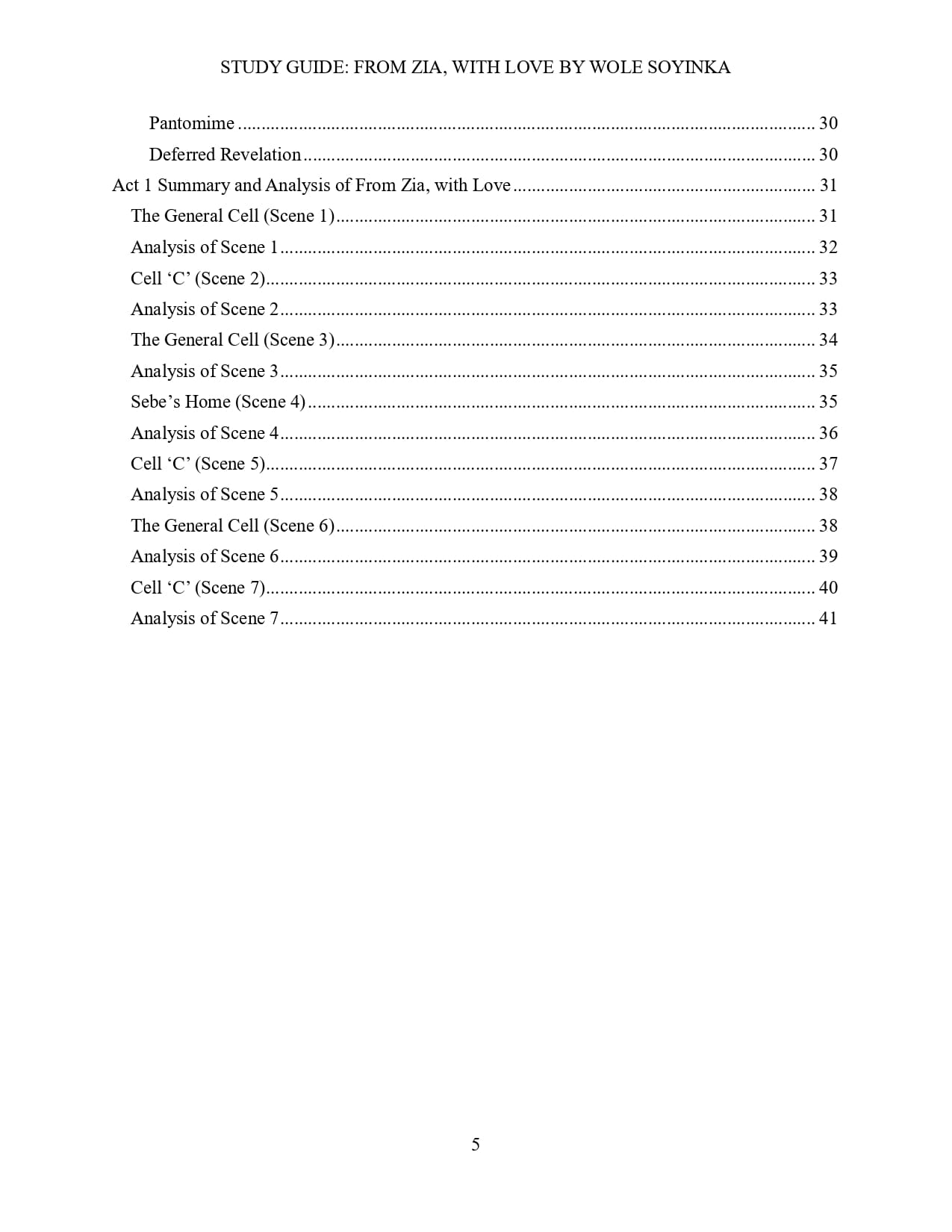
- Act 1 Summary and Analysis of From Zia, With Love by Wole Soyinka
- Dramatic Devices in From Zia, With Love by Wole Soyinka
Receive Literary Updates through our Social Media Channels:
- WhatsApp: Literature PADI
- Telegram: Literature PADI
- YouTube: @literaturepadi
- Facebook: Literature PADI