

Download our SSCE Study Guide Bundle
From Zia, with Love by Wole Soyinka is a continuous, one-act performance that relies on a fluid structure. The play moves seamlessly between locations and realities using lighting changes, musical bridges, and a divided stage. However, the performance can be broken down into seven structural movements whose fluid shifts in location give them the semblance of traditional scenes. We shall rely on this for our sectioned summary and analysis of Soyinka’s play.
The General Cell (Scene 1)
From Zia, with Love opens in a grim, half-arc cell equipped with a makeshift latrine and populated by a mix of hardened convicts, political detainees, and disabled inmates. A burly prisoner known as the “Commandant” sits on a plastic chair, presiding over a mock military “Cabinet” made up of fellow inmates who use broomsticks and planks as weapons. In the corner, three well-dressed newcomers—Miguel Domingo, Detiba, and Emuke—squat uncomfortably, trying to avoid the filthy floor.
The Commandant holds a session to hear reports from his “Ministers.” The Minister of Health reports that an epidemic has killed seven inmates in the last twenty-four hours. The Commandant cynically dismisses the deaths; he concludes that if the situation is predictable, it is “stable,” and stability is necessary for progress.
The “Director of Security” (Major Awam) then delivers his report. He absurdly encroaches on the portfolios of other ministers by discussing religion, food shortages, and public transportation. The Commandant interrupts the bureaucratic squabbling to praise the “water hyacinths”—weeds clogging the local waterways. He argues that the weeds provide an excellent “security barrier” that prevents escapes from waterside prisons like Ita Oko Penal Island.
When the Director of Security reveals he has no new detainees or subversives to report, the Commandant flies into a violent rage. He launches into a tirade against politicians, “radicals,” human rights advocates, and university professors who demand democracy, viewing them all as useless agitators. To relieve his built-up tension, the Commandant literally “explodes,” a theatrical effect achieved by a subordinate popping an inflated paper bag.
The focus shifts when the “Minister for Home Affairs” formally introduces the three newcomers. The Commandant’s men forcefully drag Miguel, Detiba, and Emuke to the centre and beat them to their knees for failing to address the Commandant with proper military protocol. The Commandant demands they present their “curriculum vitae,” a mandatory theatrical re-enactment of the crimes that brought them to prison.
The Commandant proudly compares his own theatrical directing skills to the late, famous maestro Hubert Ogunde. To demonstrate the cell’s “tradition,” the Commandant forces the inmates into alphabetical order and has them perform the “Ode to Commodore Hyacinth.” The inmates perform a parade-ground dance and chant a song comparing the Commandant and themselves to the indestructible, parasitic water hyacinths.
The performance is suddenly cut short by a look-out announcing the arrival of the Superintendent. The inmates instantly blow out the lights and pretend to be asleep. The Superintendent enters and orders Domingo, Emuke, and Detiba to gather their things and come outside. This ends the General Cell sequence.
Analysis of Scene 1
This opening sequence establishes the play’s central satirical device: the prison cell perfectly mirrors the military state outside its walls. The criminal Commandant operates an “Eternal Ruling Council,” in which he assigns portfolios like “Minister of Agriculture” and “Director of Security” to common thugs. They all mimic the vacuous, bureaucratic jargon of the real regime (“situation report,” “counter-subversion,” “stability”). With the violent criminals masquerading as a government cabinet, Soyinka is saying that there is functionally and morally no difference between the state’s military generals and a gang of convicts.
Then, we move to the dialogue which clearly critiques the regime’s twisted priorities. When told that inmates are dying of an epidemic, the Commandant declares the health situation “condition critical but stable” and insists that “without stability, there can be no progress.” This highlights how authoritarian regimes sanitise suffering and prioritise superficial order over human life. Moreso, the Commandant views the choking “water hyacinths” as a positive development because they serve as a natural “security barrier” against escapes. To the dictator, the strangulation of the country’s waterways (and metaphorically, its society) is acceptable as long as it reinforces state control.
The Commandant’s “explosive” tirade is particularly concerning. It reveals the deep-seated paranoia and anti-intellectualism typical of military juntas. He views demands for “civil rule,” “human rights,” and “democracy” as personal attacks. His hatred is specifically directed at “damned universities” and “professors.” His deep-seated hatred, no doubt, mirrors the historical reality that military dictatorships often violently suppress students, academics, and artists who challenge their authority.
Another topical issue worthy of mention in this scene is the theatricality of state violence, as evident in the Commandant’s demand that the prisoners enact their “curriculum vitae.” Apparently, the regime sees justice and human suffering as a form of entertainment. The Commandant considers himself a director; he even compares himself to the famous Nigerian theatrical figure Hubert Ogunde. Moreover, the brutal beating of Miguel and his friends is highly performative; they are slapped and forced to kneel not just for punishment, but to demonstrate the “culture” and “tradition” of the cell to the audience of inmates.
Also inserted in the discussion is the metaphor of the hyacinths, as contained in the “Ode to Commodore Hyacinth” which explicitly links the criminal inmates to the invasive weeds. The song describes them as “unsinkable flotsam,” “rootless,” and “stubbornly green.” They are a “monster from the sea” that “feeds on pollution.” This metaphor suggests that the criminal underworld is a direct by-product of the nation’s rot. The state cannot eradicate the criminals (the weeds) because the systemic corruption and moral decay of the state (the pollution) provides the exact environment they need to thrive.
Cell ‘C’ (Scene 2)
The Superintendent moves the political detainees (Miguel Domingo, Detiba, and Emuke) into Cell ‘C’, a large cell on the other side of the stage. He apologises for mistakenly housing them with the “hard-core criminals”; he explains that the military command utilises Ita Oko because its lagoon setting makes it the regime’s most secure prison. He then offers them the choice of a reading material, games, or a confiscated Scrabble set to make them comfortable.
Suddenly, a hidden loudspeaker comes to life, broadcasting a propaganda message from a “Military Voice.” The voice rails against smuggling, corruption, and drug trafficking. It labels them as economic sabotage and treason. It goes on to urge citizens to support the “Battle Against Indiscipline” (BAI) and to expose dealers to protect the nation.
Once the guards leave, the three men discuss the shocking outcome of their tribunal. Emuke bitterly notes the absurdity of their situation: they committed a crime, were arrested, and even granted bail under laws where the penalty was relatively light (a maximum of seven years). However, while they were navigating the legal system, the regime introduced a new decree making their crime a capital offense, applied retroactively. Detiba likens this to a football game where a referee suddenly changes the rules halfway through the match, deciding that a corner kick taken ten minutes ago is now a penalty kick. Miguel is paralysed by the reality that he might be put before a firing squad; he notes that he had driven past the prison walls countless times without any premonition that he would end up trapped inside.
The men look out the sole window of their cell at the lagoon, which is heavily choked by invasive water hyacinths. They discuss how the weeds have stopped all motor-boats and made navigation impossible, cutting off the prisoners from seeing the fishermen and normal life outside. They spot a lone paddler in a canoe attempting to break through the thick weeds. Detiba and Emuke excitedly cheer the paddler on; they consider his struggle as a sign of hope. However, the paddler eventually gives up and turns back. Miguel watches him fail and bleakly concludes, “We are all trapped where it will never happen. And if it does, we won’t be here to see it.” The scene ends as the light fades in Cell ‘C’ and shifts back to the General Cell.
Analysis of Scene 2
Detiba’s football metaphor is the ideological core of the play’s critique of the regime’s “Military Time-Machine.” His comparison of the retroactive law to a referee changing rules after a play has already happened exposes the absolute absurdity and unfairness of the dictatorship. The state claims to be fighting “indiscipline,” but their manipulation of the law demonstrates that the regime itself operates outside of any legal or moral boundaries. As Emuke notes, there is “no proper foul,” which means the state has violated the fundamental social contract.
This section highlights the class dynamics of the prisoners. Emuke, who speaks Pidgin and represents the working-class hustler, is resentful of being grouped with a wealthy “tycoon” like Miguel. He points out that typically the rich use their money and connections to escape justice while the “petty criminal” suffers. However, Detiba rightly points out, “We are all in the same boat”. The brutality of the military dictatorship is thus a grim equaliser; its retroactive decrees are so absolute that they strip the wealthy and educated of their usual protections, and trap them in the same cell as the common man.
The scene also explores the symbolism of the hyacinths and the paddler. The water hyacinths outside the window are both a physical and thematic symbol. They represent the choking, systemic corruption of the nation that has paralysed the society—just as the weeds have stopped the boats. The lone paddler struggling against the weeds symbolises the futility of individual resistance against the overwhelming force of the state’s oppression. When the paddler gives up and turns back, the cheering inside the cell turns from “optimism to defeat,” which mirror the political detainees’ realisation that there is no escape from their own impending doom. Miguel’s final, despairing realisation that they are “trapped” cements the tragic trajectory of their storyline.
Get the Full Analysis in PDF
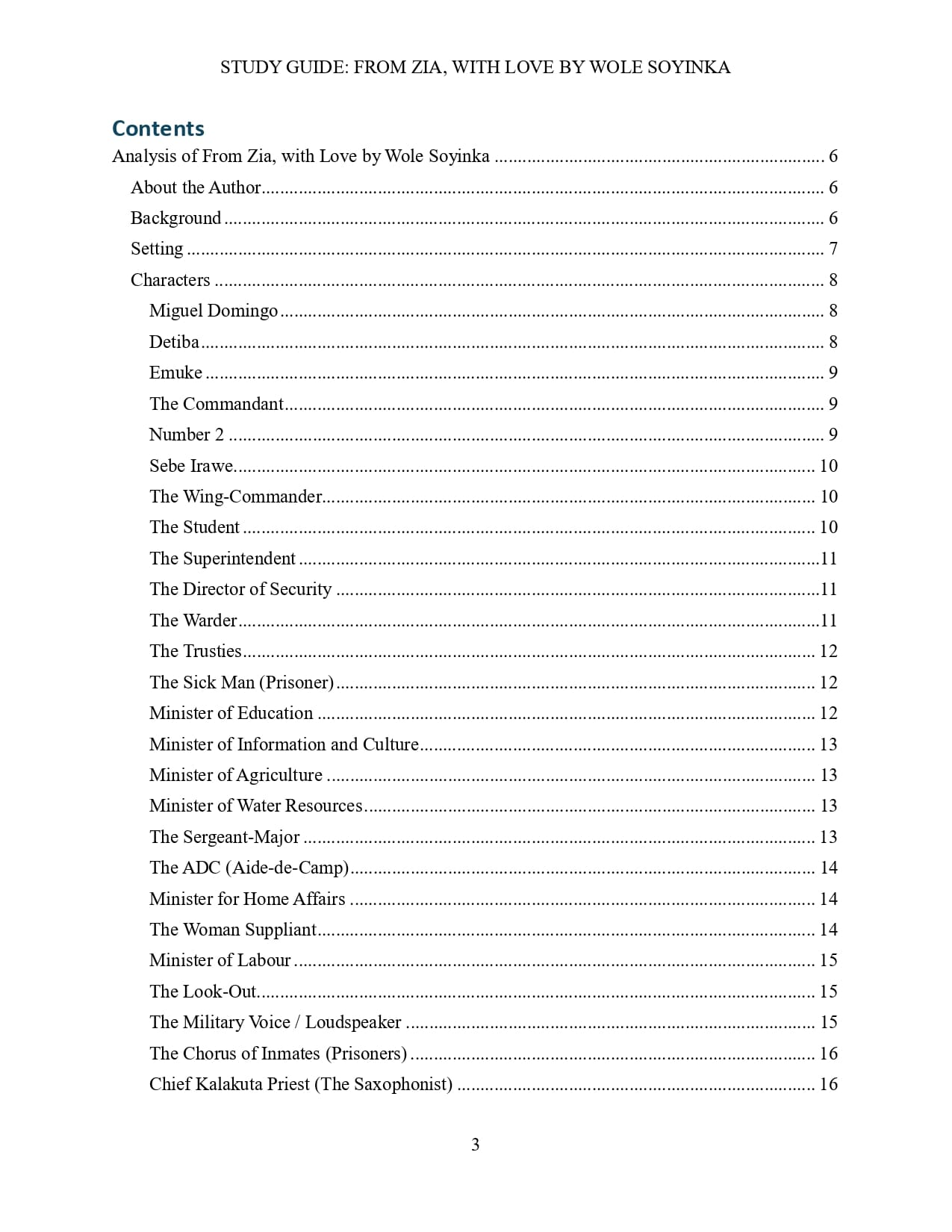
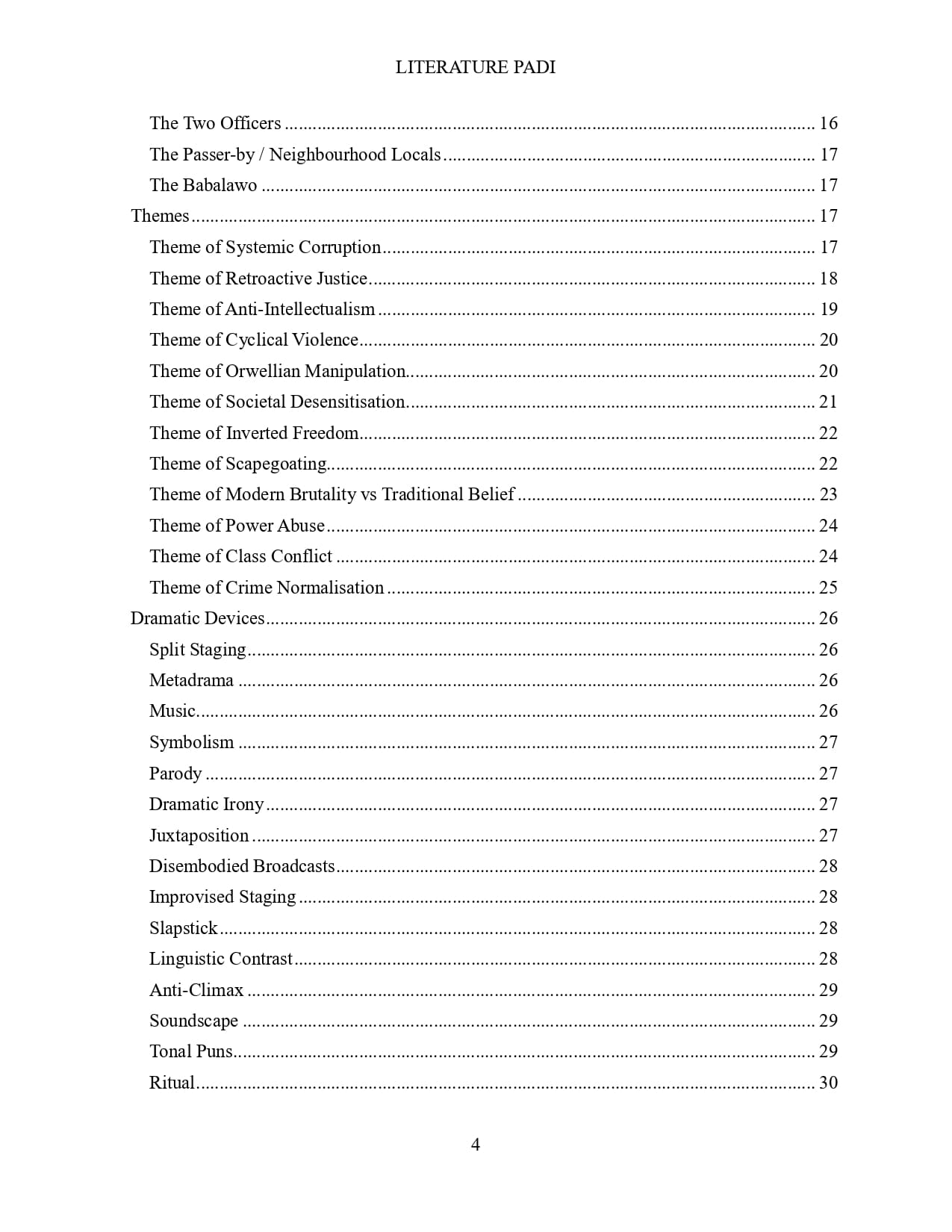
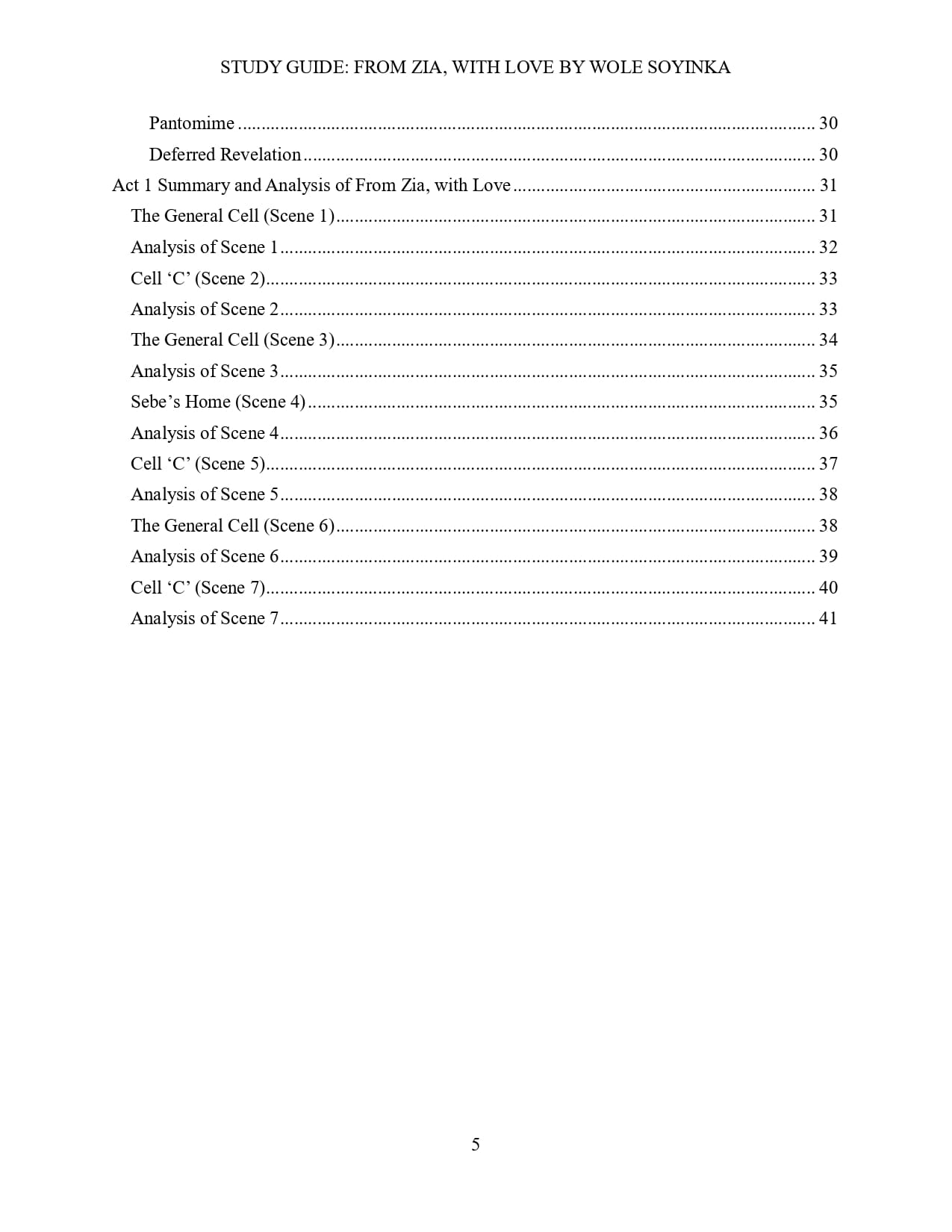
Enjoying this breakdown? What you’re reading is just part of the full experience. The premium PDF edition brings everything together in one seamless, distraction-free document that has the background, setting, plot summary, act summary and analysis, dramatic devices, characters, and themes. If you’re studying seriously, this is the version you’ll want.
The General Cell (Scene 3)
This scene begins as the light fades out in Cell ‘C’ and a “Military Voice” begins broadcasting over the prison loudspeakers. The voice spouts state propaganda; it defines the national goals as “discipline,” “self-reliance,” and “vigilance” while condemning drugs as the “bane of society.”
Simultaneously, the lights come up in the General Cell to reveal the Commandant haranguing his inmates “in sync” with the military broadcast. His booming voice drowns out the speakers as he demands that every citizen must present their “curriculum vitae” to justify their right to exist in the cell. He absurdly describes his squalid, brutal prison domain as “paradise before the apple of knowledge.” He claims they run an “open government” with “no skeletons in the cupboard” and “no dirty linen in the wash.”
The ADC announces that a prisoner known as the “Student” is ready to present his curriculum vitae. The Commandant playfully demands extra payment for his improvised prologue, which he refers to as an “opening glee.” He once again boasts about his theatrical pedigree. He claims that the late, famous Nigerian theatre maestro Hubert Ogunde used to drill them to perfection. At the Commandant’s cue, the inmates break into a quick, choreographed “Ogunde-style” jig and chant.
“Number 2” interrupts the performance with his warning to the Commandant that if they do not begin the actual CV soon, they will not finish before the prison’s general inspection. Yielding the floor, the Commandant points at the Student and chuckles, as he reveals a bizarre twist to the inmates: the Student “got himself arrested and gaoled for his own protection.”
As the Commandant speaks, the other inmates begin to prepare the “set.” They use simple prison props (a loose Dansiki over a wrapper, a touch up of eyelashes, and the stuffing of rags into shirts to simulate breasts) to transform themselves into the characters of the Student’s past. The scene then seamlessly dissolves into the Student’s enactment; it shifts the setting to the home of the crime lord Sebe Irawe.
Analysis of Scene 3
The most striking dramatic technique in this scene is the Commandant speaking “in sync” with the Military Voice. The playwright literally has the criminal gang leader mimic the state’s propaganda broadcast to cement the central satire of the play: there is no ideological or moral difference between the military regime and the criminal underworld. Both use the exact same empty, bureaucratic jargon (“open government,” “discipline”) to mask their violent, absolute control.
Moreover, this brief sequence is heavily laden with dark irony regarding the nature of freedom and captivity. First is the depiction of the cell as paradise. The Commandant calls the General Cell “paradise before the apple of knowledge.” This implies that in a dictatorship, the ideal state of being is utter subjugation and ignorance. The state views a locked cage where no one can question authority as a utopia. Second is the portrayal of prison as sanctuary. Again, the Commandant reveals that the Student got himself thrown in jail “for his own protection.” This flips the entire concept of a penal system on its head. It suggests that the “free” world outside run by corrupt military officers and ruthless crime lords is so lawless and deadly that a maximum-security prison cell is the only safe place left in the country.
More significantly, the Commandant’s obsession with presenting the CV as an “opening glee” and his tribute to Hubert Ogunde deepen the play’s use of metatheatre (a play-within-a-play). Hubert Ogunde was a real-life pioneer of Nigerian theatre who used his art to criticise the government (and was himself a political prisoner, as referenced earlier in the play). By having the Commandant appropriate Ogunde’s “can-can style choreography” for a forced prison confession, the play highlights how the regime twists and corrupts even the nation’s culture and art for its own amusement. State violence is thus treated as a theatrical spectacle.
Structurally, this scene acts as a masterful transition. Instead of dropping a curtain to change scenes, the play uses the prisoners themselves to build the next reality. The inmates pulling on rags and wrappers to become women or crime lords allows the narrative to fluidly transport the audience from the immediate despair of the prison directly into the flashback that explains why the characters are in this situation. It reinforces the non-naturalistic, highly theatrical style of the production.
Sebe’s Home (Scene 4)
The prison enactment fluidly dissolves into the external world. It establishes the setting of Sebe Irawe’s home, which is furnished with gaudy covers and armchairs. Sebe, a notorious underworld kingpin, treats his criminal enterprise like a legitimate, bureaucratic business. A “Woman” visits him, acting as a suppliant trying to recover her aunt’s stolen property. Sebe calmly explains that “everyone knows I keep regular hours” and extorts a massive fee of ten thousand from her to “find” the goods. This extortion demonstrates his complete control over the local thievery.
The scene escalates when the “Student” arrives. He attempts to placate Sebe by piling money on the windowsill. Instead of accepting it, Sebe viciously attacks the young man, grabbing him, shoving his head back, and stuffing the money into his mouth to choke him. Sebe interrogates the Student about a missing “package.” It is revealed that the Student acted as a drug mule for Sebe’s syndicate to deliver a consignment to Milan, but conspired to split the package with an accomplice who was subsequently caught. During this torture, Sebe forces the Student to acknowledge his full name, “Sebe Irawe,” explaining that irawe refers to leaves on the ground or covering the lagoon, under which a deadly snake hides.
A corrupt, high-ranking military officer—the Wing-Commander—arrives in civilian clothes. He demands from Sebe an update on the missing package, which is revealed to be 50 kilograms of prime-grade cocaine. The Wing-Commander explains that he personally secured the drugs during a “VIP” diplomatic trip to Pakistan, in which he had to negotiate directly with government officials.
This leads to a chilling discussion where the Wing-Commander expresses profound admiration for General Zia (the dictator of Pakistan). He praises Zia for ignoring international protests and hanging a former Prime Minister (Zulfikar Ali Bhutto) after arranging a “fair trial” under newly applied Islamic Law. The Commander and Sebe casually discuss how military regimes can change laws overnight to suit their business needs and create “stability” through absolute terror.
The Wing-Commander reveals that the cocaine was smuggled back to Nigeria as a “fraternal gift” of a thousand bags of fertiliser, which completely bypassed customs inspections. He also boasts about how his syndicate previously covered their tracks during a Scotland Yard bust in London by using an incendiary device to burn a diplomatic bag full of marijuana. Suddenly, they hear a noise and realise the Student has been eavesdropping on their entire conversation. Sebe threatens to kill him, but the Student runs off. The Student explains why he later chose to get himself arrested and thrown into the maximum-security prison “for his own protection” from Sebe and the military.
Analysis of Scene 4
This scene provides the ideological core of the play and directly explains its title. The Wing-Commander’s admiration for General Zia’s ruthless manipulation of the law to execute a political rival serves as a blueprint for the Nigerian junta. The Wing-Commander notes that Zia “applied Islamic Law, and that is constant,” using it to justify retroactively hanging Bhutto. This directly parallels the Nigerian regime’s use of retroactive decrees to execute the political detainees in Cell ‘C’. The play suggests that authoritarian tactics and the disregard for human life are “gifts” shared among global dictators—imported from Pakistan to Nigeria, with love.
It also captures the hypocrisy of the military elite and the regime’s “War Against Indiscipline,” which the Wing-Commander perfectly embodies. He is a senior member of the “Eternal Ruling Council,” the very body broadcasting propaganda about rooting out “drug dealers” and “economic saboteurs” to protect the nation. Yet, he uses state resources (presidential diplomatic missions and “Operation Feed-the-Nation” fertiliser bags) to smuggle 50 kilos of cocaine. Apparently, the military does not want to eradicate crime; they want to monopolise it.
Notably, Sebe’s lecture on his name, “Sebe Irawe” (leaves that hide a deadly snake), expands upon the play’s central metaphor of the water hyacinths. Just as the weeds choke the lagoon, Sebe thrives in the city’s rot. He explicitly tells the Student that the government cannot rid the waterside of weeds because they thrive on the “excrement which they flush into the lagoon.” Sebe is pointing out that the criminal underworld (the snake under the leaves) is entirely sustained by the moral and structural filth (the corruption) created by the ruling class.
The scene sheds light on the bureaucratisation of crime. The interaction between Sebe and the Woman highlights the tragic normalisation of lawlessness in the society. The Woman does not go to the police to find her stolen goods; she goes directly to the crime lord, pays a set fee, and treats the transaction like a standard bureaucratic process. Sebe notes that even when people report things to the police, “the police send people to us.” This illustrates a failed state where the criminal syndicate is more organised, reliable, and institutionally powerful than the actual government.
Then, there is the illusion of hope, represented by the Student’s trajectory. It demonstrates the inescapable nature of the regime’s corruption. The outside world is run by murderous drug lords who sit on the Ruling Council. That a citizen must go to a squalid prison just to survive provides Soyinka the right opening to brutally satirise the idea of “freedom” in a dictatorial state.
There are 2,455 words waiting beyond this point.
You’ve just read part of the act summary and analysis. What follows is a further 2,455 words that complete this segment. If this portion has been useful so far, the continuation delivers the full act summary and analysis. Continue reading to unlock the remaining 2,455 words.
Related:
- Plot Summary and Setting of From Zia, With Love by Wole Soyinka
- Characters in From Zia, with Love by Wole Soyinka
- Themes in From Zia, With Love by Wole Soyinka
- Dramatic Devices in From Zia, With Love by Wole Soyinka
Receive Literary Updates through our Social Media Channels:
- WhatsApp: Literature PADI
- Telegram: Literature PADI
- YouTube: @literaturepadi
- Facebook: Literature PADI