

Download our SSCE Study Guide Bundle
Plot Summary of To Kill A Mockingbird
To Kill a Mockingbird by Harper Lee is a novel that follows the story of young Scout Finch and her brother Jem as they are forced to confront the deep-seated racial prejudices and hypocrisies of their community, when their morally upright father, Atticus, takes on the controversial task of defending Tom Robinson, a Black man falsely accused of a terrible crime. As the case progresses against the background of their fascination with their mysterious, reclusive neighbour, Boo Radley, the children learn the importance of empathy and understanding others by looking at the world from their perspective.
The novel is set in the sleepy town of Maycomb, Alabama, during the Great Depression. It begins during summer with the children and their imaginative summer friend Dill becoming fascinated by their reclusive neighbour, Arthur “Boo” Radley, a man heavily shrouded in town gossip who is described as a “malevolent phantom.”
Initially, the children spend their summers acting out superstitious dramas about the Radley family and daring each other to approach the house. Soon, however, Jem and Scout begin discovering small, mysterious treasures (chewing gum, polished Indian-head pennies, soap dolls carved in their exact likeness, a spelling medal, and a broken pocket watch) hidden in the knot-hole of an oak tree on the Radley property. This silent, benevolent communication abruptly ends when Boo’s older brother, Nathan, cruelly fills the hole with cement. As the children mature, their fear of Boo transitions into curiosity and empathy, especially after Miss Maudie’s house catches fire on a freezing winter night and an unseen Boo slips a warm blanket over Scout’s shoulders.
Concurrently, Atticus shapes his children’s moral compass. He teaches Scout the novel’s most important lesson: you never really understand a person until you “climb into his skin and walk around in it.” He also warns them that it is a “sin to kill a mockingbird” because the birds do no harm; they exist only to make music for people to enjoy. Atticus further demonstrates true courage by forcing Jem to read to their vicious, racist neighbour, Mrs. Dubose, as she bravely battles a morphine addiction before her death. With this, he tries to teach his young son that courage is “when you know you’re licked before you begin but you begin anyway.”
The town’s social fabric is torn apart when Atticus is court-appointed to defend Tom Robinson, a Black man falsely accused of raping Mayella Ewell, a white woman from a desperately poor, ignorant family. The Finch family faces intense backlash from the town and their own extended relatives. To help the family maintain its dignity and provide a “feminine influence” for Scout, Atticus’s sister, Aunt Alexandra, moves in. On the night before the trial, a lynch mob of local farmers confronts Atticus at the county jail, but the tense standoff is miraculously defused when Scout innocently talks to a man in the mob, Mr. Cunningham, about his son, effectively shaming the men into leaving peacefully.
During the trial, Atticus systematically dismantles the prosecution’s case. He proves that Mayella was beaten primarily on the right side of her face by a left-handed attacker, and then demonstrates to the court that her father, Bob Ewell, is left-handed. When Tom Robinson takes the stand, the court sees that his left arm was completely mangled in a cotton gin when he was a boy, making it physically impossible for him to have committed the brutal assault. Tom testifies that Mayella actually invited him inside, made sexual advances toward him, and that he fled out of sheer terror when her father caught them. Atticus gives an impassioned closing argument reminding the jury that “in our courts all men are created equal.” Unfortunately, the deeply prejudiced, all-white jury convicts Tom in spite of the overwhelming evidence exonerating the man.
After the guilty verdict, Tom Robinson loses all hope in white men’s justice. In prison, he makes a blind charge to climb the prison fence in order to escape. He is shot seventeen times and killed by prison guards in the process. Meanwhile, Bob Ewell is furious that Atticus destroyed his remaining shreds of credibility during the trial. Seeking cowardly revenge, Ewell spits in Atticus’s face and threatens to kill him. He also begins harassing Tom’s widow, Helen, and stalking the presiding judge, John Taylor.
Bob Ewell makes good on his threat on a pitch-black Halloween night when Jem and Scout are walking home from a school pageant, with Scout wearing a cumbersome chicken-wire ham costume. He violently attacks the children in the woods as a retaliation for the humiliation he suffers in the hands in Atticus in the courtroom. In the ensuing life-or-death struggle, Jem’s arm is badly broken, and Ewell attempts to squeeze Scout to death. Suddenly, an unknown figure pulls Ewell away, ends the fight, and carries the unconscious Jem to the Finch house.
When Scout arrives home, she discovers that their silent rescuer is none other than Arthur “Boo” Radley. Sheriff Heck Tate investigates the scene and reports that Bob Ewell is dead, lying under an oak tree with a kitchen knife stuck under his ribs. Although Atticus initially believes Jem killed Ewell in self-defence, Sheriff Tate firmly insists that Ewell fell on his own knife. Technically, he is trying to protect the painfully shy Boo Radley from the destructive limelight of the town’s gratitude. It is obvious that Boo stabbed Ewell to death. Scout fully grasps this moral necessity. She tells Atticus that exposing Boo to the public would “be sort of like shootin’ a mockingbird.”
The novel concludes with Scout gently escorting Boo back to the Radley house. After he goes inside, she turns and looks at the neighbourhood from the exact vantage point of his front porch. She finally masters her father’s lasting lesson about empathy by standing in Boo Radley’s shoes.
Get the Full Analysis in PDF
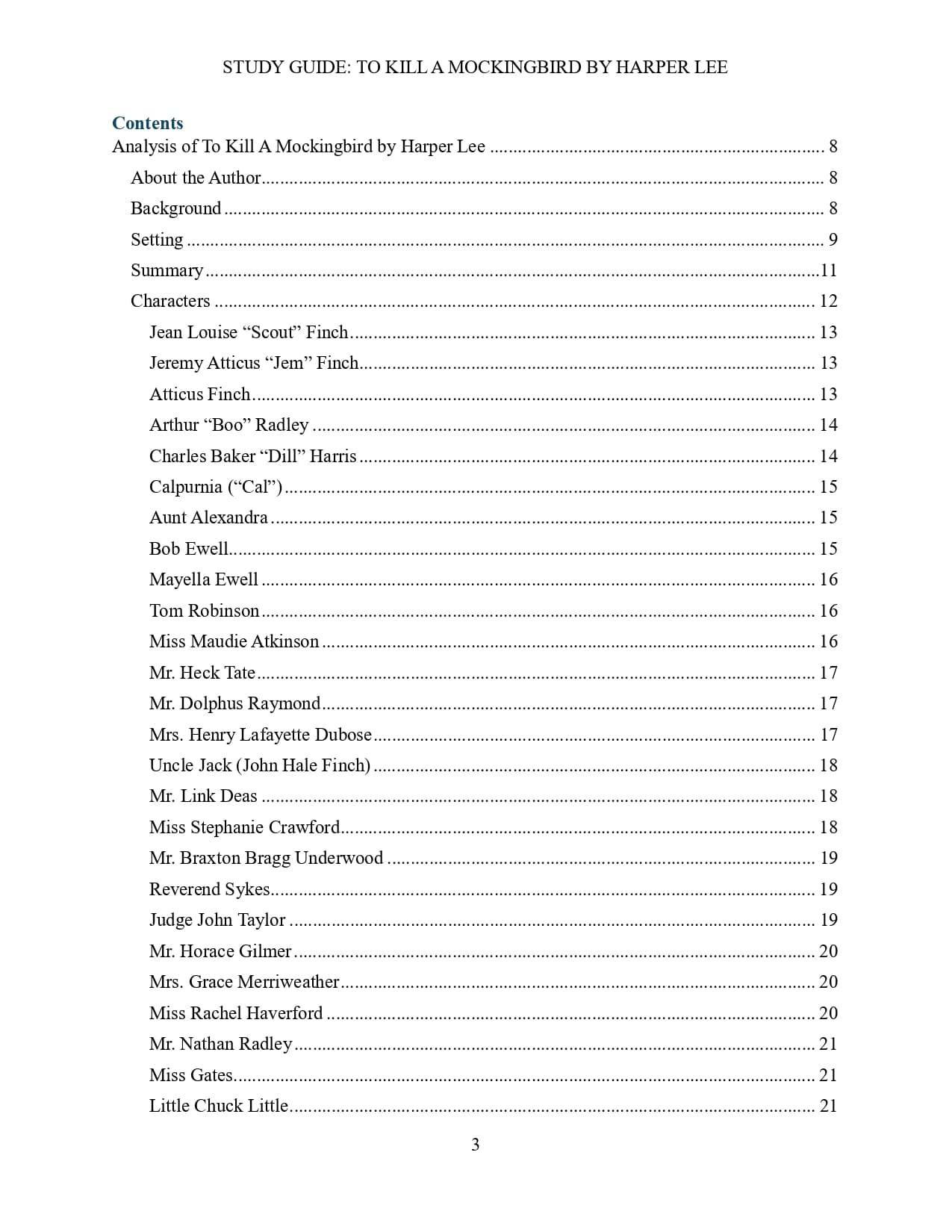
Enjoying this breakdown? What you’re reading is just part of the full experience. The premium PDF edition brings everything together in one seamless, distraction-free document that has the background, setting, plot summary, chapter-to-chapter summary and analysis, narrative devices, characters, and themes. If you’re studying seriously, this is the version you’ll want.




Setting of To Kill A Mockingbird
The novel is set in the fictional, geographically isolated town of Maycomb, located in South Alabama, during the Great Depression of the 1930s. The era’s economic hardship is evident throughout the text: the stock market “crash” has left the local farmers desperately poor, which in turn means professionals like lawyers and doctors are paid in goods like hickory nuts or turnip greens instead of cash. The narrator notes that it is a time of “vague optimism” because the county had recently been told it had “nothing to fear but fear itself,” a direct allusion to Franklin D. Roosevelt’s 1933 inaugural address. Later in the text, historical markers such as the death of the National Recovery Act (NRA) in 1935 further anchor the story in this specific decade.
Maycomb is described as a “tired old town” where the pace of life is incredibly slow because people have “nowhere to go, nothing to buy and no money to buy it with.” The climate is characterised by oppressive heat, where men’s stiff collars wilt by nine in the morning and ladies bathe before noon only to be covered in “frostings of sweat and sweet talcum” by nightfall. In rainy weather, the unpaved streets turn into “red slop.” Historically, the town is situated awkwardly inland, far away from river-boat transportation, because an early tavern owner named Sinkfield deliberately got government surveyors drunk to ensure the county seat was built around his establishment. Because of this isolation, Maycomb grew inward; new people rarely settled there. As a result, the town becomes populated by a static population with a rigid caste system where the same families intermarried for generations.
The protagonists live on the main residential street in the town. To the south lies the Radley Place, a deeply eerie and decaying property that juts into a sharp curve. It features a slate-grey yard, rain-rotted shingles, and great oak trees that keep the sun away. This tree is a physical embodiment of the Radley family’s unnatural isolation. To the north is the home of Mrs. Henry Lafayette Dubose, characterised by its steep front steps and a dog-trot hall, which the children must pass every time they walk to town.
The Maycomb County courthouse is the centre of civic life. Its architecture is a mismatched combination of styles, featuring early Victorian elements, Greek revival columns, and a large nineteenth-century clock tower, because the town stubbornly built around the surviving concrete pillars of an 1856 fire. Adjacent to the square is the Maycomb jail, described as the most “venerable and hideous” building in the county. It is a “miniature Gothic joke” made of red brick and thick steel bars that looks entirely out of place among the town’s conventional stores.
The Ewell family lives in extreme squalor behind the town garbage dump in an old Negro cabin. The cabin is patched together with corrugated iron, its roof is shingled with flattened tin cans, and its windows are covered with greasy cheesecloth. The yard is littered with a chaotic assortment of trash, which include an old Model-T Ford, a dentist’s chair, and rusty tools. The only spot of beauty in this bleak setting is a corner of the yard where Mayella Ewell tends to six chipped-enamel jars holding “brilliant red geraniums.”
Then, there is the First Purchase African M.E. Church, which is located in the “Quarters” outside the southern town limits. It is Maycomb’s only church with a steeple and a bell. It is an ancient, paint-peeled frame building paid for by the first earnings of freed slaves. Inside, it is unpainted and unceiled; it features pine benches for pews and unlighted kerosene lamps along the walls. It is a spiritual sanctuary for the Black community on Sundays, though it is disrespectfully used by white men for gambling on weekdays.
Finch’s Landing is also spotlighted in the novel. Located twenty miles east of Maycomb, this is the Finch family’s ancestral homestead established by Simon Finch. It consists of a large two-storied white house situated at the end of a dirt road near the river. The house’s architecture reflects the strict patriarchal control of the Old South in that it features a separate “Daughters’ Staircase” located inside the parents’ bedroom so the patriarch could strictly monitor his daughters’ nocturnal movements.
About the Author
Nelle Harper Lee, widely known as Harper Lee, was an influential American novelist. She was born on April 28, 1926, in Monroeville. She grew up in a small Southern town whose social environment later inspired the fictional setting of Maycomb in To Kill a Mockingbird. Her upbringing in the American South during a period marked by racial segregation shaped her perspective on justice, morality, and human dignity.
Lee came from a family connected to the legal profession. Her father, Amasa Coleman Lee, was a lawyer and newspaper editor. His career influenced the creation of Atticus Finch, one of the novel’s most respected characters. During her childhood, Lee formed a close friendship with fellow writer Truman Capote, who later became a major figure in American literature.
Lee attended Huntingdon College before enrolling at the University of Alabama, where she studied law. However, she left her studies to pursue a career in writing and moved to New York City. There, she worked various jobs while developing her manuscript, which eventually became To Kill a Mockingbird, published in 1960. The novel achieved immediate success and earned the Pulitzer Prize for Fiction in 1961.
Although she published only one novel for most of her life, Lee’s reputation remained strong because of the novel’s powerful themes of racial injustice, moral courage, and empathy. Her second book, Go Set a Watchman, was released decades later and is considered an earlier draft version of her famous work.
Harper Lee lived a largely private life and never married or had children. She died on February 19, 2016, at the age of 89.
Related:
- Characters in To Kill A Mockingbird by Harper Lee
- Themes in To Kill A Mockingbird by Harper Lee
- Narrative Devices in To Kill A Mockingbird by Harper Lee
- Study Guide: To Kill A Mockingbird by Harper Lee
Receive Literary Updates through our Social Media Channels:
- WhatsApp: Literature PADI
- Telegram: Literature PADI
- YouTube: @literaturepadi
- Facebook: Literature PADI