🎥 We’re cooking something delicious for you on our YouTube channel. In the coming days, you will learn SSCE literature texts like you're in class 📚✍🏽
Be part of this new journey we are about to embark on.
🔔 Subscribe Now
“Still I Rise” by Maya Angelou is written in a simple, conversational diction. It uses everyday words such as “write,” “walk,” “laugh,” and “dance” to allow the message resonate with a wide audience. The poem adopts a direct address, using the second-person pronoun “you” to confront oppressors openly, which makes it sound like a personal challenge rather than a detached reflection. Examined in this section are the figures of speech employed in the poem.
Alliteration
Alliteration is the repetition of initial consonant sounds in closely placed words. Maya Angelou makes effective use of alliteration in “Still I Rise.” Examples include: “may … me” (line 1), “walk … wells” (line 7), “laugh like” and “got gold” (line 19), “dance … diamonds” (line 27), “huts of history” (line 29), “past … pain” (line 31), and “gifts … gave” (line 39). These repeated sounds make the poem musical and draw attention to key ideas like confidence, suffering, and inherited strength.
Assonance
Assonance is the repetition of similar vowel sounds within nearby words. The /i/ sound is repeated in “bitter, twisted lies” (line 2). Then, /ai/ is repeated in “behind nights” (line 35).
Antithesis
Angelou employs antithesis to place contrasting ideas side by side. For example, in lines 3-4, the contrast between being “trod … in the very dirt” and still rising indicates the opposition between oppression and resilience. Similar contrast appears in lines 21-24, where the poet contrasts attempts to destroy the speaker through hatred with the speaker’s unstoppable rise.
Simile
Simile is the comparison between two unlike things using the words “like” or “as.” It is used in the poem to clarify abstract ideas through comparison. The speaker compares herself to “dust” (line 4), “moons and suns” (lines 9), “air” (line 24), and to someone possessing “oil wells,” “gold mines,” and “diamonds” (lines 7-8, 19-20, 27-28). These comparisons depict her resilience and inevitability on one part, and her inner wealth and self-assurance on the other.
Rhetorical Question
A rhetorical question is asked for effect or to make a point, rather than to get an actual answer. Angelou uses rhetorical questions to challenge and confront the oppressor. Questions such as “Does my sassiness upset you? / Why are you beset with gloom?” (lines 5–6), “Did you want to see me broken?” (line 13), “Does my haughtiness offend you?” (line 17), and “Does my sexiness upset you?” (lines 25) do not demand answers but expose the discomfort and insecurity of those threatened by the speaker’s confidence.
Get the Full Analysis in PDF
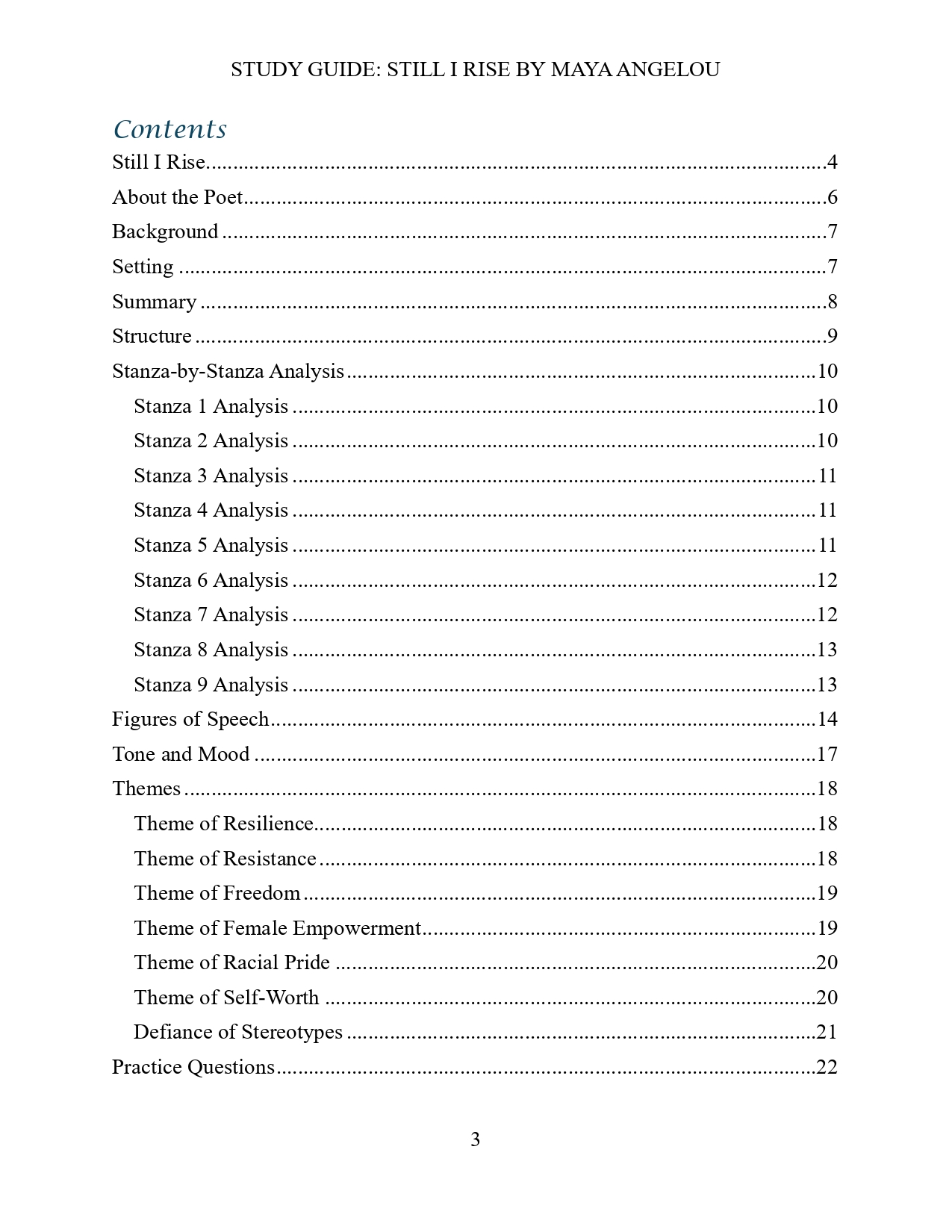
Enjoying this breakdown? What you’re reading is just part of the full experience. The premium PDF edition brings everything together in one seamless, distraction-free document that has the poem, themes, structure, and full commentary. If you’re studying seriously, this is the version you’ll want.
Personification
Personification is used to give human qualities to abstract ideas. In line 11, hope is said to be “springing high,” while in line 29, history is described as possessing shame. These expressions deepen emotional impact and humanise historical suffering.
Parallelism
Parallelism is the use of components in a sentence that are grammatically the same, or similar in their construction, sound, or meaning. The poet employs parallelism through the repetition of similar sentence structures in lines 21–23: “You may shoot me… / You may cut me… / You may kill me….” This structure reinforces the persistence of oppression.
Hyperbole
Hyperbole is an intentional and extreme exaggeration used for emphasis or effect, not meant to be taken literally. This appears in lines 21–23, where the speaker claims she may be shot, cut, or killed by words and hatred. This exaggeration depicts the severe psychological and emotional harm caused by oppression.
Repetition
Repetition is the simple repeating of a word or phrase for emphasis. It is one of the most striking devices in the poem. The repeated expressions “I’ll rise” (lines 4,12, and 24) and “I rise” (lines 30, 32, 36, 38, 41, 42, and 43) are used as refrains to convey the poem’s message of resilience and triumph.
Metaphor
Metaphor is a direct comparison between two unlike things without using “like” or “as.” It states that one thing is another. Examples of metaphor abound in the poem. There is one in line 33, “I’m a black ocean,” where the speaker is representative of collective Black strength. There is another in line 40, “I am the dream and the hope of the slave,” where the speaker represents the fulfilment of ancestral aspirations. In addition to these, a metaphorical expression like “the huts of history’s shame” (line 29) represents slavery and historical oppression.
Apostrophe
Apostrophe is a figure of speech in which the speaker addresses an absent person, an abstract idea, or an inanimate object as if it were present and capable of responding. The poem contains apostrophe through the direct address to “you”, an unnamed but ever-present oppressor. This device creates immediacy and confrontational intensity.
Anaphora
Anaphora is a specific type of repetition where the same word or phrase is repeated at the beginning of successive clauses or sentences. It appears in phrases such as “You may…” (lines 21, 22, and 23), “Does …” (lines 25 and 26), and “I rise” (lines 41, 42, and 43). This technique builds rhythm and emphasis.
Get the Full Analysis in PDF
Enjoying this breakdown? What you’re reading is just part of the full experience. The premium PDF edition brings everything together in one seamless, distraction-free document that has the poem, themes, structure, and full commentary. If you’re studying seriously, this is the version you’ll want.
Allusion
Allusion is a brief and indirect reference to a person, place, thing, or idea of historical, cultural, literary, or political significance. Angelou employs allusion to connect the speaker’s personal triumph to the collective history of Black oppression and survival.
In line 29, “Out of the huts of history’s shame,” the poet alludes to the era of slavery and racial degradation, where enslaved Africans were forced to live in poor, dehumanising conditions. The phrase suggests not only physical hardship but also the shame imposed by an oppressive historical narrative.
Similarly, in line 40, “I am the dream and the hope of the slave,” Angelou alludes to the unfulfilled aspirations of enslaved Africans: their longing for freedom, dignity, and a better future. The speaker presents herself as the realisation of those suppressed dreams.
Receive Literary Updates through our Social Media Channels:
- WhatsApp: Literature PADI
- Telegram: Literature PADI
- YouTube: @literaturepadi
- Facebook: Literature PADI