Quality UTME Lessons for Art Students
Individual and group classes • Student-friendly rates
📞 Contact Ayomiposi on WhatsApp now
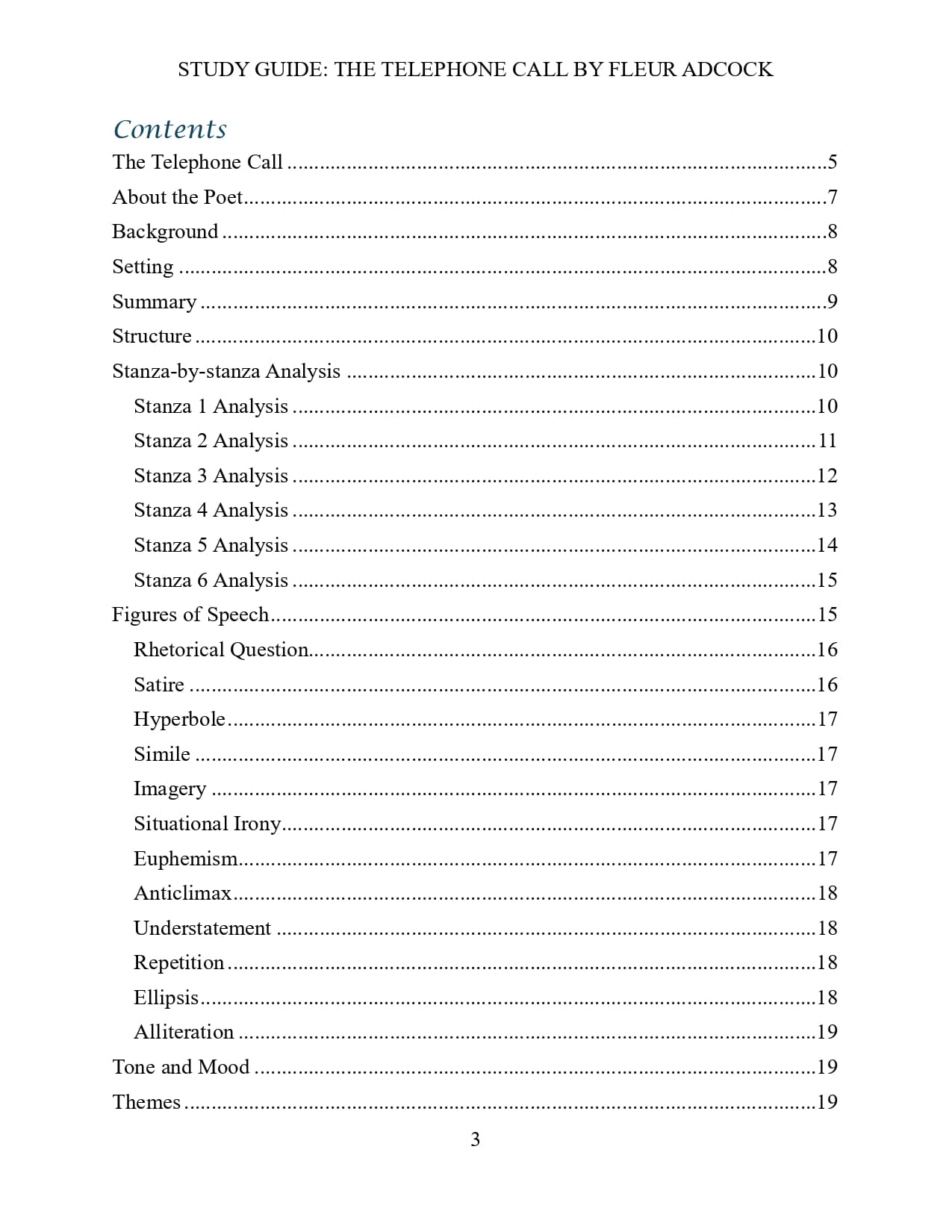
Fleur Adcock employs a range of figures of speech in “The Telephone Call” to dramatise emotional manipulation and expose the cruelty of modern institutional practices. Some of the figures of speech employed in “The Telephone Call” include rhetorical question, hyperbole, simile, and repetition.
Rhetorical Question
A rhetorical question is a question asked not to obtain an answer, but to provoke thought, emotion, or reaction. Rhetorical questions are used throughout the poem to control the speaker’s emotions and thoughts. They can be found in the following lines:
“Are you sitting down?” (l. 1)
“What would you do with a million pounds?” (l. 5)
“how does it feel?” (l. 10)
“You’ve had a great experience, right?” (l. 44)
“Exciting? Something you’ll remember?” (l. 45)
These questions are designed to shock, excite, and direct the speaker’s imagination toward wealth and emotional reaction. They weaken the speaker’s critical thinking and draw her into emotional compliance. The repeated questioning also gives the callers conversational dominance.
Get the Full Analysis in PDF
Enjoying this breakdown? What you’re reading is just part of the full experience. The premium PDF edition brings everything together in one seamless, distraction-free document that has the poem, themes, structure, and full commentary. If you’re studying seriously, this is the version you’ll want.
Satire
Satire is the use of humour, exaggeration, or ridicule to criticise human behaviour or institutions. It manifests in lines 2, 4, and 31-32:
“Universal Lotteries”
“the Ultra-super Global Special”
“Retrospective Chances Module”
These phrases imitate official corporate language but are deliberately absurd. The poet uses bureaucratic diction to mock modern institutions that hide emptiness and deception behind impressive terminology.
Hyperbole
Hyperbole is a deliberate exaggeration used for emphasis or emotional effect. It can be found in lines 14-15: “I feel the top of my head / has floated off, out through the window.” This expression exaggerates the speaker’s reaction. It conveys the speaker’s psychological disorientation.
Simile
A simile is a comparison between two unlike things using “like” or “as.” In line 16, “revolving like a flying saucer” likens the speaker’s imagined floating head to an object associated with speed, confusion, and unreality. The simile reinforces the speaker’s sense of loss of control.
Imagery
Imagery is the use of language that appeals to the senses (sight, touch, physical sensation). The poet employs the use of visual and physical imagery as evident in expressions like “out through the window” (l. 15), “My throat’s gone dry, my nose is tingling.” (l. 19), and “I think I’m going to sneeze – or cry” (l. 20). These bodily sensations translate the speaker’s emotional shock into concrete physical experiences.
Situational Irony
Situational irony occurs when the outcome is the opposite of what is expected. The poem builds expectation around winning a large sum of money, only to reveal that there is no money at all. The speaker “wins” but receives nothing tangible. In this regard, “You’ve won the top prize” (l. 3) is contrasted with “there’s no cheque… We don’t deal in money” (ll. 41-43).
Euphemism
A euphemism is a mild or indirect expression used in place of a harsh or unpleasant truth. It is discernible in line 43: “Experiences are what we deal in.” Here, the callers describe the deception of the speaker as an “experience,” in order to avoid direct acknowledgment of harm. Euphemism is employed to disguise the institutional cruelty of the callers and absolve them of the moral responsibility of fulfilling their material promise to the speaker.
Get the Full Analysis in PDF
Enjoying this breakdown? What you’re reading is just part of the full experience. The premium PDF edition brings everything together in one seamless, distraction-free document that has the poem, themes, structure, and full commentary. If you’re studying seriously, this is the version you’ll want.
Anticlimax
Anticlimax is a sudden shift from high expectation to disappointing reality. It manifests after a sustained emotional build-up centred on the promise of wealth but it is then revealed that “there’s no cheque” (l. 41). This abruptly deflates the speaker’s expectations.
Understatement
Understatement is the presentation of something as less important than it really is. This is deducible from the callers’ polite farewell “Have a nice day!” which follows the emotional devastation they have inflicted on the speaker. This understatement trivialises the serious emotional harm, and makes the callers’ behaviour appear even more callous.
Repetition
Repetition is a figure of speech in which words, phrases, or ideas are deliberately repeated in a poem. This is instantiated in the repeated expressions “go on” (ll. 13 and 17) and “tell us” (ll. 10 and 13). The callers repeat these expressions to ensure control over the conversation and keep the speaker emotionally engaged.
Ellipsis
Ellipsis is more of a stylistic device in the poem. It is employed to show hesitation, pause, emotional strain, or unfinished thought. Ellipses appear in lines 11, 26, and 39:
“I just…I can’t believe it”
“we’ll give you a moment…”
“I still can’t quite…”
The use of ellipsis in the poem reflects the speaker’s mental confusion and the callers’ calculated pauses.
Alliteration
Alliteration is the repetition of initial consonant sounds in closely placed words. It is found in “what would” (l. 5) and “more … million” (l. 6) where /w/ and /m/ alliterate respectively.
Receive Literary Updates through our Social Media Channels:
- WhatsApp: Literature PADI
- Telegram: Literature PADI
- YouTube: @literaturepadi
- Facebook: Literature PADI