Quality UTME Lessons for Art Students
Individual and group classes • Student-friendly rates
📞 Contact Ayomiposi on WhatsApp now
The Telephone Call

They asked me ‘Are you sitting down?
Right? This is Universal Lotteries,’
they said. ‘You’ve won the top prize,
the Ultra-super Global Special.
What would you do with a million pounds?
Or, actually, with more than a million –
not that it makes a lot of difference
once you’re a millionaire.’ And they laughed.

‘Are you OK?’ they asked – ‘Still there?
Come on, now, tell us, how does it feel?’
I said ‘I just…I can’t believe it! ’
They said ‘That’s what they all say.
What else? Go on, tell us about it.’
I said ‘I feel the top of my head
has floated off, out through the window,
revolving like a flying saucer.’

‘That’s unusual,’ they said. ‘Go on.’
I said ‘I’m finding it hard to talk.
My throat’s gone dry, my nose is tingling.
I think I’m going to sneeze – or cry.’
‘That’s right,’ they said, ‘don’t be ashamed
of giving way to your emotions.
It isn’t every day you hear
you’re going to get a million pounds.

Relax, now, have a little cry;
we’ll give you a moment…’ ‘Hang on!’ I said.
‘I haven’t bought a lottery ticket
for years and years. And what did you say
the company’s called?’ They laughed again.
‘Not to worry about a ticket.
We’re Universal. We operate
a Retrospective Chances Module.

Nearly everyone’s bought a ticket
in some lottery or another,
once at least. We buy up the files,
feed the names into our computer,
and see who the lucky person is.’
‘Well, that’s incredible,’ I said.
‘It’s marvellous. I still can’t quite…
I’ll believe it when I see the cheque.’

‘Oh,’ they said, ‘there’s no cheque.’
‘But the money?’ ‘We don’t deal in money.
Experiences are what we deal in.
You’ve had a great experience, right?
Exciting? Something you’ll remember?
That’s your prize. So congratulations
from all of us at Universal.
Have a nice day!’ And the line went dead.

— Fleur Adcock
Reference
Adcock, F. (2000). The telephone call. In Poems 1960–2000. Bloodaxe Books. (Original work published 1974)
About the Poet
Kareen Fleur Adcock (1934-2024) was a New Zealand-born poet, editor, and translator whose work is noted for its conversational clarity, dry wit, and ironic restraint. Much of her poetry grows out of a life lived between New Zealand and Britain, a dual identity that shaped her recurring concerns with displacement, belonging, and emotional independence.
Adcock was born in Papakura, New Zealand. She spent part of her childhood in England during World War II. Then, she returned to New Zealand in her youth, before later settling permanently in London in 1963. Her name is pronounced “Flur Ad-cock.”
Adcock’s personal life intersected closely with literary circles. She was the sister of novelist Marilyn Duckworth. She was also briefly married to the poet Alistair Campbell, before she later married the writer Barry Crump, a turbulent relationship she later reflected on obliquely in her work.
Stylistically, Adcock avoided grand lyricism. Her poems are cool, precise, and quietly subversive. They present everyday situations that end with an unsettling or sharply perceptive turn. Well-known poems such as “Leaving the Tate,” “England’s Glory,” and “Against Coupling” exemplify her interest in art, social class, solitude, and personal autonomy.
Over her career, she published several influential collections, including The Inner Harbour (1979), Poems 1960–2000, Glass Wings, and Collected Poems (2024). She received major honours in both Britain and New Zealand, some of which included an OBE, the Queen’s Gold Medal for Poetry, and an appointment as a Companion of the New Zealand Order of Merit (CNZM).
“The Telephone Call” by Fleur Adcock is cited from Poems 1960–2000, a volume that brings together poems from the poet’s earlier collections. The poem was originally published in The Incident Book, where it first appeared as part of Adcock’s satirical engagement with everyday encounters.
Background of “The Telephone Call”
“The Telephone Call” is a poem by Fleur Adcock. It was first published in the late 20th century, a period marked by the rapid expansion of mass media, advertising culture, and impersonal corporate communication. The poem emerges from, and reacts to, a modern social environment in which human experience is increasingly mediated by institutions, technology, and profit-driven systems.
It draws on a familiar modern scenario: an unsolicited phone call that promises sudden wealth. During the decades in which Adcock was writing, lottery culture, prize draws, and promotional scams were becoming commonplace in Britain and other Western societies. Such calls exploited hope, excitement, and vulnerability among ordinary people dreaming of sudden transformation. Adcock uses this recognisable context to anchor the poem in everyday reality.
However, the poem’s background is also philosophical and ethical. Adcock was known for her sharp, ironic examination of modern life, especially the ways institutions manipulate language and emotion. In this poem, the fictional organisation “Universal Lotteries” represents faceless corporate power with its slick, confident, and emotional manipulation. The callers speak in rehearsed clichés, guiding the speaker’s emotional responses as if following a script.
The poem also reflects post-war disillusionment with grand promises. After decades of political slogans, advertising hype, and bureaucratic systems claiming to improve lives, many writers grew sceptical of abstract rewards and empty assurances. The revelation that the “prize” is not money but a fleeting emotional “experience” satirises a world where genuine material or moral value is replaced by psychological stimulation and corporate spin.
The poem also reflects post-war disillusionment with grand promises. After decades of political slogans, advertising hype, and bureaucratic systems claiming to improve lives, many writers grew sceptical of abstract rewards and empty assurances. The revelation that the “prize” is not money but a fleeting emotional “experience” satirises a world where genuine material or moral value is replaced by psychological stimulation and corporate spin.
Get the Full Analysis in PDF
Enjoying this breakdown? What you’re reading is just part of the full experience. The premium PDF edition brings everything together in one seamless, distraction-free document that has the poem, themes, structure, and full commentary. If you’re studying seriously, this is the version you’ll want.
Summary of “The Telephone Call”
“The Telephone Call” by Fleur Adcock presents a dramatic yet ironic account of a phone conversation in which the speaker is told she has won an enormous lottery prize.
The poem begins with anonymous callers informing the speaker that she has won a “top prize” worth over a million pounds. The callers sound confident, cheerful, and rehearsed, asking if she is sitting down and prompting her to describe how she feels.
Overwhelmed by the news, the speaker reacts physically and emotionally: she is shocked, disoriented, and almost unable to speak. She describes sensations of dizziness, dryness in her throat, and a mixture of tears and disbelief, all of which show how powerfully the promise of sudden wealth affects her.
As the conversation continues, the speaker begins to question the situation. She realises that she has not bought a lottery ticket in years and asks for clarification about the company. The callers calmly explain that tickets are unnecessary because they operate a “Retrospective Chances Module,” claiming they select winners from past lottery records. Although the explanation sounds absurd, the speaker is still drawn in and waits for confirmation in the form of a cheque.
The final twist comes when the callers reveal that there is no money at all. Instead, they claim that the excitement, shock, and emotional upheaval she has just experienced is the real “prize.” Having delivered this revelation, they abruptly end the call, leaving the speaker deflated and exposed.
On the whole, “The Telephone Call” exposes how modern systems manufacture hope, commodify emotion, and discard individuals once the ‘experience’ is complete. The poem is even more relevant in an age of scam calls, phishing, clickbait, and emotional manipulation through media.
Themes in “The Telephone Call”
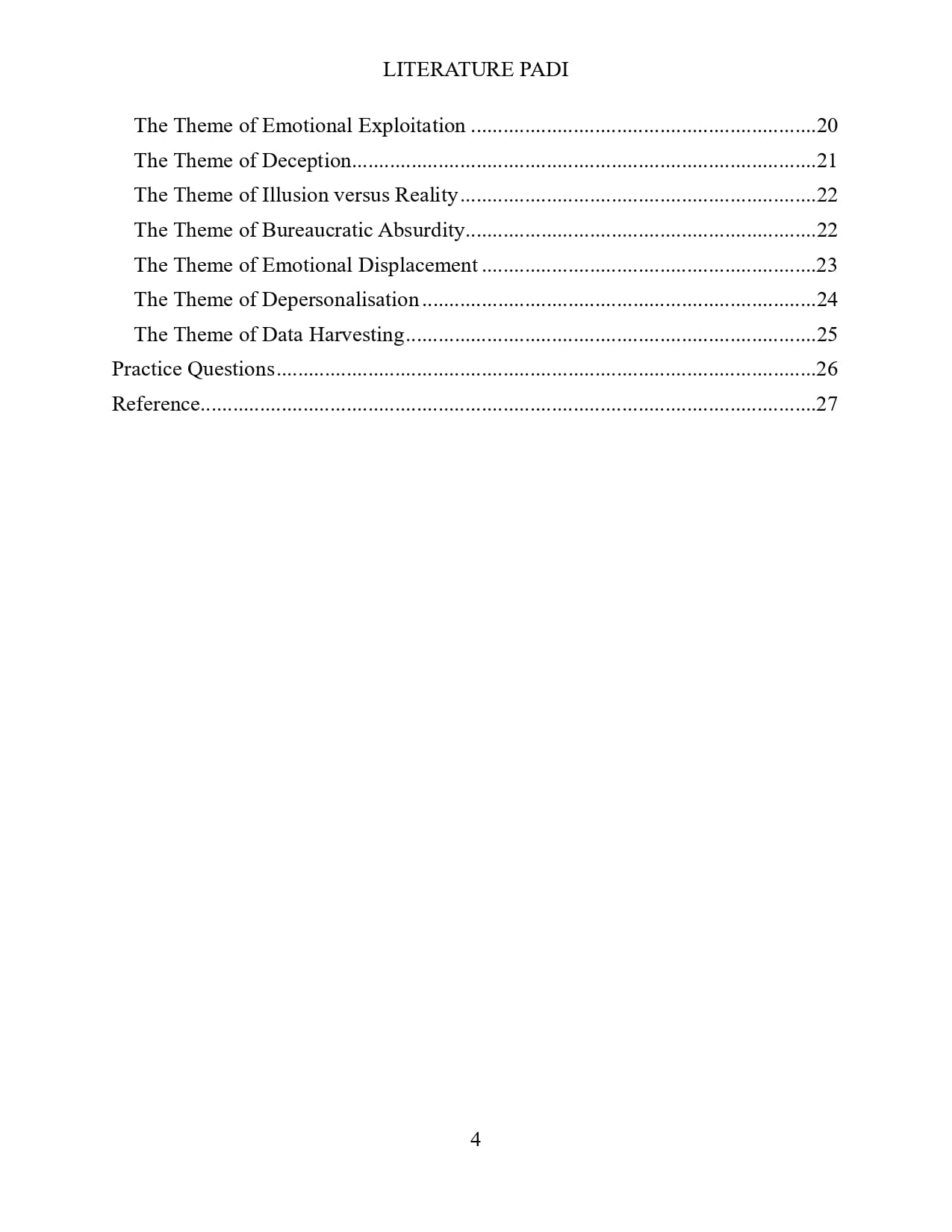
“The Telephone Call” by Fleur Adcock is a modern satirical poem that exposes the dark side of institutional power and communication. It shows how large organisations manipulate people’s emotions, distort their reality, and treat them as mere data rather than human beings. In presenting the speaker’s experience over a simple but disturbing event of a phone call, the poem raises important themes such as deception, illusion versus reality, emotional exploitation, emotional displacement, depersonalisation, bureaucratic absurdity, and data harvesting. The poem also reveals the institutional coldness that results from depersonalisation and bureaucratic routine.
The Theme of Emotional Exploitation
“The Telephone Call” presents emotional exploitation as a deliberate and systematic process through which an institution gains satisfaction while the individual bears the emotional cost. The poem shows that the callers actively engineer, monitor, and finally discard the speaker’s emotions.
From the outset, emotional exploitation is established through the callers’ calculated questioning. The question “Are you sitting down?” (l. 1) is not asked out of concern but as a psychological device to heighten suspense and anxiety. Similarly, “What would you do with a million pounds?” (l. 5) pushes the speaker into emotional fantasy. These questions demonstrate how emotions are provoked before any factual basis is provided.
As the poem progresses, emotional exploitation becomes more explicit. The callers repeatedly demand emotional feedback through lines such as “how does it feel?” (l. 10) and “Go on, tell us about it” (l. 13). This insistence shows that the speaker’s feelings are being treated as a resource to be extracted. Her physical reactions, for example, confirm that the emotional pressure has begun to overwhelm her. She finds herself saying that her “throat’s gone dry … [her] nose is tingling” (l. 19).
The callers’ pretence of sympathy marks a more disturbing stage of emotional exploitation in the poem. When the callers say “don’t be ashamed of giving way to your emotions” (ll. 21-22) and “have a little cry” (l. 25), they adopt the language of care. However, this false compassion is itself exploitative, as it encourages emotional breakdown without offering real support. In other words, her emotional vulnerability is encouraged for effect.
The climax of emotional exploitation occurs when the callers reveal “there’s no cheque” (l. 41). Having fully drawn out the speaker’s excitement and hope, they abruptly withdraw the promised reward. Their claim that “Experiences are what we deal in” (l. 43) exposes the full extent of the exploitation: the speaker’s emotional turmoil is rebranded as a “prize.” This moment shows that her feelings were never respected.
The poem ends with emotional abandonment. The polite dismissal “Have a nice day!” followed by “the line went dead” (l.48) confirms that once the emotional experience has been harvested, the individual is discarded. There is no apology, reflection, or concern for the aftermath of their cruel experiment on the speaker.
Get the Full Analysis in PDF
Enjoying this breakdown? What you’re reading is just part of the full experience. The premium PDF edition brings everything together in one seamless, distraction-free document that has the poem, themes, structure, and full commentary. If you’re studying seriously, this is the version you’ll want.
The Theme of Illusion versus Reality
The theme of illusion in the poem is first created through the false authority and confident assertion of the callers. They identify themselves as “Universal Lotteries” (l. 2) and declare that the speaker has “won the top prize” (l. 3). With this pretentious declaration, the callers construct an appearance of legitimacy. Undoubtedly, the speaker accepts this illusion because the information is delivered with confidence. This shows that illusion thrives where authority goes unquestioned.
The illusion is strengthened through inflated language and imaginative distraction. Expressions such as “the Ultra-super Global Special” (l. 4) sound impressive but lack real meaning. The question “What would you do with a million pounds?” (l. 5) further shifts the speaker away from factual thinking into fantasy. At this stage, illusion operates by replacing reason with emotional anticipation.
Adcock also shows that illusion is sustained by suppressing reality. When the speaker briefly recalls that she has not bought a lottery ticket for years (ll. 27–28), reality threatens to interrupt the illusion. However, this moment of logic is quickly neutralised by the invented explanation of a “Retrospective Chances Module” (l. 32). The technical tone of this phrase gives the illusion a false sense of logic.
Reality finally asserts itself in a blunt and irreversible manner. The statement “there’s no cheque” (l. 41) abruptly destroys the illusion that has been carefully built. Unlike illusion, which is gradual and emotionally engaging, reality arrives suddenly and without explanation. The callers’ claim that they “don’t deal in money” (l. 42) and that the experience itself is the prize (ll. 43-46) highlights the gulf between what was imagined and what is actually true.
The Theme of Emotional Displacement
The theme of emotional displacement is presented in “The Telephone Call” as a deliberate disturbance of emotional balance, in which an individual is lifted out of emotional stability, held in an artificial state of excitement, and then abruptly abandoned.
At the start of the poem, the speaker exists in a state of emotional normalcy. This stability is disrupted by external intervention. The question “Are you sitting down?” (l. 1) immediately unsettles the speaker, while the announcement that she has “won the top prize” (l. 3) abruptly displaces her emotions from calm into shock and excitement. Emotional displacement here is shown as something imposed on her.
The poem further develops this theme by showing how the speaker’s emotions are drawn away from reality and anchored in fantasy. The question “What would you do with a million pounds?” (l. 5) forces the speaker to imagine a life that does not yet exist. At this point, emotion replaces reason, and the speaker becomes emotionally detached from her actual circumstances. Her description that “the top of my head has floated off” (ll. 14-15) illustrates how far removed she has become from emotional grounding.
Adcock also shows that emotional displacement is sustained through external control. The callers repeatedly prompt emotional responses by asking how the speaker feels (ll. 10, 13) and encouraging her to “give way to [her] emotions” (ll. 21-22). Rather than helping her regain emotional balance, they prolong her displacement by keeping her focused on sensation instead of reality.
At a point, the poem briefly suggests the possibility of emotional re-anchoring when the speaker remembers she has not bought a lottery ticket for years (ll. 27-28). This moment represents an attempt to return to logic and emotional stability. However, this return is immediately blocked by the technical explanation of a “Retrospective Chances Module” (l. 32). Emotional displacement is thus maintained by preventing a full return to reality.
The most damaging aspect of emotional displacement appears at the end of the poem. The statement “there’s no cheque” (l. 41) violently collapses the emotional state that has been artificially sustained. The speaker’s emotions are suddenly dropped. The claim that the experience itself is the prize (ll. 43-46) confirms that her emotional movement was instrumental from the start. Once the displacement has served its purpose, the speaker is left alone to deal with its effects.
The Theme of Depersonalisation
Fleur Adcock examines the theme of depersonalisation in “The Telephone Call” as a process through which an individual is stripped of uniqueness and reduced to a function within an impersonal system. The poem suggests that modern institutions relate to people as predictable units whose reactions can be managed and discarded.
Depersonalisation is evident from the callers’ scripted and impersonal mode of address. The opening question, “Are you sitting down?” (l. 1), and the announcement that the speaker has “won the top prize” (l. 3) are delivered without any personal reference to her identity. There is no name, greeting, or acknowledgement of who she is. This establishes a relationship in which the speaker exists merely as a recipient of information.
The poem further develops this theme when the callers dismiss the speaker’s reaction with the comment, “That’s what they all say” (l. 12). This statement places the speaker within a general category of responses. Her emotional reaction is treated as routine and expected. This gives us the idea that individuality has no value within the system.
Depersonalisation is intensified through the callers’ obsession with the speaker’s emotional output rather than her emotional wellbeing. They reduce the speaker’s emotions to something to be extracted and observed. Her feelings are treated as measurable reactions. This turns the speaker into a source of emotional data rather than a human being deserving care.
The technological language used by the callers strengthens this theme. When they explain that they “buy up the files” and “feed the names into [their] computer” (ll. 35-36), human beings are reduced to names and data entries. This imagery presents a system that operates mechanically, without personal contact or moral reflection.
On the whole, Adcock presents depersonalisation as a defining feature of modern institutional behaviour. Her poem shows how individuals are reduced to reactions, data, and procedures.
Receive Literary Updates through our Social Media Channels:
- WhatsApp: Literature PADI
- Telegram: Literature PADI
- YouTube: @literaturepadi
- Facebook: Literature PADI